











We design, build, integrate, and modernize production-grade APIs using Python, Django, FastAPI, Celery, Redis, and PostgreSQL.
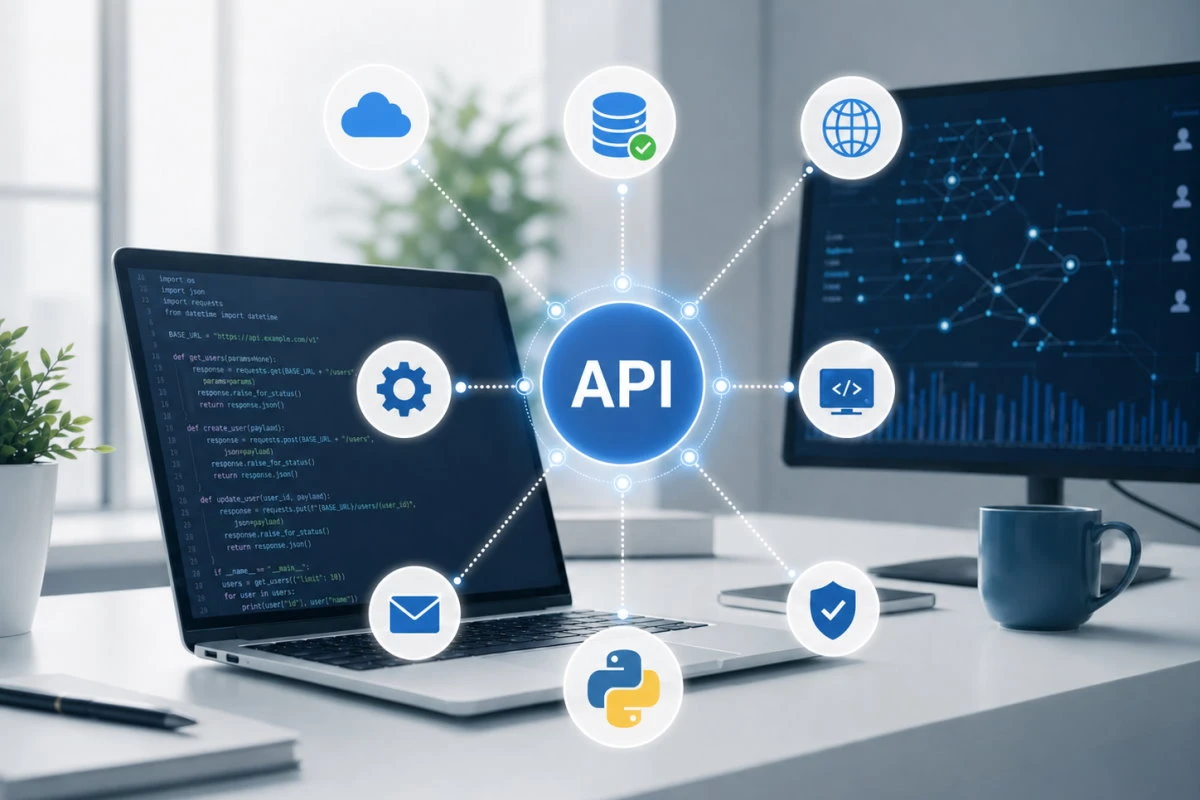
Most API integrations look straightforward at the start and may work perfectly under light usage. The complexity is introduced later, when traffic increases, requests start failing, data gets out of sync, or one system slows down and affects each part connected to it. At that point, a simple integration can cause a reliability challenge.
We build API integrations using Python, Django, FastAPI, Celery, PostgreSQL, and Redis, considering such scenarios in mind from the outset. This means planning for retries, handling partial failures, and keeping data consistent, especially under load. We establish resilient, seamless connections for your solutions, ensuring they perform stably when your product grows.
API Integration Services We Provide
Our API development and integration services cover end-to-end engineering, focusing on both designing greenfield architectures and improving performance and reliability in existing systems.
Custom API Development
Third-Party API Integration
Data Synchronization & Workflow Automation
Enterprise and Internal System Integration
API Performance Optimization
Legacy API Modernization
Our approach
How We Build Reliable API Integrations
Production integrations must handle slow providers, repeated webhooks, incomplete responses, traffic spikes, and temporary outages. We design each integration around these real-world conditions.
We move long-running API operations to Celery and Redis background queues. Django or FastAPI can respond immediately while workers handle synchronization, notifications, data processing, and external requests.
We use idempotent operations, validation, PostgreSQL transactions, and event logs to prevent duplicate or conflicting records. Resumable workflows allow failed processes to continue without repeating completed steps.
Our integrations handle timeouts, rate limits, invalid responses, and provider outages through controlled retries, exponential backoff, circuit breakers, fallback data, and delayed processing.
We separate critical and resource-intensive operations into dedicated queues and workers. This prevents slow tasks from delaying payments, confirmations, or other time-sensitive events.
Integration logic is isolated in dedicated FastAPI services or Django modules with consistent validation, logging, and error-handling patterns. External API changes therefore affect only the relevant connector.
We implement structured logs, correlation IDs, latency metrics, webhook tracking, retry monitoring, and alerts. This helps teams identify and resolve integration failures before they significantly affect users.
We protect integration points through OAuth 2.0, JWT, SAML, role-based permissions, encryption, and secure credential management. Access is limited to the systems and data each service requires, while audit logs provide visibility into critical operations and administrative actions. Security requirements are defined during architecture design and validated before production deployment.
For migrations and major integration changes, we use staged cutovers, data validation, and rollback plans to reduce the risk of downtime or corrupted records.
Is an existing integration becoming difficult to maintain?
We can review its architecture, failure handling, performance, and data flows and prepare a practical improvement plan.
Types of API Integrations We Build
Our work spans several common integration cases across backend systems, including payments, marketplaces, internal platforms, analytics pipelines, and many more. As part of our API development and integration service, we provide reliability and data accuracy, which directly affect business operations.
Our techstack
Technologies we use for API integration
Each tool serves a specific purpose in our Python web API integration stack.
Custom API Development Services
Our custom API development services include REST APIs, GraphQL, and event-driven architectures for startups deploying their first product to market and for enterprises that need to optimize years of accumulated integrations. Our crucial goal is to arm your software ecosystem with an API that cleanly connects your systems, handles dynamic workload, and gives your team room to add, change, and extend your solutions. Our architecture roadmap is established on security, performance, and scalability to ensure absolute protection and compliance at every layer and flow of your product.
API DEVELOPMENT COST
API Development Cost Calculator
How much does it cost to develop an API
2
How many endpoints will the API have?
3
What level of authentication and security do you need?
4
Will the API need to integrate with third-party services?
5
What data storage solution do you need?
6
Do you need rate limiting and traffic management?
7
Will the API require real-time capabilities?
8
What kind of API documentation do you need?
9
Will the API require automated testing?
10
Do you need deployment and hosting services?
11
Do you need ongoing support and maintenance?
2 (1)
How many endpoints will the API have?
Final Step
Our API Development Process
We have a well-structured flow within our custom API development services, making sure each step from an initial conversation to a production-ready system delivers maximum value for your business and ensures the expected outcomes.
Discovery and Requirements Analysis
Architecture and API Design
API Development
Testing and QA
Deployment
Monitoring and Optimization
Real Previous Experience

Isolated Slow APIs
Optimized PostgreSQL
Handled High Load
Common API Integration Use Cases
We build API integrations for recurring business workflows across ERP, CRM, ecommerce, document management, marketing, and analytics systems. Each integration is adapted to the platforms involved, data requirements, and operational impact of delayed or failed synchronization.
Electronic Signature and Document Workflows
Why Companies Choose PLANEKS
PLANEKS combines Python API expertise with a production-first engineering approach. We build integrations that remain reliable, understandable, and extendable as products and workloads grow.
Integration Architecture Options
The appropriate architecture depends on the number of connected systems, data volume, synchronization frequency, and operational impact of delayed processing. We select the integration pattern during discovery rather than applying the same approach to every project.
API-Led Integration
Middleware and Orchestration
Event-Driven Integration
Data Pipeline Integration
FAQ
Check the types of API you can integrate with us.
Can you integrate legacy systems that do not have modern APIs?
Can you integrate an ERP with CRM, accounting, and ecommerce systems?
Which electronic signature platforms can you integrate
Can you integrate social media APIs with CRM and analytics systems?
Get API integration support
Testimonials
What do people praise about PLANEKS?
If your systems rely on multiple APIs that need to work together reliably, we design and implement end-to-end API integrations that connect external services, internal systems, and data flows into a single cohesive architecture. Our work includes building robust integration layers, handling complex workflows, and ensuring performance, consistency, and scalability in production environments. Schedule a call to discuss your API integration setup with engineers with deep experience in system design and optimization.

Andras Marozsi
Finding competent automation engineers who produce a high quality code was very challenging, most other candidates just automatically started to add timeouts when they faced an issue. Candidates who PLANEKS offered had a much more mature approach, started with understanding the challenge and then provide a proper solution. I am happy to refer PLANEKS to any friend who needs reliable contractors.

Gabriel Yarra
Results were exactly what I wanted. PLANEKS was very flexible and able to quickly accommodate many requests. The fulfilled all phases of the project, and the result was a working application. Clear communication with no miscommunications or confusion. Professionals. Easy to work with!

Antoine Falisse
I am happy with PLANEKS’ services. The team’s project management is great, and their resources always meet deadlines. Communication is great too. I feel they’re a part of my team and really care about the project. Overall, the partnership has been truly successful.

Anonymous (Financial App)
What we found most impressive about PLANEKS was their exceptional ability to seamlessly integrate complex financial and technical components, delivering a user-friendly solution that met our needs effectively. Their dedication to both project management and customer service set them apart, ensuring that every aspect of our collaboration, from development to issue resolution, was handled with the utmost professionalism and responsiveness. This combination of technical prowess and exceptional service made them a unique and outstanding partner.

Marissa Huggins
PLANEKS did deliver projects on time and we are extremely happy with our services to-date. Not only has Anton been extremely kind in helping us navigate many time zones and work cultures, the engineers assigned have always been extremely professional and complete their work relatively as requested and on time. This is the most thorough and considerate engineering team we have ever outsourced by far. While there are still some gaps around communication and expectations for deliverables,this has been our best experience with offshore work yet.

Turi Mercuri
PLANEKS was ahead of schedule and built far more advanced than expected! What did I find most impressive or unique about this company? Professionalism, efficiency, clear communication and willingness to think outside the box to complete the tasks within fewer hours and at a higher standard than expected!! I will be working with PLANEKS for any future software development.

James Plowright
They meet their customer promises and communicate well. Anton is a great project manager and communicator, as a non-tech product owner I’ve found that he’s played an integral role in filling in the gaps to ensure there’s product design and technology alignment. We are due to launch soon and excited to start collecting feedback!

Daniel Smith
The projects have been completed on time and within budget. PLANEKS made sure that everything goes smoothly. Communication is excellent. They are happy to integrate with our existing tools and processes to communicate on projects. Furthermore, PLANEKS are open and honest about their capacity and capabilities.

Chloe Dagenais-Mignault
Our app needs quite specific knowledge and there is a big learning-curve, to which they have adapted quickly. Every deliverable has been finished in time and with great quality. All expectations were met and beyond. We really like PLANEKS’s teamwork and ability to understand complex business problems, business logic and how to efficiently address those problems in our code.
5.0/5.0
Blogs & news
Interesting articles regularly updated

Best 7 Hospitality API for Restaurants
The top seven hospitality APIs restaurants should adopt, how to choose the right one, and what to watch out for when you …

Django API Development: the Complete Guide
Evaluating Django for an upcoming project, want to define what their engineering team is building with, or need to assess whether Django …