


Get an in-depth audit of your Python codebase
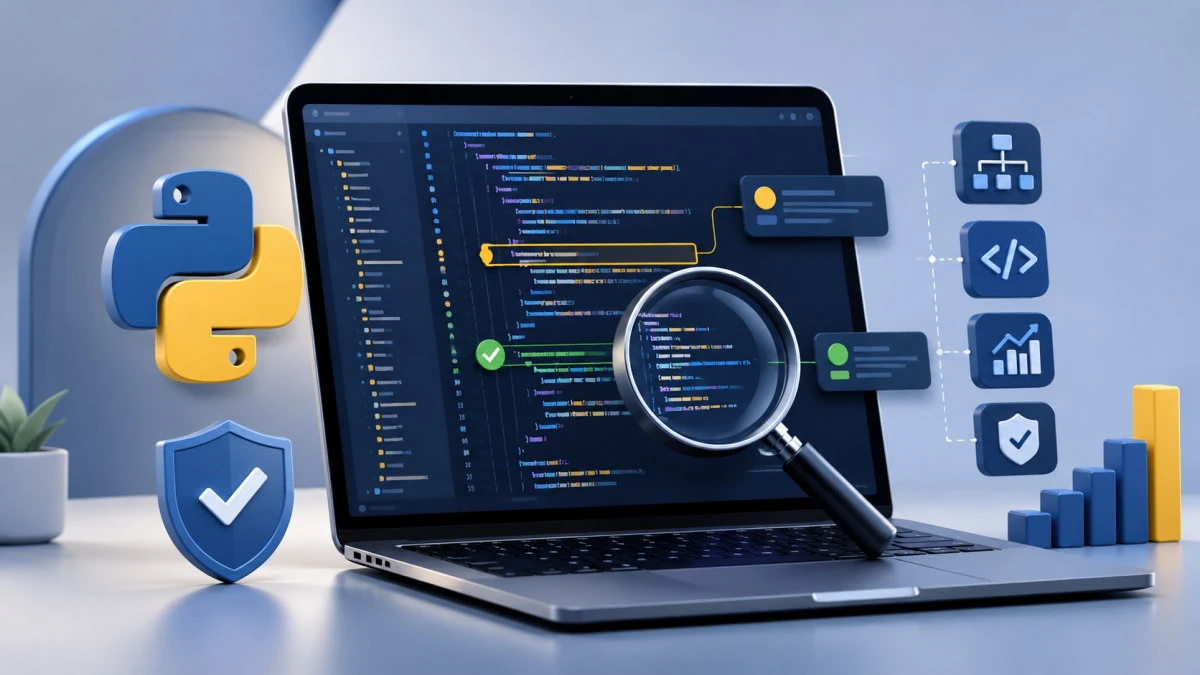
If your Python code runs, that doesn’t mean it is secure, scalable, or ready for what comes next. Identifying security, architecture, and maintainability issues before launch is less disruptive than correcting them after product production.
PLANEKS provides independent Python code review services for startups and product teams that need a senior engineering opinion on code written by AI tools, freelancers, agencies, or previous technical partners.
Independent Python Code Review
Our clients reach out for consulting when they have a working product but cannot answer what it would take to scale it, hand it off, or build on it in the future.
What Our Python Code Review Covers
Our Python code review services cover the architectural decisions, security standards, and performance characteristics that determine if the codebase can support a product in a real environment.
- Python Code Quality and Maintainability
- Deployment Infrastructure and Observability Review
- Architecture and Scalability Review
- Technology Stack and Dependency Review
- Security Code Review
- Performance and Database Review
- AI-Generated Code Risks
- Software Architecture and Infrastructure Review
- Test Coverage and QA Readiness
- Compliance Review
We review function complexity, naming, separation of concerns, and duplicated logic. The most common finding: business logic scattered across Django views, serializers, and model methods with no consistent ownership.
Our engineers assess if the application can support more users, and larger datasets. Most Python projects we review have grown to the point where a single change requires tracking down dependencies across the entire codebase.
We assess how the Python application is configured, deployed, monitored, and supported in production. Depending on the project scope, this may include Docker configuration, CI/CD workflows, cloud resources, environment management, logging, error tracking, health checks, background workers, backup processes, and monitoring coverage. The review identifies infrastructure decisions that may affect application reliability, deployment safety, scalability, or incident investigation.
Authentication, authorization, input validation, unsafe dependencies, and API vulnerabilities. DRF permission classes are often misconfigured in ways that unit tests do not simulate and production requests expose.
Our engineers assess Python versions, frameworks, libraries, third-party packages, and external services used by the application. We identify outdated or vulnerable dependencies, unsupported components, unnecessary complexity, and technology choices that may affect security, maintainability, or future development.
We examine application response times, database queries, indexing, ORM usage, caching, background tasks, external API calls, and resource-intensive code paths. For Django applications, this includes detecting N+1 queries, inefficient serializers, unnecessary database operations, and Celery task bottlenecks. The review identifies performance risks and provides prioritized recommendations rather than promising improvements without testing the application under realistic conditions.
Our Python code review assesses if critical paths, edge cases, and CI pipelines actually catch regressions before production. Do tests cover the core scenarios: the edge cases, failure modes, and integration points determining reliability?
AI coding tools generate code that fits a pattern but not your system. We review AI-written Python for invented abstractions, security shortcuts, and error-handling gaps that break under real requests.
We evaluate how the codebase interacts with databases, background workers, third-party services, deployment environments, and cloud infrastructure. The review identifies tightly coupled components, scaling constraints, single points of failure, configuration risks, and architectural decisions that may complicate future development or deployment.
Python Frameworks and Technologies We Review
Each Python framework has a specific failure pattern. These are the frameworks our engineers use on client projects every day, so we know where to look first.


Has It Been Reviewed?
AI-generated, outsourced, or built in-house – every codebase has blind spots you don’t know about. PLANEKS reviews your work against production-grade standards and tells you exactly where it holds up and where it doesn’t.
Who Needs Python Code Review Services?
Teams usually turn to Python code review when a product is growing, but no one outside the delivery team has assessed the codebase. Most clients come to us with a codebase that has been in active development for months or years and lacks an independent senior engineer’s perspective.
Startup Founders Without a Technical Co-Founder
CTOs and Product Leaders Preparing to Scale
Startups Using AI-Assisted Development
Companies Taking Over a Python Project
Investors and Companies Evaluating a Software Product

Case Study
The Upcomer project is a direct example of the case when companies take over the Python project: when Enthus Group took over responsibility for a four-year-old Django application, they first needed a clear understanding of the codebase, infrastructure, and accumulated technical debt.
PLANEKS audited 10 active GitHub repositories and a complex AWS environment, reducing endpoint response times from over 20 seconds to under one second before any new development began.
What You Get After the Review
Our Python code review delivers more useful details than a mere list of issues. Every engagement ends with a prioritized plan, clear recommendations, and a roadmap your team can act on.
Our Python Code Review Process
IT audit services are crucial for organizations that require scalable, reliable, and well-structured systems. Our methodical review can save valuable time, minimize risk, and accelerate your roadmap, which is perfect for teams preparing to launch or manage a complex Django platform.
Python Code Review for AI-Generated Code
AI coding tools generate code fast, while we review it against your actual architecture, data model, and security requirements.
What We Check in AI-Written Python Code
When AI Code Review Is Especially Useful
Python Code Review for Startup MVPs
When you partner with PLANEKS for a Python code audit, you work with engineers who blend deep technical expertise with real-world development experience. We bring hands-on experience in Python and its frameworks, supporting projects across diverse domains, incorporating financial services, e-commerce, SaaS, and automation.
Why Choose PLANEKS for Python Code Review?
A code review is as useful as experience behind it. Ours comes from building Python backend systems across 100+ clients and 150+ successfully completed projects.
Python Code Review Deliverables
Every engagement produces a range of structured outputs your team can use directly.
Startup partnerships
Job success rate
Clients served
raised by our clients
Projects completed
only by our clients
Common Problems We Find in Python Codebases
These are the patterns we see across startup codebases, from AI-generated MVPs to products that outgrew their architecture.
| ISSUE | DESCRIPTION |
| Code That Works but Is Hard to Maintain | Functions grew across sprint cycles until they handled multiple responsibilities, and changing them safely became impossible. |
| Business Logic Hidden in the Wrong Places | Django views carrying logic that belongs in services, making every feature implementation more expensive. |
| Weak API Validation and Permission Logic | FastAPI and DRF permission classes are correct in tests but misconfigured against live request patterns. |
| Slow Database Queries and ORM Misuse | N+1 queries, missing indexes on filtered fields, and Django ORM-generated SQL that was never manually reviewed. |
| Missing or Low-Value Tests | Test suites that cover the straightforward cases while leaving critical error paths and integration points untested. |
| Overcomplicated AI-Generated Code | AI-generated modules with unnecessary abstractions and architecture that handle challenges the project does not have. |
| Poor Error Handling and Logging | Exceptions caught silently and error responses exposing internal stack traces to API consumers. |
| Dependencies That Create Security or Maintenance Risk | Unpinned packages and unmaintained libraries with known CVEs have not been updated because the code still runs. |
| No Visibility into Production Behavior | Applications ship without metrics, structured logs, or alerts, so the first sign of a problem is a user complaint rather than a dashboard. |
| Secrets and Credentials Stored in the Clear |
API keys, database passwords, and tokens live unencrypted in the database or committed straight into the repo and its git history, where anyone with read access can lift them.
|
FAQ
Most common questions about our Python code review services – answered.
Do you review AI-generated Python code?
Can you review code written by another developer or agency?
Do you work with non-technical founders?
What is the difference between Python code review and Python code audit?
Can you fix the issues after the review?
How long does a Python code review take?
What do you need to start the review?
Testimonials

Andras Marozsi
Finding competent automation engineers who produce a high quality code was very challenging, most other candidates just automatically started to add timeouts when they faced an issue. Candidates who PLANEKS offered had a much more mature approach, started with understanding the challenge and then provide a proper solution. I am happy to refer PLANEKS to any friend who needs reliable contractors.

Gabriel Yarra
Results were exactly what I wanted. PLANEKS was very flexible and able to quickly accommodate many requests. The fulfilled all phases of the project, and the result was a working application. Clear communication with no miscommunications or confusion. Professionals. Easy to work with!

Antoine Falisse
I am happy with PLANEKS’ services. The team’s project management is great, and their resources always meet deadlines. Communication is great too. I feel they’re a part of my team and really care about the project. Overall, the partnership has been truly successful.

Anonymous (Financial App)
What we found most impressive about PLANEKS was their exceptional ability to seamlessly integrate complex financial and technical components, delivering a user-friendly solution that met our needs effectively. Their dedication to both project management and customer service set them apart, ensuring that every aspect of our collaboration, from development to issue resolution, was handled with the utmost professionalism and responsiveness. This combination of technical prowess and exceptional service made them a unique and outstanding partner.

Marissa Huggins
PLANEKS did deliver projects on time and we are extremely happy with our services to-date. Not only has Anton been extremely kind in helping us navigate many time zones and work cultures, the engineers assigned have always been extremely professional and complete their work relatively as requested and on time. This is the most thorough and considerate engineering team we have ever outsourced by far. While there are still some gaps around communication and expectations for deliverables,this has been our best experience with offshore work yet.

Turi Mercuri
PLANEKS was ahead of schedule and built far more advanced than expected! What did I find most impressive or unique about this company? Professionalism, efficiency, clear communication and willingness to think outside the box to complete the tasks within fewer hours and at a higher standard than expected!! I will be working with PLANEKS for any future software development.

James Plowright
They meet their customer promises and communicate well. Anton is a great project manager and communicator, as a non-tech product owner I’ve found that he’s played an integral role in filling in the gaps to ensure there’s product design and technology alignment. We are due to launch soon and excited to start collecting feedback!

Daniel Smith
The projects have been completed on time and within budget. PLANEKS made sure that everything goes smoothly. Communication is excellent. They are happy to integrate with our existing tools and processes to communicate on projects. Furthermore, PLANEKS are open and honest about their capacity and capabilities.

Chloe Dagenais-Mignault
Our app needs quite specific knowledge and there is a big learning-curve, to which they have adapted quickly. Every deliverable has been finished in time and with great quality. All expectations were met and beyond. We really like PLANEKS’s teamwork and ability to understand complex business problems, business logic and how to efficiently address those problems in our code.
5.0/5.0
Blogs & news
Interesting articles regularly updated

9 Advantages of Hiring Full-Stack Developers for Startups: Practical Benefits
The benefits are most noticeable in the early stages. When your product grows more complex, specialists become necessary again. In this article, …

API Development and Integration Process Explained
The API development process adheres to the same sequence, with one distinction: rather than consuming an existing interface, you are responsible for …