Isolated applications are rare in modern software architecture. A checkout page communicates with a payment provider, a warehouse system relays stock counts to a marketplace listing, and an internal dashboard retrieves and aggregates data from three databases simultaneously. All of this traffic passes through APIs, and companies now build on them deliberately: according to SQ Magazine, 83% of businesses use APIs to maximize ROI on their digital assets.
Reduced to its essentials, the API integration process follows a defined flow: determine what the systems must exchange, design the contract, build the connection, secure it, test it, deploy it, and monitor it after launch. The API development process adheres to the same sequence, with one distinction: rather than consuming an existing interface, you are responsible for designing it. We’ll walk through both: building a new API from the ground up and integrating with an existing one.
Table of Contents:
API development vs. API integration
Clients often use the two terms interchangeably and often ask for one when they need an entirely different service. The difference determines your budget and who bears responsibility should the integration fail.
| API development | API integration |
| Creates a new interface | Connects to an interface that already exists |
| Defines endpoints and data contracts | Maps data between systems |
| Requires backend development | May involve backend code, middleware, or an integration platform |
| Full control over behaviour | Shared control with an external provider |
| Authentication method set by your team | Authentication method dictated by the provider |
| Versioning policy defined internally | Deprecation schedule set by the provider |
| Documentation written for your consumers | Provider documentation reviewed, observed behaviour recorded |
| Testing covers the contract, business rules, and load | Testing covers full workflows and failure paths |
| Primary risk: design decisions locked in too early | Primary risk: provider changes or removals |
| Example: a public API for SaaS customers | Example: marketplace orders synced into accounting software |
In our practice, most projects need both, and Taxomator is a case where we handled each side successfully. The SaaS pulls invoice data from Amazon and Etsy and pushes it into accounting software, so its Flask backend talks to the Amazon MWS API and the Etsy API on one side, then writes into iCount, OfficeGuy, and Green Invoice on the other. Five external interfaces, none of them ours to design: that work was integration. The endpoints its React frontend calls and the calculation logic behind them were ours to build: that was development.
Step 1 – Define Business and Technical Requirements
Begin with the business outcome, not the technical framework. Clients often open with ‘we need an API’ as shorthand for a more specific problem – inventory counts falling out of sync, or two systems reporting different order statuses.
This is why requirements gathering starts before any technical decision is made. Which systems need to communicate, and what data actually moves between them, matter more at this stage than which protocol or framework will carry it. Just as important is identifying which system holds the source of truth, since two systems that conflict on stock counts or other details are usually a sign that there’s no clear ownership assigned. From there, the sync pattern needs to be settled: does the business genuinely need real-time updates, or would a scheduled job run every few minutes suffice at a fraction of the complexity and cost? Access and volume come next – who or what will be calling this API, and at what request volume, since that shapes decisions on rate limiting and infrastructure long before a line of code is written.
Depending on the industry, compliance and data-residency rules may also constrain where data can be stored or processed. Failing to account for these requirements early can result in costly rework later. Last but not least, failure handling deserves the same attention as the primary flow. What should happen if one of the connected systems goes down? Should the integration degrade gracefully, or should the failure bring the rest of the workflow down with it?
Define measurable success criteria
Those answers become targets you can verify after launch in your API development lifecycle: orders synchronized within one minute, manual data entry cut by an agreed number of hours per week, fewer failed transactions, response time under a set threshold.
Step 2 – Analyze the Existing Systems and APIs
Technical discovery determines most of the timeline. We recommend allocating a few days for reading a vendor’s documentation, which costs less than finding their rate limit in production. Before quoting any API integration process work, our team follows the same checklist.
That starts with the current architecture: the databases involved, and any legacy components that might constrain how the new connection gets built. After that, the focus should be on the vendor’s documentation itself: how complete it is, and which endpoints and operations it actually supports, since gaps here tend to surface mid-project rather than upfront.
Authentication method, rate limits, and webhook availability come next, as these three factors establish both the integration’s architecture and its practical timeline. Data formats, the API version in use, and the vendor’s deprecation policy matter just as much, since building against an API that’s scheduled for retirement creates rework nobody budgeted for.
Finally, sandbox access, the vendor’s track record for reliability, and how responsive their support team is round out the picture – these are less about the API itself and more about how smoothly the integration process is likely to go.
What if the system has no usable API?
Systems that expose no usable API at all turn up on a good share of projects, which changes the plan without necessarily ending it. Older platforms are the obvious case, though plenty of current SaaS products publish reports and no endpoints. We turn to several alternatives that remain viable: wrapping a custom API around the existing system, placing middleware in front of it, exchanging structured files on a scheduled basis, or modernizing the application itself. Direct database access is often the fastest way to resolve the immediate problem, but it tends to create the most significant complications later, and should therefore be treated as a last resort.
Profit Per Pillow, a rental analytics SaaS we built for the US rent-by-room market, runs on the file-exchange path. The source platform provides no API, so property owners upload four CSV exports, and a parsing engine resolves edge cases within them: mid-month move-ins, partial billing periods, and vacant rooms carrying stale data. The aggregation logic sits behind an internal API, which means onboarding a new owner needs no changes to the parsing layer.
Step 3 – Choose the API Architecture and Python Technology Stack
Architecture should be based on traffic patterns and consumer needs. The API design process starts here, because a contract designed on the wrong protocol often leads to a rewrite.
REST APIs
REST suits standard web and mobile clients, public or partner APIs, and CRUD-heavy systems with broad tooling support.
GraphQL APIs
GraphQL earns its complexity when several clients need different shapes of the same data, or when frontend teams keep over-fetching from fixed REST endpoints.
gRPC
gRPC fits internal microservice traffic: low latency, typed contracts, high message volume between services you control on both ends.
Choosing a Python API framework
While we select the tech stack for each project individually, having delivered 150+ projects means our team works equally well across the Python ecosystem. FastAPI handles asynchronous, high-throughput services and generates OpenAPI schemas and interactive docs on its own. Django REST Framework fits well with APIs attached to a larger Django application with complex business logic, an admin interface, and mature data models, and it ships authentication, permissions, and serialization as a toolkit. Flask suits small services where a full framework adds unnecessary weight.
Step 4 – Design the API Contract and Data Flow
Contract-first design prevents the scenario where the backend, frontend, and integration teams each build against different sets of assumptions. Agreeing on the contract’s shape before any code is written typically costs a week and saves a month. For this reason, the API endpoint development process starts with a written contract before any implementation work begins.
This contract should address endpoints, request and response structures, required and optional fields, validation rules, naming conventions, status codes, pagination, error formatting, idempotency, versioning, and backward compatibility.
Map how data moves between systems
Document the source and destination for every field, the transformations applied, sync triggers, validation rules, retry logic, and failure behavior.
One of our projects, Spontivly, a data analytics platform, needed that mapping before any code was written. The platform integrates with 120+ community tools – Slack, Zoom, Discord, LinkedIn, Google Calendar, and Airtable among them – to pull data into a single dashboard hub, and each of those tools names the same concept differently. A documented mapping layer up front turned that inconsistency into a clean data model from the outset.
Create an OpenAPI specification
An OpenAPI file provides everyone with a single source of truth. It drives documentation, contract tests, client generation, and mock servers, and stays language-agnostic, so a partner understands your API without reading your source.
Step 5 – Develop the API or Integration Layer
Implementation covers endpoints, business logic, database and external service connections, input validation, data transformation, secret management, logging, timeout handling, and background jobs. The API endpoint development process moves fast here when steps from 1 to 4 are handled properly.
Direct integration vs. middleware
Direct integration means your application calls the vendor API itself. Middleware means a separate service handles the calls, transformations, and error recovery. Middleware earns its keep when several systems connect, business rules are complex, or providers might change. A time-tested practice we apply is to keep integration logic out of the main application from the start, because fixing it later takes more resources than getting it right from the start.
Webhooks vs. scheduled API requests
Webhooks deliver events as they happen and require fewer requests. Polling covers providers with no webhook support. Most production systems we build use both webhooks for speed and a scheduled job that catches whatever the webhooks drop.
Step 6 – Secure the API and Integration
We treat security as part of the API integration process, taking care of it from the outset. OWASP lists broken authorization, broken authentication, unrestricted resource consumption, poor API inventory, and unsafe consumption of third-party APIs as posing the greatest risk, and many of these risks are shaped by early architectural decisions.
Authentication and authorization
Authentication confirms the caller’s identity, while authorization determines what that caller is allowed to do. API keys work for server-to-server traffic, OAuth 2.0 for delegated user access, JWT for stateless sessions. Grant each client the smallest set of permissions it needs, and check them per resource, not per endpoint.
Data and infrastructure protection
This includes HTTPS for all traffic, secrets stored in a managed store and kept out of environment files within a repository, strict input validation, rate limiting, request size limits, audit logging, IP allowlisting with a fixed client set, and scheduled dependency scanning.
Securing third-party API integrations
Our team treats every vendor response as untrusted input and validates it before it reaches the database. Credentials are rotated regularly, granted scopes are kept to a minimum, call patterns are monitored for anomalies, and a fallback behavior is defined in advance for cases where a provider becomes unavailable.
Step 7 – Test the API and Integration
Testing an integration means verifying the seams between systems, not only the endpoints. During API development lifecycle reviews, most defects our engineers find aren’t in either the calling system or the system it depends on but in what happens between the two.
Functional testing
Check requests and responses against the contract, plus business rules, data transformations, permissions, and the error messages a consumer reads.
Integration and workflow testing
Run the whole workflow: a customer submits an order, the payment is confirmed, inventory updates, and the confirmation email fires. That approach can reveal failures that endpoint-level tests can’t detect.
Additional testing types
Unit, contract, security, load, regression, and recovery tests, plus a full pass against the vendor sandbox before production.
Test common failure scenarios
Invalid credentials, expired tokens, rate-limit responses, timeouts, duplicate events, partial payloads, wrong data types, provider downtime, and deprecated endpoints.
Step 8 – Deploy the API and Integration
а, deployment separates development, staging, and production, each with its own credentials and vendor accounts. CI/CD pipelines, database migrations, configuration management, controlled releases, a rollback plan, and a post-deploy validation run make up the rest of these API lifecycle stages.
Prevent duplicate or lost data during deployment
Restarts and retries during a release produce duplicate orders and missing records more often than any other cause we see. Idempotency keys, message queues with dead-letter handling, defined retry policies, and a reconciliation job protect the data through the switchover.
Step 9 – Document the API
Documentation serves two audiences with different questions. Without the system details, you lose product knowledge every time an engineer leaves the project. Good API governance means documenting both the implementation and the design decisions, while making it clear who is responsible for the API over time.
Developer-facing documentation
Endpoint descriptions, authentication instructions, parameters, request and response examples, error codes, rate limits, webhook payloads, versioning notes, and a quick-start guide that gets a developer to a first successful call. FastAPI generates the OpenAPI schema, Swagger UI, and ReDoc interfaces, covering the reference layer out of the box.
Internal operational documentation
System architecture and data-flow diagrams, dependency maps, environment configuration, API credentials and secret ownership, deployment procedures, logging and monitoring locations, alert thresholds, runbooks for common failures, escalation contacts, and recovery procedures for failed integrations.
Step 10 – Monitor and Maintain the Integration
We usually don’t end the collaboration once the deployment is complete. With an average cooperation length of two years, we continue supporting clients through API changes, scaling requirements, security updates, and ongoing improvements.
Plan for API changes and versioning
Vendors change their APIs, and the later API lifecycle stages exist to absorb that. Separate breaking from non-breaking changes, publish a deprecation period, version your endpoints, keep SDKs and docs current, and run regression tests before accepting a provider upgrade.
Reconcile data regularly
An integration can look resilient in monitoring tools while still producing incomplete records. Regular reconciliation checks compare data between connected systems (such as orders, payments, customer records, and transaction totals) to identify missing or inconsistent information before it affects the business.
Common API Development and Integration Challenges
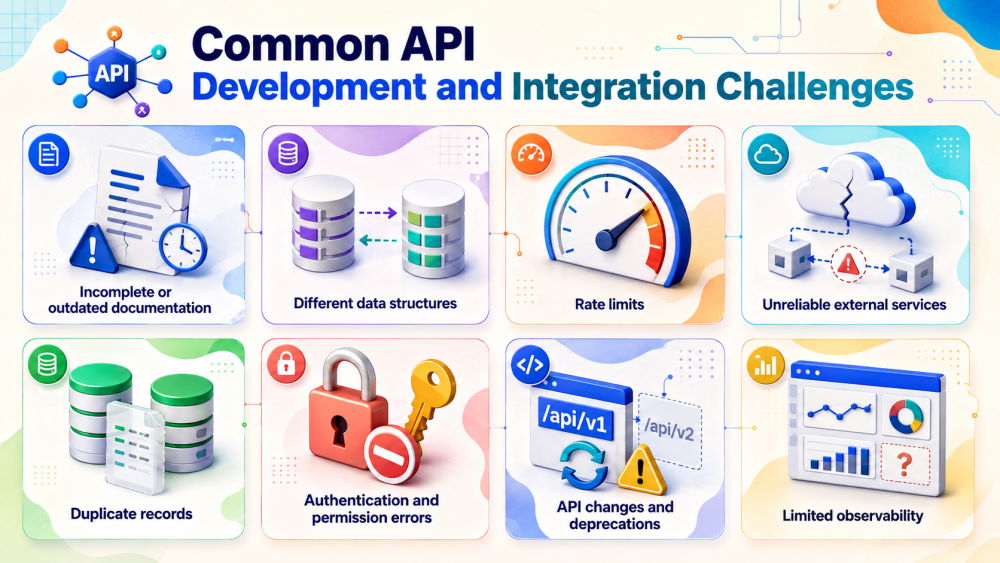
Our experience across 20+ domains has shown that most API challenges are predictable: advanced tooling handles some, engineering discipline covers the rest, and the right design decisions prevent many issues before they reach production.
Incomplete or outdated documentation
Probe the sandbox, write contract tests against observed behavior, document what the API does.
Different data structures
Add a mapping and validation layer so neither system dictates the other’s schema.
Rate limits
Cache, batch, queue, back off on failure, prioritize requests that affect the customer.
Unreliable external services
Set timeouts, add retries with backoff, use circuit breakers, define what the product shows when the provider is down.
Duplicate records
Idempotency keys and unique transaction identifiers.
Authentication and permission errors
Centralize credential management, test token renewal and scope changes before they expire in production.
API changes and deprecations
Subscribe to provider announcements, version your own endpoints, keep regression tests running.
Limited observability
Structured logs, request IDs that follow a transaction across services, dashboards, and actionable alerts.
How Long Does API Development and Integration Take?
Timelines primarily depend on the systems involved. API project estimates depend on several aspects, including the number of systems involved, API maturity and documentation quality, business logic complexity, authentication requirements, migration scope, compliance constraints, sandbox access, and stakeholder availability.
A straightforward API integration process with a well-documented API often takes 2-4 weeks, while complex integrations involving multiple systems, custom APIs, or legacy platforms can last 3-6+ months.
How Much Does API Development and Integration Cost?
Cost is formed by the same drivers as the timeline: discovery and architecture, number of endpoints and external systems, data mapping complexity, custom authentication, middleware, testing scope, compliance work, and long-term maintenance.
Delivering a price range for the API development lifecycle without seeing your systems would be inaccurate. Our team can consult with you on your project, review your current architecture, identify the endpoints and dependencies involved, define potential risks, and help define a practical scope and budget.
When should you hire an API development company?
Some projects are suitable for in-house teams, particularly simple integrations with clear requirements and experienced developers. The calculation for the API development lifecycle changes when it supports business-critical operations. It also changes when several systems or vendors sit in the chain, or when an existing integration fails outside working hours.
Heavy security, compliance, or API governance requirements push in the same direction, as does a legacy API that needs modernizing before traffic outgrows its underlying design. The clearest signal tends to be an absence: no documentation, no automated tests, and no safe way to change the integration once it is in production.
Why use Python for API development and integration?
Python suits integration work because most of it is data transformation and automation, and the ecosystem for both is strong. The JetBrains and Python Software Foundation survey of 30,000+ developers found that FastAPI is in use by 38% of respondents who work with web frameworks, with Django by 35%, and Flask by 34%. Since developers often use more than one, the figures represent adoption, but not exclusive choice.
At PLANEKS, we use AI-assisted development to optimize repetitive implementation and test writing across the API design process, while senior Python developers review architecture, security, business logic, and production code.
API development and integration checklist
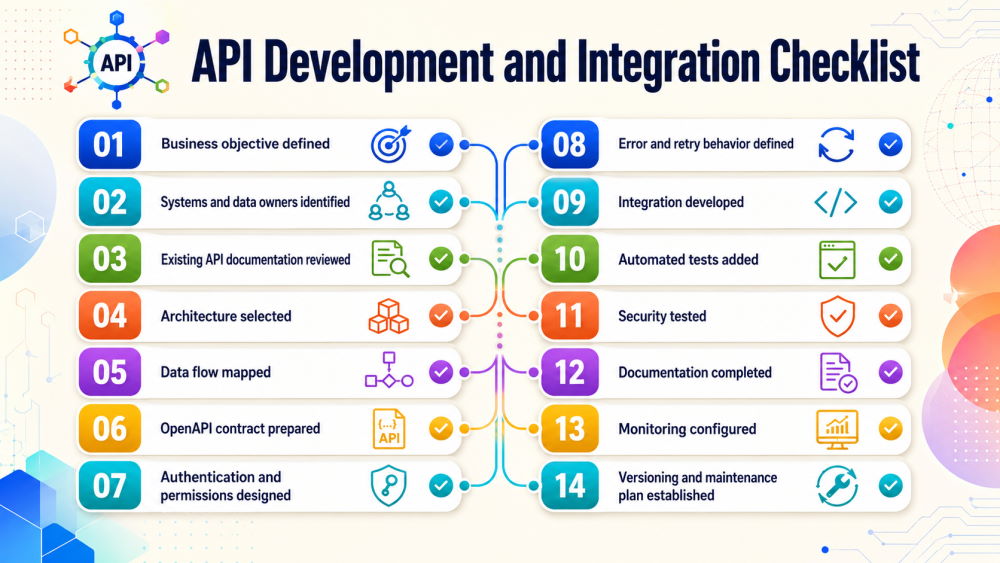
A scannable version of the API lifecycle stages covered above:
- Business objective defined
- Systems and data owners identified
- Existing API documentation reviewed
- Architecture selected
- Data flow mapped
- OpenAPI contract prepared
- Authentication and permissions designed
- Error and retry behavior defined
- Integration developed
- Automated tests added
- Security tested
- Documentation completed
- Monitoring configured
- Versioning and maintenance plan established
Frequently asked questions
Common questions about the API development process steps, from first requirement to post-launch monitoring.
What are the main steps in API development?
Start the API design process by defining requirements, choosing the architecture and stack, designing the contract, building the endpoints, securing them, testing, deploying, documenting, and monitoring. The API endpoint development process depends on agreeing the contract before implementation starts.
What are the main steps in API integration?
Analyze the systems and their APIs, map the data between them, design authentication and error handling, build the connection, test the full workflow, deploy with idempotency protection, then reconcile records after launch.
What is the difference between API development and integration?
Development creates a new interface you control. Integration, on the other hand, connects to an interface that someone else already built. Development requires backend work on your side; integration requires mapping, error handling, and a plan for when the provider changes something.
Which programming language is best for API development?
The tech stack is determined by your project requirements. Python fits data-heavy APIs, Node.js fits event-driven services, Go fits high-concurrency infrastructure. For most business applications, practical experience with a technology stack matters more than performance differences.
Is Python suitable for API integration?
Yes. Python handles data transformation, scheduling, and third-party SDKs well, and Celery covers retries and background jobs outside the request cycle. Most marketplace integrations we build are written in Python.
What is the difference between REST API and GraphQL?
REST exposes fixed endpoints that each return a defined structure. GraphQL exposes a single endpoint where the client specifies the fields it wants. REST caches more easily; GraphQL cuts over-fetching when clients need different data shapes.
How do you test an API integration?
Test the contract, then the full workflow across systems, then the failure paths: expired tokens, rate limits, timeouts, duplicate events, provider downtime. Run it against the vendor sandbox before touching production data.
How do you secure a third-party API integration?
Store credentials in a managed secret store, grant only the minimum required scopes, validate every response before it reaches your database, rotate keys on a schedule, and define a fallback for an offline provider.
How long does an API integration project take?
A simple third-party integration takes 2 to 4 weeks. Multi-step business integrations run 1 to 3 months, custom API development 3 to 6 months, and legacy modernization 3 to 6 months. A multi-system integration platform starts at 6 months. Working through the API development process steps in order keeps the later categories from doubling.
What happens when a third-party API becomes unavailable?
A well-built integration queues the requests, retries with backoff, opens a circuit breaker to stop hammering the provider, and shows the user a clear message. Once the provider returns, the queue drains and reconciliation confirms nothing was lost.
Connecting two endpoints is the easy part
Requirements, data mapping, architecture, security, testing, documentation, and monitoring all belong in a working integration. Following these API development process steps in order helps keep your project on schedule and the integration resilient after launch.
Book a technical discovery call with our team. We’ll provide a mapped list of the systems involved, the endpoints required, the risks worth planning for, and a realistic scope for the API integration process ahead.