Uber, Netflix, and Microsoft use FastAPI to build high-performance services.
FastAPI is used in production by technology companies including Microsoft, Uber, Netflix, and Cisco. Their published examples cover machine learning services, model-serving APIs, incident-management software, automation, and other internal or customer-facing systems.
These examples do not mean that each company’s entire platform runs on FastAPI. Large organizations use multiple languages and frameworks, and FastAPI normally supports specific services or products within a broader architecture.
FastAPI is a modern Python framework for building APIs based on standard Python type hints. It provides request validation, data serialization, automatic OpenAPI documentation, dependency injection, security utilities, and support for asynchronous operations. These capabilities make it particularly relevant for API-driven products, machine learning services, integrations, and backend applications that need clear contracts and efficient development.
Below, we examine documented examples of companies using FastAPI, what they built with it, and what these implementations demonstrate about the framework’s practical use.
FastAPI is designed based on Starlette and Pydantic libraries, seamlessly combining innovative, asynchronous programming techniques with the capacity of standard Python. The main power of FastAPI can be described as the ability to create APIs swiftly and efficiently due to its integral peculiarities:
- Dependency injection system
- Asynchronous support
- OpenAPI and JSON Schema documentation generation
- Serialization
- Automatic data validation
- Intuitive API declaration
Such a unique and valuable set allows software engineers to build powerful, reliable, and highly performant APIs with decreased development milestones. However, the advantages of FastAPI extend beyond exceptionally fast development and simplicity. Its asynchronous concept allows it to cope with higher levels of concurrent connections. This is a key feature for applications requiring real-time data, such as eSports platforms, online booking Hospitality software, Fleet management, and Fintech. It integrates seamlessly with other asynchronous Python libraries, contributing to its versatility and adaptability. Yet, to make the maximum from this framework’s opportunities, we recommend you hire FastAPI developers with proven in-depth IT experience.
FastAPI has become a core tool for many businesses striving to stay competitive within the market digitalization. So, who uses FastAPI? Let’s move on and cover which companies use FastAPI, defining how this robust framework has become the inalienable element of their development strategy, streamlining development workflows, and delivering momentum-fast APIs.
Make an Informed FastAPI Decision
Learn the key factors to consider before choosing FastAPI for your API project.
Uber
Uber’s open-source Ludwig project adopted FastAPI to provide a REST server that applications can query for machine learning predictions. This creates an API layer around trained models and enables other systems to submit input data and receive prediction results.
This example demonstrates a practical FastAPI use case: exposing Python-based machine learning functionality through documented HTTP endpoints. FastAPI’s validation, Python type support, and automatic API documentation are particularly useful when model-serving services must exchange structured data with other applications.
Netflix
Netflix used FastAPI in Dispatch, its open-source crisis-management orchestration framework. Dispatch centralizes incident information and coordinates workflows involving tools such as Slack, Jira, PagerDuty, Google Drive, and Google Calendar.
Netflix documented an architecture consisting of Python, FastAPI, Vue.js, and PostgreSQL. In this system, FastAPI supports the application backend and integrations rather than Netflix’s core video-streaming platform.
Netflix has also documented FastAPI within an internal large-language-model serving architecture, illustrating another production use case involving Python-based inference services.
Microsoft
Microsoft engineers have publicly described using FastAPI for machine learning services, including services connected with Windows and Office products. This makes Microsoft one of the companies explicitly referenced by the official FastAPI project.
Microsoft also provides documentation and deployment examples for running FastAPI applications with Azure Functions and Azure App Service. These examples demonstrate how FastAPI can operate within serverless and managed-cloud environments while connecting to other Azure services.
Microsoft’s use and platform support show that FastAPI can serve both as an application framework for individual services and as part of a broader enterprise cloud architecture.
Cisco
Cisco has described FastAPI as a component of its API-first development strategy. According to a testimonial published by the FastAPI project, the framework supports internal automations and services such as Cisco’s Virtual TAC Engineer.
This example shows how FastAPI can be used beyond a standalone public API. It can support automation services that connect internal knowledge, operational workflows, and application interfaces through documented endpoints.
For enterprise teams, FastAPI’s type-based validation, OpenAPI support, dependency system, and compatibility with the wider Python ecosystem can simplify the development and maintenance of such services.
Expedia Group
Expedia Group, a leading travel technology company, has also included FastAPI in its solution stack for specific projects. This is due to the efficient and high-performance nature of this framework, which aligns well with the demands of a dynamic travel platform like Expedia. As an output, the company is able to design reliable and scalable APIs for a range of functionalities, as well as develop solutions using FastAPI to disseminate market insights and benchmarking information, including competitive analysis. The automatic documentation generation and asynchronous capabilities contribute to streamlining and boosting the development processes, guaranteeing reliability and conditioning smooth interactions within Expedia Group’s extensive suite of travel services.
OnlineDoctor
According to StackShare, OnlineDoctor leverages FastAPI to provide an efficient and seamless platform for users seeking dermatological consultations. Utilizing FastAPI’s capabilities, OnlineDoctor offers a rapid and responsive experience, ensuring users receive a specialist diagnosis and recommended course of action within a few hours. The framework’s asynchronous design allows for quick data processing, enabling timely interactions between users and their chosen dermatologists. By streamlining the consultation process, OnlineDoctor addresses the common challenges associated with traditional in-person visits, offering a convenient and time-saving solution for individuals seeking expert medical advice for dermatological concerns.
TravelPerk
TravelPerk is a company that offers a platform for booking and managing business travel. Using FastAPI, technicians smoothly develop APIs for handling various aspects of their platform, such as user authentication, booking requests, and travel itinerary management. The asynchronous support is leveraged to handle simultaneous operations, ensuring efficient communication between different components. All these features of FastAPI, in conjunction, help create a robust and scalable backend for TravelPerk’s business travel management platform.
Primer
Primer is a PCI-1 and GDPR-compliant platform that allows businesses to streamline payments, shipping, returns, customer loyalty, and marketplace management. FastAPI’s asynchronous capabilities are useful for Primer.io’s need for a Universal Checkout and Unified Payments API, ensuring efficient handling of concurrent payment requests. Its high-performance design contributes to the platform’s reliability, supporting the 99.99% uptime requirement. FastAPI’s flexibility allows for quick integration of new payment methods and scale operations, fitting in the dynamic payment and commerce stack.
SendCloud
SendCloud, a shipping software provider, leverages FastAPI to enhance its platform’s performance and scalability. With FastAPI’s asynchronous capabilities, the SendCloud team creates a responsive shipping workflow, automating label creation, tracking emails, and returns seamlessly. The framework’s automatic data validation and documentation features ensure a robust API, simplifying integration with external systems. As a matter of fact, SendCloud keeps integrating with e-commerce platforms actively, offering over 50 integrations. FastAPI’s support for modern web standards, including OAuth2 for secure authentication, aligns with the need to protect parcels and businesses in the shipping process. Last but not least, the framework’s ability to handle high traffic and complex data structures optimizes the checkout experience, offering customers the best delivery options.
EcoCart
EcoCart is an end-to-end sustainability platform offering a comprehensive solution for businesses to analyze, offset, track, and communicate their ecological footprint. The platform, dealing with real-time calculations of carbon footprints for each order, employs FastAPI to handle concurrent requests efficiently, ensuring a responsive and seamless user experience. FastAPI’s automatic data validation and documentation tools enhance the accuracy and clarity of the API, facilitating smooth integration with various components of the sustainability solution. Also, the framework’s ability to handle high traffic and complex data structures aligns well with the platform’s need for processing and presenting real-time impact metrics and sustainability stories.
HENNGE K.K.
HENNGE K.K., a company specializing in cloud security solutions, employs FastAPI in its technology stack. The company provides cloud security solutions, covering its flagship service, HENNGE One, which offers Single Sign-On and secure access management. FastAPI is integral to HENNGE’s platform, helping handle high volumes of concurrent requests and ensuring secure, high-performance API interactions. HENNGE delivers reliable cloud security solutions using FastAPI’s asynchronous support and automatic data validation. Its capabilities streamline the development of secure, scalable services, enhancing.
Yogiyo
Yogiyo, a leading food delivery platform in South Korea, incorporates FastAPI to enhance its operational efficiency and user experience. The platform leverages FastAPI’s asynchronous capabilities to handle high volumes of concurrent API requests, establishing a highly efficient ecosystem for seamless communication between restaurants, delivery drivers, and customers.
FastAPI also helps the platform to improve real-time updates, such as order tracking and personalized recommendations. Yogiyo’s adoption of FastAPI has also accelerated API response times, ensuring effective interactions for millions of daily users.
FastAPI Development Expertise
Build powerful, high-performance APIs tailored to your business needs.
FastAPI Use Cases at a Glance
| Company | Documented FastAPI use case | Industry |
|---|---|---|
| Uber | REST service for Ludwig machine learning predictions | Mobility and technology |
| Netflix | Dispatch incident-management platform and internal model serving | Media and technology |
| Microsoft | Machine learning services and Azure application deployment | Enterprise technology and cloud |
| Cisco | API-first automation and Virtual TAC Engineer services | Networking and enterprise technology |
FastAPI has become a fundamental framework in the niche of software development, being especially valued for its speed, efficiency, and versatility. Companies across diverse industries and varied concepts take huge advantage of FastAPI for its ability to streamline API development, delivering such opportunities as automatic data validation, serialization, and seamless OpenAPI documentation generation. Its asynchronous design makes it ideal for handling concurrent connections, ensuring high-performance applications.
Robot Factory
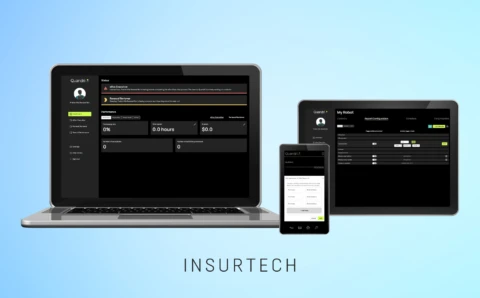
Robot Factory by Quandri.io revolutionizes insurance brokerages by automating manual tasks with bespoke software bots (RPA). Our collaboration led to the creation of a web app where users can craft and deploy bots that integrate into their systems, operating autonomously. This solution empowers brokerages to cut down on repetitive work and focus on core business activities.
What These FastAPI Examples Demonstrate
The documented implementations show that companies use FastAPI for several recurring scenarios:
- exposing machine learning models through APIs;
- building internal operational platforms;
- connecting automation services and third-party systems;
- developing independently deployable backend services;
- providing validated and documented interfaces between applications.
FastAPI is particularly relevant when a team already works with Python and needs an API framework with type-based validation, automatic OpenAPI documentation, asynchronous support, and compatibility with Python data and machine learning tools.
Framework selection should nevertheless follow the product requirements. Data volume, concurrency, authentication, background processing, database access, deployment, monitoring, and team experience will have a greater effect on the production system than framework benchmarks alone.
If you are evaluating FastAPI for a new API or an existing Python application, PLANEKS can help define the architecture, develop the service, integrate it with your systems, and prepare it for production deployment.
Why Companies Adopt FastAPI
FastAPI adoption has grown significantly across the Python ecosystem. In the 2024 Python Developers Survey, 38% of respondents reported using FastAPI, up from 29% in 2023 and 21% in 2021. This placed it ahead of Django at 35% and Flask at 34%. Among respondents using Python for web development, 56% reported working with FastAPI.
Companies adopt FastAPI because it combines standard Python type hints with request validation, data serialization, OpenAPI documentation, dependency injection, and asynchronous request handling. It is particularly suitable for API-first products, integrations, independently deployable services, automation, and machine learning applications.
FastAPI is not automatically the right choice for every backend. The final decision should also consider the product architecture, database operations, authentication, background processing, deployment environment, expected traffic, and the development team’s experience.
Adoption of frameworks and libraries
- Percentage
- Percentage