
MVP development is building the smallest usable version of a product to validate demand with real users, reduce risk, and guide the next development steps with data.
Most Minimum Viable Product (MVP) guides speak the language of delivery, as they are prepared for founders who already live inside product backlogs, sprint boards, and technical outcomes. Decision-makers, nevertheless, deal with different circumstances. For executives, investors, and business owners, MVP development is a strategic method that impacts capital efficiency, time-to-market, and the product’s long-term economic viability.
A disciplined MVP approach materially improves the likelihood of commercially viable results. In fact, Forbes reports that roughly 90% of startups fail within their first five years, with the leading cause of failure being the development of products that the market does not want. Specifically, 42% cite the lack of genuine market demand as the single most significant reason for collapse. These outcomes are rarely the consequence of poor execution standalone. More often, they arise from early decisions that place greater emphasis on implementation than on validation, committing resources before critical business assumptions are sufficiently validated.
A poorly designed MVP can lock an organization into the wrong architectural path, validate misleading assumptions, or consume months of runway without generating decision-grade insight. In contrast, MVPs that are comprehensively structured around validation, not mere delivery, can become highly efficient early risk-control mechanisms. By verifying demand, adoption barriers, and value propositions in real environments, MVPs help leadership teams detect structural weaknesses from the outset, recalibrate strategy with limited exposure, and prevent the amplification of flawed assumptions.
This guide approaches MVP development from a business and engineering leadership perspective. It discloses how early product decisions establish excellent scalability, operational cost, and future development velocity.
Table of Contents:
What MVP Development Actually Means in Business Terms
MVP development is often described as a delivery exercise. In business practice, however, it is a validation and learning mechanism. At the executive level, an MVP exists to answer high-risk questions early, before capital, time, and organizational cadence are fully committed.
The Real Purpose of an MVP
The core purpose of an MVP development for startups is to validate assumptions that materially affect the business model. This comprises confirming that a real problem exists, the proposed solution creates tangible value, and customers are willing to adopt or pay for it under production-like conditions. An MVP should generate demonstrated, tangible evidence that informs strategic choices, such as whether to scale, pivot, enhance positioning, or stop altogether. Success at this stage is defined by the quality of insights generated, rather than by the breadth of functionality delivered.
What an MVP Is Not
There is a specific difference between PoC, MVP, and prototype, as well as a stripped-down version of a future product. A PoC is designed to answer a narrow technical question, whether a specific approach, algorithm, or integration is feasible, without concern for usability, scalability, or market demand. A prototype, by contrast, is an exploratory artifact used to visualize ideas, test interactions, and support internal discussion, but it is not intended for sustained or real-world employment.
Demos serve yet another purpose: they are built to persuade, often optimized for presentations, investor meetings, or internal alignment, prioritizing narrative and appearance over measurable learning. Half-built products sit uncomfortably between these categories, consuming engineering effort and budget while still failing to answer the most critical business questions. Unlike an MVP, these artifacts do not generate the decision-grade evidence required to guide strategic action under real conditions.
Why Executives Often Misjudge Scope
Sometimes executives misjudge the MVP scope by applying delivery-stage expectations at a time when validation should take precedence. Concerns around polish, scalability, brand perception, or long-term architecture often drive premature scope expansion, shifting the effort from learning to optimization. As an outcome, teams invest time and capital in features and infrastructure that have not yet been justified by market signals and proof. This may slow feedback cycles, increase sunk costs, and erode flexibility, degrading the MVP’s primary aim, which is achieving rapid, evidence-supported learning that assists high-stakes business decisions before meaningful commitment is made.
When an MVP Is the Right Decision, and When It Isn’t
While the benefits of building an MVP for startups are significant, the approach is not one-size-fits-all and must be applied with clear strategic intent. Its value depends on the nature of uncertainty an organization is facing and on whether validation outcomes can measurably impact strategic direction. When it comes to entrepreneurs, the critical question is not how fast an MVP can be delivered, but whether it will meaningfully reduce business risk.
Situations Where an MVP Creates Clarity
An MVP application development is most effective when market uncertainty is high, and assumptions cannot be substantiated through analysis, benchmarks, or prior experience alone. This occurs when entering unfamiliar markets, introducing new value propositions, or addressing problems with obscure user behavior. In these scenarios, real-world usage can help generate the missing clarity around demand, adoption friction, pricing sensitivity, and integration constraints. Thus, an MVP retrieves confirmed signals from untested assumptions, enabling leadership to make high-stakes decisions to scale, pivot, or stop with limited capital exposure.
Cases Where an MVP Wastes Time or Budget
MVPs tend to waste time and budget when uncertainty is low and requirements are already meticulously defined. Internal systems, compliance-driven platforms, or incremental extensions of mature products rarely benefit from experimental validation. In these cases, startup MVP development can introduce unnecessary coordination overhead, delay execution, and fragment accountability. In these terms, instead of accelerating learning, they often slow delivery by imposing artificial constraints on problems that are already grasped, where disciplined software engineering implementation would guarantee better outcomes.
Internal vs Market-Driven Validation
Internal validation ensures feasibility, stakeholder alignment, and delivery readiness, whereas market-driven validation assesses whether the underlying business assumptions hold in real operating environments. MVPs are appropriate only when external validation is required to resolve strategic uncertainty, such as customer pain points and readiness to adopt, pay, or change behavior. When leadership decisions depend primarily on internal constraints (process, capacity, or compliance), market validation adds little value. An MVP delivers returns only when real users, real data, and real consequences directly inform the next strategic move.
Key Business Questions an MVP Should Answer
The effectiveness of an MVP is provided by the assumptions it proves or disproves, rather than by the functionality it provides. At this stage, leadership teams should assess success based on the questions answered, not on the features implemented. An effective MVP is purpose-built to generate substantiated insights that reduce uncertainty across commercial, operational, and strategic considerations.
Market Demand Validation
An MVP should provide clear, objective signals regarding whether real, urgent demand exists for the proposed solution. This goes well beyond positive feedback, survey responses, or expressions of interest. Stakeholders, in turn, observe if users actively engage with the product, return over time, and incorporate it into their existing workflows without excessive prompting or explanation. Consistent adoption patterns, repeat engagement, and organic retention are strong indicators that the problem being addressed is both real and relevant. This goes both ways: weak, sporadic, or short-lived demand signals at this stage often point to deeper issues in issue definition, target audience selection, or value proposition clarity.
Willingness to Pay
Market interest alone does not establish commercial viability. As was mentioned, an MVP must determine if the audience is willing to make a tangible commitment: financial, contractual, or operational, to access the solution. Early revenue, paid pilots, signed letters of intent, or clearly observed price sensitivity provide far more reliable validation than stated intent or hypothetical willingness to purchase. Such markers help leadership assess the perceived value that turns into sustainable economics. In case credible evidence of payment intent is missing, scaling efforts remain based on belief, significantly increasing the risk of investing in growth without a viable business foundation.
User Behavior vs Assumptions
There is frequently a substantial gap between what users claim they will do and how they actually behave, especially outside real operating contexts. One of the MVP objectives is to expose actual behavior patterns rather than stated intent: how users navigate the product, where they hesitate, what they adopt naturally, and which features they consistently ignore. These behavioral signals are often more reliable than interviews or surveys alone. They are critical for correcting internal assumptions before those assumptions solidify into architectural choices, roadmap commitments, and go-to-market strategies that become increasingly expensive to reverse.
Sales and Onboarding Friction
Finally, an MVP should reveal how difficult it is to acquire and onboard customers under realistic conditions. Long sales cycles, extensive explanations, or complex onboarding flows can be early indicators of structural friction that directly constrain scalability and growth potential. At this stage, the objective is not to optimize conversion, but to determine where resistance emerges in the buying and adoption journey. Friction that appears initially often compounds at scale. This increases customer acquisition cost, slowing revenue realization, and placing additional strain on sales and support teams.
The Right MVP Scope (Without Overbuilding)
The essence of an MVP is not to pack as much functionality as possible into a limited budget, but to build only what is required to answer viability questions. As an entrepreneur, you should avoid overbuilding at this stage, as it dilutes focus, takes you further from tangible feedback, and increases the cost of change at the most sensitive stage of the product lifecycle.
Core Problem vs Nice-to-Have Features
The starting point for defining the MVP web development scope is a precise articulation of the core challenge being addressed. Every MVP feature should exist solely to test whether that issue is real and whether the proposed solution handled it effectively. Nice-to-have features (those aimed at comfort, visual polish, or exhaustive edge-case coverage) rarely contribute to meaningful validation at the MVP stage. Some of the common supplementary functions cover advanced customization options, refined UI animations, dark mode, extensive user preference settings, multi-role permission systems, detailed analytics dashboards, or support for rarely used workflows. Introducing such features early often redirects effort away from learning and toward premature optimization.
Feature Prioritization From a Business Perspective
Feature prioritization in an MVP app development should be driven by business risk, not by engineering convenience or stakeholder preference. The highest-priority features are those that straightforwardly test assumptions with the greatest financial or strategic impact, such as core adoption drivers, pricing and monetization logic, or reliance on external systems and integrations. They generate signals that materially affect investment decisions. In case a feature does not influence a clear go, pivot, or stop outcome, it holds zero corroboration value and should not be incorporated in the MVP.
Trade-Offs Between Speed, Quality, and Flexibility
MVP scope always involves deliberate trade-offs. Speed accelerates feedback, quality safeguards credibility, and flexibility preserves future options. Your final objective is not to optimize all three simultaneously, but to harmonize them intentionally in service of learning, making choices that support validation while avoiding early commitments that introduce unnecessary complexity or constrain future direction.
MVP Development Process
For non-technical leaders, MVP development should be regarded as a structured decision-making flow. Each stage is standardized to gradually cut uncertainty and determine if further investment is justified.
Discovery and Validation
The first step of the roadmap is discovery, in which teams define the problem, target users, and key assumptions to validate. The stage mainly focuses on comprehending user pain points, market context, and business constraints. The required output is a transparent, prioritized set of hypotheses that guide startup MVP development and ensure that validation efforts remain tightly coordinated with strategic objectives.
MVP Design and Development
The MVP software development and design phase takes over the configuration of prioritized hypotheses. Web application engineers implement a minimal product capable of generating meaningful validation signals, with the scope being intentionally constrained to what is necessary to test assumptions in real operating environments. Speed and learning take precedence over completeness, without compromising the level of quality required for trustworthy user feedback.
Launch and Feedback Collection
After launch, the MVP is introduced to real users via pilots, limited rollouts, or early-access initiatives. Insight is extracted from practical usage behavior patterns, engagement indicators, and direct customer feedback. It is essential due to the shift in decision-making from internal assumptions to measurable external evidence.
Iteration or Pivot Decision
As part of the final stage, the leadership reviews MVP outcomes to deeply determine if the underlying assumptions have been confirmed, require targeted iteration, or warrant a strategic pivot or termination. Thus, attention shifts to whether the evidence credibly supports continuation, refinement, or exit. The MVP’s purpose is considered to be fulfilled when it leads stakeholders to a transparent, defensible decision.
Budget, Timeline, and Risk: What Decision-Makers Should Expect
From a leadership perspective, MVP planning requires a realistic view of financial capacity, timeline, and risk as interdependent variables. Misalignment in one tends to amplify issues in the others. Through disciplined MVP scoping, organizations are able to set expectations from day one and retain strategic optionality.
Typical MVP Cost Ranges and What Affects Them
Cost to build an MVP typically ranges from the high five figures to the low six figures, depending on the level of uncertainty being tested and the environment in which validation occurs. In practical software engineering terms, a lean MVP that validates basic demand or usage patterns often falls within the $40,000-$70,000 range, covering discovery, UX, backend development, and a limited production deployment. Furthermore, MVPs that necessitate workflow support, authentication, or moderate integrations commonly reach $70,000-$120,000, reflecting additional engineering effort, Quality Assurance (QA), and infrastructure setup. To support early-stage planning, businesses can rely on the PLANEKS MVP cost calculator to assess cost implications based on validation scope and complexity.
In these terms, cost is attributable less to feature count and more to complexity factors such as domain knowledge requirements, third-party integrations, compliance constraints, and the quality threshold required for credible user interaction. MVPs engaging payments, external APIs, data pipelines, or production-grade security routinely exceed $120,000, as they demand more senior engineering time, integration testing, and operational hardening. In contrast, MVPs focused purely on substantiating demand or behavioral patterns can remain significantly leaner, provided scope discipline is maintained.
Timeline Expectations
From a planning perspective, most MVP initiatives span several weeks to a few months from discovery through initial launch. Milestones can be extended when assumptions are poorly defined, decision authority is fragmented, or scope alterations occur midstream. Sustained execution speed heavily depends on transparency of intent and decision discipline.
A representative example is PLANEKS’ work on the Digital Plant platform for an industrial automation client in the US. The engagement began with a structured discovery phase to define data models, validation goals, and scope boundaries for an MVP suitable for early sales and market testing.
The MVP, covering asset data mapping, a streamlined administrative interface, QR-based field access, and core 3D asset visualization, was delivered in five months by a five-person team, despite operating in a heavily standardized industrial environment. Crucially, early alignment on assumptions and validation objectives allowed scope adjustments without derailing timelines, enabling the client to proceed into commercial validation and go-to-market activities.
Common Financial and Strategic Risks
The primary financial risk lies in committing excessive resources ahead of evidence-based confirmation. Strategically, teams may validate the wrong assumptions, misinterpret early signals, or optimize for internal coordination at the expense of external evidence. These risks compound when MVP success is measured by delivery milestones.
Where Cost Overruns Usually Happen
Cost overruns most often appear when MVPs drift toward full-scale products without an explicit decision to do so. Underestimated integration effort, late-stage quality requirements, and reactive feature additions in response to internal pressure frequently inflate budgets. Over time, erosion of discipline leads to unplanned product builds that consume resources without delivering proportional insight or decision clarity.
Choosing the Right MVP Development Partner
The choice of an MVP development partner has a direct impact on learning velocity, cost discipline, and outcome reliability. Partners that lead with validation help leadership teams manage risk through structured experimentation instead of feature accumulation. In this role, the partner helps define what to build, what to defer, and what assumptions must be tested first, directly reducing technical and commercial risk.
What to Look for Beyond Technical Skills
Strong technical execution establishes trustworthiness, but it is only the starting point. Senior leaders should prioritize partners who demonstrate strong product judgment, profound awareness of business context, and proven experience operating under vague requirements. This implies the ability to challenge assumptions, propose alternative validation approaches, and communicate technical trade-offs in clear, non-technical terms.
An experienced and capable MVP partner also comprehends that early architectural and scope decisions have long-term cost and scalability implications, and actively guides leadership toward empirical support choices. For Software as a Service (SaaS) MVPs, partners must understand subscription models, onboarding funnels, and usage-driven validation
Red Flags in Proposals and Timelines
Proposals that sell a dream of fixed outcomes, aggressive timelines, or guaranteed, “inevitable” success should raise immediate concern. MVP work is inherently exploratory, and credible partners acknowledge uncertainty while knowing how to structure it into testable assumptions and controlled experiments. Other warning signs you should pay attention to include feature-heavy scopes missing clear validation rationale, ambiguous success criteria, and rigid timelines that preclude iteration. Such signals usually reflect a delivery-first mindset that is misaligned with the MVP intent.
In-House vs Agency vs Hybrid Approach
In-house teams offer deep domain knowledge and strong control, but can lack the objectivity or specialized experience required for early-stage validation. Agencies introduce speed, pattern recognition from multiple MVP engagements, and an external perspective that helps challenge internal assumptions, though incentives must be managed through transparent governance. Hybrid models bring together internal ownership and pre-verified expertise, often delivering the most effective outcomes when decision authority, accountability, and validation goals are clearly defined and actively enforced.
Measuring MVP Success: Metrics That Actually Matter
The criteria for MVP success differ significantly from those applied to fully launched products. Executive stakeholders should assess whether the MVP has generated sufficient, reliable insight to guide next-step decisions.
What “Success” Looks Like at the MVP Stage
An MVP development can be considered successful when it measurably reduces ambiguity around the most influential business assumptions. This may mean confirming strong demand, revealing weak adoption, or exposing structural friction that invalidates the original thesis. A solid result brings clarity: presenting that an idea will not scale can be just as valuable as validating one that should, provided the insight is decisive and timely.
Metrics Tied to Business Decisions
Meaningful MVP metrics are directly linked to the actions leadership must take. These incorporate activation rates that indicate initial value, retention signals that suggest sustained usefulness, conversion or payment indicators that test revenue potential, and funnel drop-offs that reveal sales or onboarding barriers. Here, metrics are valuable only to the extent that they inform go, pivot, or stop the further strategy.
When Data Is Sufficient to Move Forward
Data becomes sufficient when patterns stabilize, and additional collection is unlikely to change the decision. Leaders should seek consistent behavior across user cohorts and synchronization between qualitative feedback and quantitative signals. Extending MVPs indefinitely in pursuit of perfect data often delays action without materially improving confidence.
What Comes After the MVP: Scale, Pivot, or Stop
The value of MVP development lies in clarifying which strategic path deserves further investment and which does not. For leadership teams, the post-MVP phase marks the point where validated data replaces assumptions and capital is allocated based on proven adoption, pricing, and execution signals.
Transitioning From MVP to a Full Product
Once core assumptions are validated, scaling should give way to a structured transition phase. This includes hardening system architecture, addressing validation-stage technical debt, and translating real usage patterns into concrete product requirements. Teams that execute this phase well prioritize foundational capabilities first, allowing scaling to follow demonstrated demand and known system constraints rather than speculative growth projections.
When to Pivot or Pause
Pivoting becomes necessary when the assembled evidence contradicts core assumptions about the problem definition, solution effectiveness, or target customer behavior. This outcome demonstrates that assumptions were tested and invalidated early, preventing misallocation of resources. In some cases, MVP results indicate that neither incremental iteration nor pivoting is justified: signals such as weak adoption, unsustainable unit economics, or prohibitive execution complexity make continuation irrational.
How MVP Insights Shape Long-Term Strategy
MVP insights feed serves as input for pricing strategy, go-to-market mechanics, product positioning, and investment prioritization. At a broader level, they set how organizations manage risk, validate assumptions, and institutionalize learning across future initiatives. As time passes, a well-run MVP creates a repeatable decision framework that improves investment discipline across the entire product portfolio.
Common MVP Mistakes Decision-Makers Make
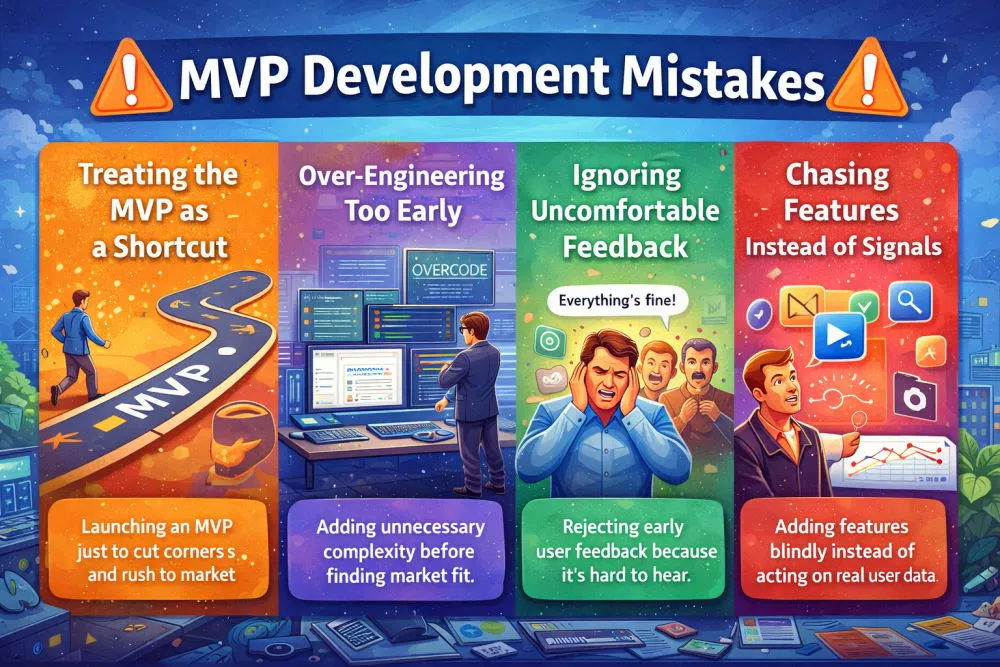
Many MVP failures originate from leadership-level misconceptions about what an MVP is designed to obtain. The root causes are traditionally pressure to show visible progress and the premature application of scale-stage product expectations during initial verification.
Treating the MVP as a Shortcut
One of the most common errors is viewing the MVP as a faster or cheaper way to reach a finished product. This mindset reorients effort from validation to delivery, encouraging early commitments before assumptions are proven. An MVP does not replace due diligence; instead, it operationalizes it through structured experimentation. When misused as a shortcut, it forfeits its strategic purpose and becomes an incomplete product lacking a valid reason to exist.
Over-Engineering Too Early
Another frequent mistake is investing in scalable architecture, edge cases, or performance optimization before validation is complete. Technical excellence matters, but over-engineering locks teams into assumptions that have not yet been proven. Early optimization constrains flexibility and accelerates sunk cost at the exact stage where change should be fastest, cheapest, and least disruptive.
Ignoring Uncomfortable Feedback
Leadership teams may discount negative signals that conflict with internal conviction or prior investment, deferring corrective action and allowing risk to compound as assumptions harden into commitments. MVPs deliver value only when evidence is permitted to challenge prevailing beliefs rather than confirm them.
Chasing Features Instead of Signals
Teams also frequently mistake progress for output, equating velocity with the volume of features delivered rather than insight generated. Features, in isolation, do not reduce uncertainty; validated signals do. When MVP application development velocity becomes the primary success metric, learning slows, and decision quality degrades.
MVP Development as a Strategic Tool
The effectiveness of MVP software development depends on treating it as a structured decision-making framework rather than an early delivery milestone. Its purpose is to replace assumptions with evidence, allowing leadership teams to deploy resources with intent. When executed well, MVPs expose market realities, highlight structural risks, and guide organizations from uncertainty to informed execution.
Moving from stage to stage delivers absolutely no advantage if it produces the wrong outcomes. The organizations that benefit most from MVP development are those that balance urgency with intent, define clear validation goals, resist premature scaling, and allow data to guide strategy. In this context, MVPs become repeatable instruments for learning, not one-off experiments, establishing how companies approach innovation well beyond a single product.
At PLANEKS, we help leadership teams use MVPs to answer the right questions before making irreversible commitments. We support the full spectrum of MVP-related services, professionally handling validation, architecture design, development, and post-MVP decision support, helping teams test the right assumptions without overbuilding or wasting budget.
If you want to approach your MVP product development with discipline and clarity, reach out to PLANEKS to start the conversation.