Even organizations with a clear product direction often face execution constraints encountered due to skill gaps and limited development capacity. Hiring experienced engineers is time-consuming, competition for talent remains intense, and retaining specialists across multiple domains puts sustained pressure on budgets. According to McKinsey, only 16% of executives feel confident in their current technology talent, while 60% cite skills scarcity as a major barrier to digital transformation, with demand projected to exceed supply by two to four times in the coming years.
As a response to this significant issue, software development outsourcing has become a pragmatic and widely adopted strategy. According to Statista, the global IT outsourcing development market is projected to reach approximately $588 billion by 2025 and grow to over $800 billion by 2030, meaning that outsourcing is an inalienable aspect of modern delivery models. When applied correctly, outsourcing equips companies to scale engineering capacity, surpass local markets, access specialized, narrow expertise on demand, and accelerate product delivery while preserving quality and strong governance.
This trend is particularly relevant for Python-based projects. Demand spans web back-ends, APIs, data platforms, automation pipelines, and machine learning systems – areas where experienced engineers remain scarce and costly to retain in-house, driving organizations to invest more heavily in external development capabilities.
Remote collaboration has become an important and established working model in the IT sector. With approximately 39-40% of professionals in IT-adjacent sectors working remotely or in hybrid arrangements in recent years, organizations have obtained substantial hands-on experience operating distributed teams.
This guide explores when outsourcing makes strategic sense, how to approach Python projects effectively, and what leaders should consider to reduce risk while maximizing long-term value.
Table of Contents:
Definition & Key Concepts
Software development outsourcing has progressed into a structured, strategic practice that supports both operational execution and long-term business goals. To evaluate whether outsourcing is the right model, decision-makers, entrepreneurs, and business owners must take a comprehensive look at what it entails, how engagement models differ, and why its role has shifted far beyond simple cost reduction.
Clear Definition of Software Development Outsourcing
So, what is software development outsourcing? At its core, this model involves contracting an external vendor, consultancy, or distributed engineering team to design, build, maintain, or scale software systems rather than relying exclusively on an internal development department. The outsourced partner assumes responsibility for specific technical outcomes, while the client retains ownership of the product, intellectual property, and strategic direction. Outsourcing software development allows organizations to gain almost borderless engineering capabilities without the delays and fixed costs associated with in-house hiring.
Common Outsourcing Models and Engagement Structures
IT outsourcing development is not a one-size-fits-all arrangement. Companies can choose between full product outsourcing, dedicated or extended teams that integrate with internal staff, managed teams responsible for delivery outcomes, or clearly scoped project-based engagements. Each strategy offers a different set of pros and cons, a balance of control, accountability, and internal involvement, enabling organizations to align project delivery structure with risk tolerance, technical complexity, and growth stage.
The Strategic Shift Behind Modern Outsourcing
IT outsourcing is now a structural component of enterprise technology strategy: industry insights indicate that approximately 92% of Global 2000 companies rely on external IT service providers to some extent. Besides, modern outsourcing remains strongly associated with cost optimization, with around 70% of organizations citing cost reduction as a key driver, according to Deloitte. However, outsourcing has outgrown a purely financial lever – the same research shows that a growing share of companies now rely on external partners to increase delivery speed, improve operational agility, and access specialized technical skills, particularly in areas where in-house talent is scarce.
Execution pressure continues to intensify as demand for advanced engineering skills outpaces supply. The World Economic Forum estimates that 44% of workforce skills will change by 2027, with software developers among the fastest-growing roles globally. At the same time, Deloitte research shows that 80% of digitally maturing companies actively cultivate innovation through partnerships with external organizations, compared with 59% of developing organizations and just 33% of early-stage businesses. In practice, this means that digitally mature companies are more than twice as likely to rely on external vendors to achieve innovation than their least mature counterparts.
In this context, outsourcing functions as a dual strategy: reducing operational costs while simultaneously enabling faster execution, access to proven expertise, and long-term scalability.
Why Outsource Software Development (Especially in Python) – Key Benefits
Within the IT environment, companies are reassessing how engineering work and partnership are implemented. Outsourcing software development is no longer a short-term solution for capacity gaps but the full strategic model for organizations that seek shorter time to market, depth of expertise, and operational flexibility. Such software development outsourcing trends are more apparent in Python-based development, where the ecosystem continues to grow, and the demand for experienced engineers consistently exceeds supply. When keeping these concrete benefits of outsourcing software development in mind, business leaders can determine when it creates long-term value rather than short-term relief.
Access to Skilled Global Talent & Specialized Expertise
Bespoke software development outsourcing services open straightforward access to a global pool of experienced engineers, removing the constraints of local hiring markets. Instead of competing for a limited number of candidates, companies can work with Python developers who have a proven background across web back-end solutions, applications, API development, data processing, machine learning, and automation. Modern software products often require concentrated technical expertise that generalist teams struggle to provide.
Many Python projects today depend on advanced tooling and architectural patterns, such as asynchronous frameworks, event-driven processing, or data-intensive workloads operating at scale. Acquiring such skills internally typically necessitates significant time and sustained investment. Meanwhile, after more than a decade of steady growth, Python’s adoption across different niches has accelerated considerably; according to the Stack Overflow Developer Survey, Python saw a 7-percentage-point increase in usage from 2024 to 2025, establishing a robust position as the go-to language for AI, data science, and back-end development. Here, offshore software development outsourcing allows organizations to engage professionals who have already designed, optimized, and maintained similar systems in production environments. Therefore, technical decisions are grounded in real-world experience, reducing architectural risk and guaranteeing stable, scalable outcomes.
Cost Efficiency & Reduced Overhead
From a financial perspective, outsourcing changes software development cost dynamics by reducing fixed commitments and introducing higher flexibility. In contrast with this approach, building an in-house team involves more than base salaries; it includes recruitment costs, benefits, onboarding time, training, equipment, infrastructure, and ongoing retention efforts. These fixed expenses can significantly exceed initial estimates, particularly when projects require senior-level expertise.
When it comes to custom software development outsourcing, companies pay for productive engineering output or allocated development capacity rather than absorbing long-term employment overhead. This model is particularly effective for startups and smaller organizations with limited budgets, as well as for established companies executing short-term initiatives or specialized technical projects. Instead of committing to permanent hires that may not be needed once a phase is complete, organizations retain financial flexibility while still accessing senior-level expertise. In many cases, this difference determines whether a project is viable without overloading internal teams or budgets.
Faster Time-to-Market & Better Agility
Time-to-market is an impactful point in software delivery, and outsourcing directly addresses one of the most substantial obstacles, which is slow hiring cycles. In 2025, 76% of employers report difficulty filling technical roles, making the recruitment of experienced Python developers a process that can stretch over several months. Outsourcing providers, by contrast, can assemble qualified teams faster and begin execution almost immediately, allowing companies to move from planning to delivery without prolonged delays.
Apart from the speed benefits of outsourcing software development, the model enables a flexible, responsive delivery rarely achievable with exclusively internal teams. Development capacity can be scaled up to meet increased demand or tightened timelines, then cut once the required objectives are obtained.
An elastic delivery model allows companies to adjust engineering capacity in response to market changes without introducing the operational burden of repeated hiring, organizational restructuring, or workforce reductions. For products facing volatile demand or rapid growth, outsourcing flexibility significantly reduces implementation risk and organizational constraints.
Freedom to Focus on Core Business Activities
Delegating technical execution to experienced outsourcing partners allows internal teams and leadership to redirect effort on the most valuable business strategy, product direction, customer engagement, and growth. This value is most visible in organizations led by non-technical founders or operating outside core software domains. Delegating execution to specialized teams allows leaders to shift attention away from day-to-day implementation and toward strategic planning and business growth.
In addition, outsourcing vendors typically bring established delivery processes, quality controls, and development standards refined across multiple projects and industries. Companies benefit from this process maturity without having to build it internally from scratch. Over time, this leads to more predictable delivery, clearer communication, and reduced management overhead. Instead of replacing internal teams, outsourcing complements them, strengthening execution while preserving strategic control.
Considering all, the benefits of outsourcing software development are why this model, especially in Python, is based as a core component of modern technology strategies. When adopted through a deliberate, goal-oriented approach, it enables companies to deploy products faster, manage technical and operational risk more effectively, and scale sustainably.
When (and When Not) to Outsource: Ideal Scenarios & Red Flags
Outsourcing software development delivers the greatest value when it synchronizes with a company’s delivery constraints, growth trajectory, and risk profile. While it can accelerate execution and expand technical capability, it is not universally appropriate for every project or organization. Exploring the pros and cons of outsourcing software development is essential for supporting evidence-based decision-making at the executive and board levels.
Ideal Situations for Outsourcing
The effectiveness of outsourcing can be evidently demonstrated in scenarios where delivery speed and flexibility directly impact business outcomes. Companies building a new product or minimum viable product often strive to move quickly without committing to the long-term cost and complexity of assembling a full internal engineering team. In such cases, outsourcing enables accelerated execution while preserving the option to reassess internal hiring once product-market fit is validated.
It is also well-suited for projects that require specialized Python expertise. High-performance back-end systems, data engineering pipelines, machine learning workflows, and automation platforms often demand senior-level skills that are scarce or prohibitively expensive in local markets. Through outsourcing, organizations gain direct access to engineers with profound experience in delivering comparable production systems, thereby reducing technical uncertainty and avoiding the internal ramp-up required for niche expertise.
Variable or unpredictable workloads further strengthen the case in the in-house software development vs outsourcing comparison. When demand fluctuates due to seasonal usage, phased rollouts, or rapid scaling, maintaining a fixed on-premise team often proves inefficient. Outsourcing introduces elasticity, allowing companies to adjust team size to match real needs rather than forecasted assumptions.
For organizations where leadership aims to remain focused on strategic priorities rather than operational execution, outsourcing provides a practical and balanced model. Implementation is handled by seasoned teams, allowing executives to concentrate on long-term vision, market alignment, and growth, without relinquishing control over results.
When Outsourcing May Be Less Appropriate
Despite its advantages, outsourcing is not a one-size-fits-all option. Projects and applications that depend heavily on deep internal domain knowledge or require continuous, close collaboration with proprietary systems may be better served by in-house teams. In such cases, the overhead of transferring context and maintaining alignment with external partners can outweigh the benefits of outsourcing.
Outsourcing may also be less suitable when strict control over intellectual property, security, or regulatory compliance is a primary concern. Although reputable IT vendors typically apply strong security controls and compliance practices, some organizations operate in contexts where limiting external dependencies is a strategic necessity. For highly sensitive systems, maintaining direct internal oversight can reduce exposure and streamline governance processes.
Cultural considerations can also play a meaningful role. Organizations with tightly coupled internal teams, highly tailored operating processes, or a strong preference for ongoing real-time oversight may not find this strategy suitable, as external teams typically work within established engagement models and delivery frameworks designed for efficiency and scalability rather than constant direct control.
Taking everything into consideration, the decision to outsource should be guided by the clarity of your requirements and well-described project objectives. When coordinated with business goals, risk tolerance, and organizational maturity, outsourcing can be the best solution to opt for. In case misaligned, it can, in turn, introduce friction, delays, and unnecessary complexity. The key lies in selecting the model that best supports long-term business outcomes and workflow peculiarities.
How to Outsource Python Software Development
The success of Python software development outsourcing depends on treating it as a disciplined engineering endeavour, supported by clear structure and management. While external partners can accelerate delivery and expand technical capacity, outcomes depend heavily on how well requirements are defined, how partners are selected, and how collaboration is governed over time. We’ve prepared a fully-fledged roadmap outlining a practical, experience-driven approach to help organizations minimize risk, maintain quality, and achieve ongoing value from outsourced Python development.
Define Your Needs & Project Scope
Before engaging any external team, it is integral to document what the project is expected to deliver and why it exists from a business perspective. This implies functional requirements, non-functional expectations such as performance and security, preferred Python frameworks or libraries, data requirements, integration points, timelines, and measurable milestones. The more explicit these inputs are, the easier it becomes to align expectations and avoid misunderstandings later in the delivery process.
At this stage, companies should also decide on the nature of the engagement itself. A short-term project with a fixed scope demands a very different structure than a long-term collaboration involving ongoing development and maintenance. Some organizations require a dedicated Python team that integrates closely with internal staff, while others prefer full end-to-end delivery with minimal internal involvement. Defining this distinction from the outset helps ensure that both the outsourcing model and the selected partner are coordinated with project complexity and delivery demands.
Choose the Right Outsourcing Model & Partner
Once you have well-scoped functional and technical requirements on hand, the focus should shift to selecting both the engagement model and the delivery partner. Dedicated teams, managed projects, fixed-price contracts, and time-and-materials models each carry different implications for control, flexibility, and risk. At this stage, grasping how to calculate effort estimation for software development becomes especially important, as it exerts a direct influence on model selection, budgeting accuracy, and delivery expectations. In practice, this means breaking the project into well-defined components, estimating effort at the task or feature level, accounting for technical complexity and uncertainty, and validating assumptions collaboratively with the delivery partner.
Highly complex or fast-growing Python systems tend to benefit from time-and-materials or dedicated team engagement models, as these approaches support continuous iteration, rapid feedback, and ongoing adaptation as scope, requirements, and priorities evolve. By contrast, more narrowly defined initiatives can be well suited to fixed-scope arrangements, provided that requirements are stable, clearly articulated, and thoroughly documented, and that they are backed by realistic, well-validated upfront estimates.
Partner selection should be approached with the same methodical thoroughness as hiring senior internal engineers. Python delivery capability, including hands-on project experience, code quality, architectural judgment, cohesive onboarding practices, and the ability to communicate effectively with both technical and non-technical stakeholders. Clear transparency around estimation methods, delivery processes, and risk management practices is a strong indicator of organizational maturity. The most effective partnerships are formed when technical competence, working culture, and delivery expectations are aligned from the outset.
Onboarding & Collaboration Setup
Onboarding sets the tone for the entire outsourcing engagement, as this is where collaboration models, responsibilities, and delivery expectations are formally established. This incorporates defining communication channels, selecting project management and documentation tools, setting up code repositories, and agreeing on development workflows. Clear ownership of responsibilities, both on the client side and the vendor side, helps avoid misapprehension, ambiguity, and potential delays.
Equally important is setting explicit expectations around deliverables, review cycles, testing responsibilities, and reporting frequency. For Python projects, this often refers to agreements on code style, documentation standards, dependency management, and security practices. Early formalization of expectations reduces ambiguity and enables delivery teams to focus on execution instead of repeatedly clarifying or renegotiating foundational elements.
Development, Quality Assurance & Delivery
During the development phase, disciplined engineering practices are critical to maintaining quality and predictability. Sustainable Python systems are built on clean architecture, modular design, and thorough documentation, all of which support long-term maintainability as complexity grows. To uphold these standards, code reviews, automated testing, and version control must be embedded as non-negotiable elements of the delivery process.
Python projects, in particular, benefit from teams that understand modern language idioms, ecosystem conventions, and performance considerations. Knowledge of contemporary frameworks, testing suites, asynchronous processing, and security best practices directly influences system reliability and scalability. Continuous integration and deployment pipelines further minimize resilience bottlenecks by catching issues early and ensuring consistent release processes as well as high failure resistance.
Maintenance, Support & Scaling (if needed)
Organizations should decide upfront whether long-term maintenance, support, and scaling fall within the scope of IT outsourcing development or whether responsibility will transition internally after launch. This decision directly shapes operational planning, including documentation standards, knowledge-transfer activities, support workflows, and handover timelines. When post-launch ownership is expected to move in-house, structured onboarding, clear runbooks, and well-defined transition phases are required to ensure continuity and prevent operational gaps.
In handover scenarios, disciplined knowledge transfer is a prerequisite for a smooth ownership transition. Comprehensive documentation, explicit code ownership, and structured walkthrough sessions help reduce dependency on external teams and preserve institutional knowledge. This rule works conversely: when the outsourced team is expected to provide ongoing support and scaling, governance, communication, as well as authority and escalation structures should be designed for sustained collaboration – not short-term project delivery.
Governance, Communication & Risk Management
Progress should be monitored employing clearly defined, meaningful metrics such as delivery velocity, code quality indicators, defect rates, and responsiveness to change or incidents. Taken together, these signals provide objective, actionable insight into delivery performance, system health, and team effectiveness, enabling stakeholders to detect emerging risks early and handle issues before they escalate into broader delivery or quality problems.
Furthermore, agreements should explicitly define intellectual property ownership, confidentiality obligations, delivery expectations, and exit conditions. Even with a trusted partner, maintaining active stakeholder involvement ensures that technical execution remains aligned with business objectives. Outsourcing does not eliminate the need for oversight; it shifts the focus from direct implementation to strategic direction and quality assurance.
Specific Advantages and Challenges of Outsourcing Python Projects
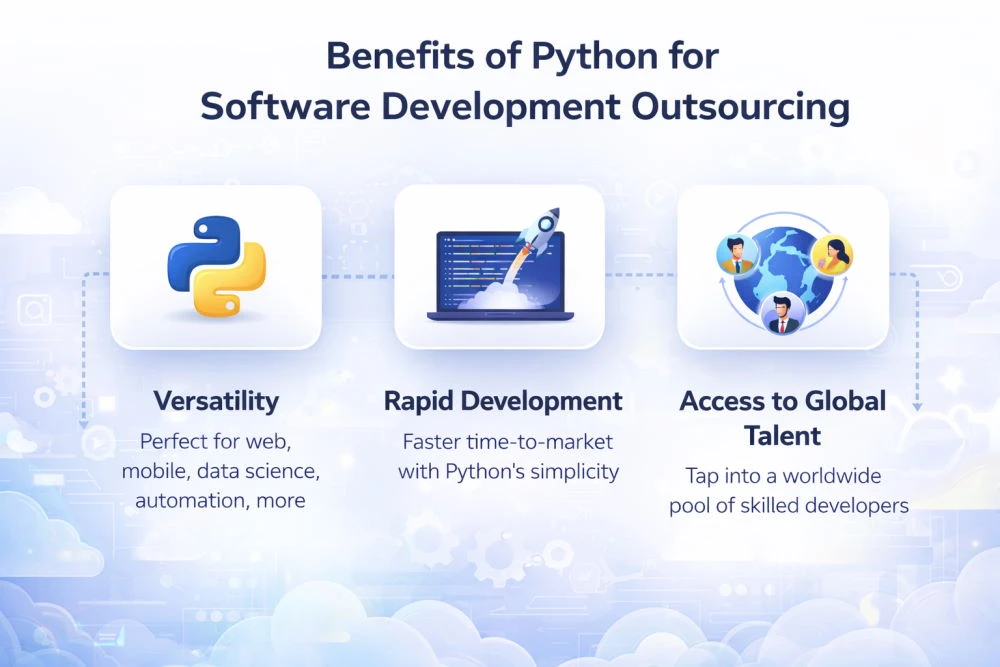
Python’s flexibility, ecosystem maturity, and broad industry adoption create a unique outsourcing profile that presents significant opportunities and specific risks, particularly given the language’s #1 global adoption ranking in the TIOBE Index. When seamlessly integrated into the current flows and governance, Python outsourcing can significantly accelerate delivery and expand technical capabilities. At the same time, the open-ended nature of Python necessitates structured management and governance to mitigate risks related to quality standards and cross-team coordination.
What Works Especially Well with Python Outsourcing
The inherent qualities of Python make it a strong fit for outsourcing software development across diverse scenarios. Its flexibility, development speed, and worldwide availability of skilled engineers allow external teams to align quickly with both product requirements and organizational processes.
Python’s Versatility Across Project Types
Python is used to build web back-end platforms, APIs, data processing pipelines, automation systems, and machine learning solutions within the same ecosystem. Its versatility allows outsourced teams to support multiple project types without frequent changes in language or tooling. The ability to reuse the same outsourcing partner across initiatives introduces meaningful operational efficiencies. Over time, continuity reduces onboarding costs, minimizes coordination friction, and enables more aligned architectural decision-making across products.
Rapid Development and Prototyping Capabilities
Python’s readability, expressive syntax, and extensive standard library are highly effective for rapid development and prototyping. Outsourced teams can go from concept to working software significantly faster, which is a must for MVPs, early-stage products, or internal tools where speed and feedback cycles matter more than exhaustive optimization. In startup and innovation-driven environments, quickly testing and validating ideas helps teams move to market faster while minimizing investment and execution risk.
Access to Specialized Global Python Talent
Advanced Python domains such as data engineering, artificial intelligence, machine learning, and high-performance back-end systems require deep, experience-based expertise. These skills are often scarce or expensive in local markets. Outsourcing enables organizations to access specialized talent globally, working with engineers who have already delivered complex Python systems in production.
Common Pitfalls and How to Mitigate Them
While Python outsourcing software development offers substantial advantages, it also introduces risks that must be actively managed. Such challenges are not unique to Python but are often amplified by the language’s flexibility and the distributed nature of outsourced teams.
Quality and Consistency Risks
Python allows for multiple valid approaches to solving the same problem, which can lead to inconsistent code quality if standards are not enforced. Some vendors or freelancers may prioritize speed over maintainability, neglecting testing, documentation, or architectural clarity. Mitigation requires careful partner vetting, reviewing real-world code samples, and enforcing practices such as code reviews, automated testing, and adherence to agreed coding standards. Working with teams experienced in production-grade Python significantly cut this risk.
Communication and Management Overhead
Outsourced teams often operate across different time zones and cultural contexts, which can introduce communication friction if not addressed deliberately. Without clear processes, misunderstandings around requirements, priorities, or timelines can slow delivery. Effective Python outsourcing depends on structured communication, well-defined documentation standards, consistent reporting, and clearly assigned ownership on both sides of the engagement. When communication is set up efficiently, and teams stay aligned, distributed delivery can pay off, enabling near-24/7 development progress while maintaining accessibility and responsiveness across time zones.
Dependency and Vendor Lock-In Risk
Prolonged reliance on external teams without deliberate internal knowledge transfer can introduce strategic dependency. If a vendor shifts priorities, faces talent attrition, or becomes unavailable, delivery continuity and system ownership may be compromised. Such risks can be mitigated by enforcing full ownership of code and documentation, maintaining internal architectural understanding, and embedding structured knowledge-sharing practices throughout the engagement. In many cases, a hybrid model, where internal stakeholders remain technically engaged alongside external teams, offers the most resilient balance.
Challenges with Unclear or Rapidly Changing Requirements
Outsourced Python teams require a baseline level of clarity to deliver predictable results. When requirements are vague or change continuously without clear prioritization, quality and timelines suffer. While iterative development is possible, it must be guided by strong product ownership and clearly defined objectives. Allocating sufficient time to upfront scoping and sustaining close alignment throughout the engagement materially reduces this risk.
Best Practices & Recommendations for Successful Outsourcing
Successful software development outsourcing is not the output of a single decision but of consistent, disciplined execution across the entire engagement lifecycle. While choosing the right partner is critical, further success depends far more on how the partnership is structured, governed, and evolved over time. Some best practices experienced organizations follow when outsourcing software development, particularly for Python projects, within a framework that maintains oversight and strategic focus.
Start with Clear, Well-Documented Project Specifications
Clarity at the outset is the single most effective risk-reduction mechanism in outsourcing. Before development begins, project specifications should be documented in sufficient detail to remove ambiguity around scope, responsibilities, and expected outcomes. As was earlier stated, this includes functional requirements, non-functional expectations such as performance and security, defined milestones, acceptance criteria, and explicit deliverables.
Well-documented specifications do not eliminate the need for iteration, but they establish a shared baseline from which informed decisions can be made. Outsourced teams rely on this clarity to estimate accurately, prioritize effectively, and deliver predictably. Organizations that underinvest in early documentation often pay for it later through rework, missed expectations, and strained relationships.
Choose a Partner with Proven Python Expertise and Delivery Maturity
Not all outsourcing vendors are armed to deliver high-quality Python systems to the same degree. Partner selection should prioritize evidence of real production experience over conceptual knowledge. Trustworthy Python expertise worthy of collaboration extends framework proficiency to include disciplined testing practices, reliable deployment processes, performance awareness, and a proven track record of maintaining systems throughout their lifecycle.
Undoubtedly, hard skills alone are insufficient without corresponding delivery maturity. Indicators of delivery maturity include transparent operating processes, reliable communication practices, and a record of consistent project outcomes. Partners operating at this level engage in open risk discussions, make trade-offs explicit, and cohesively adapt their delivery approach to the business context, not just merely executing requirements in isolation.
Maintain Active Collaboration Throughout the Engagement
One of the most common misconceptions about outsourcing is that it reduces the need for engagement. In fact, fruitful outsourcing software development requires active collaboration, especially at key decision points. Regular meetings, shared planning sessions, and ongoing feedback loops help maintain alignment and prevent small issues from escalating into structural problems.
Depending on the chosen IT outsourcing development model, these practices should be applied jointly by the delivery partner and the internal team or led by a clearly designated technical owner on the client side. Regular code reviews, architectural discussions, and transparent progress reporting ensure that quality standards are upheld and that technical decisions remain aligned with business priorities. Outsourcing delivers the strongest results when treated as a collaborative partnership, with organizations that stay actively engaged consistently achieving better key performance indicators (KPIs), higher accountability, and enduring collaborative relationships.
Apply In-House Engineering Standards to Outsourced Work
Outsourcing does not lower the bar for engineering standards; it requires the same level of technical discipline expected from internal teams. Core practices such as version control, automated testing, CI/CD pipelines, formal code reviews, and thorough documentation are essential to ensuring maintainability and long-term system health.
For Python projects, this includes adherence to established coding conventions, test coverage expectations, dependency management practices, and security standards. Divergent engineering standards between internal and outsourced teams tend to introduce technical debt and complicate future integration. Enforcing consistent engineering discipline across both delivery models reduces friction and optimizes scaling and ownership transitions.
Protect the Business with Clear Legal and Contractual Safeguards
Strong technical execution and sound contractual structure are inseparable in successful outsourcing engagements. Clear, unambiguous agreements covering intellectual property ownership, confidentiality, data protection, and regulatory compliance are essential, particularly for long-term engagements or projects involving sensitive data, proprietary algorithms, or customer-facing systems. These provisions safeguard not only the organization’s intellectual assets but also its ability to ensure continuity, transfer ownership smoothly, and scale the system over time without legal or operational friction.
Beyond legal protection, contracts must establish explicit operational expectations that govern how work is delivered. This includes precise definitions of scope, deliverables, milestones, acceptance criteria, timelines, and roles and responsibilities on both sides of the engagement. Well-structured agreements also define governance mechanisms such as escalation paths, change management procedures, audit and reporting rights, and dispute resolution frameworks. When contractual clarity reinforces technical discipline, outsourcing relationships become more predictable, resilient, and capable of supporting long-term collaboration.
Exit and transition planning is another critical, but often overlooked, aspect of contractual design. Even in highly productive partnerships, business priorities, market conditions, or internal strategies can change and stay dynamic. Well-defined provisions for knowledge transfer, documentation handover, transition support, and disengagement timelines protect the organization from disruption and preserve operational continuity under any future scenario. These safeguards are by no means a signal of mistrust but rather a disciplined approach to risk management and a mature, professional approach to outsourcing operations.
Treat the Outsourced Team as an Extension of Your Organization
Outsourced teams deliver their best work when they are treated as part of the broader organization but not as an external utility. Therefore, sustainable collaboration depends on dedicating sufficient time to onboarding, shared context, and alignment on objectives and values. When organizations take this approach, they see higher levels of engagement, stronger quality outcomes, and more transparent accountability. Crucially, this alignment must encompass product vision, commercial constraints, and success criteria, not merely technical execution.
Cultural alignment is not a matter of uniformity, but of mutual understanding and clearly articulated ways of working. Communication norms, decision-making structures, and escalation procedures play a critical role in preventing misalignment and encouraging a sense of shared ownership across teams.
Review Outcomes and Evolve the Model Over Time
After major milestones or delivery phases, organizations should conduct structured reviews to evaluate what worked well, where challenges emerged, and how processes can be improved. Input from both internal stakeholders and the outsourced team offers a valuable perspective on collaboration quality, delivery effectiveness, and operational alignment.
These insights enable more data-backed decisions about next steps, such as whether to expand the engagement, refine the delivery model, invest in internal capability, or continue outsourcing where it remains effective. In these terms, most mature organizations treat outsourcing as a flexible operating lever that can be recalibrated as business needs grow.
When Outsourcing Is a Strategic Advantage: Use Cases & Business Profiles
The impact of outsourcing is greatest when it coordinates with an organization’s stage of growth and its specific technical and operational realities. For small and mid-sized businesses in particular, IT outsourcing serves as a means for narrowing capability gaps, used by 24% of U.S. small businesses and 66% of all U.S. companies to access capabilities that are often impractical or cost-prohibitive to build and maintain in-house.
Startups and Small Companies Building MVPs
For startups and small businesses, IT outsourcing is often the most practical approach to building an MVP or early-stage product. Limited budgets and uncertain roadmaps make full-time hiring a high-risk commitment in the early phases. To handle this, outsourcing enables founders to validate ideas, deliver functional software, and iterate based on real market feedback without incurring long-term employment overhead or making premature scaling decisions.
Businesses Requiring Specialized Python Expertise
Organizations that depend on advanced Python capabilities, such as data pipelines, automation frameworks, machine learning systems, complex back-end architectures, or third-party integrations, benefit significantly from outsourcing. The breadth of required skills is often scarce in local talent markets and costly to secure through full-time hires. Pre-vetted external Python specialists are ready to deliver immediate, production-level experience, reducing technical risk, shortening ramp-up time, and accelerating delivery from the outset.
Companies with Variable or Peaky Workloads
When engineering demand fluctuates due to growth phases, major product launches, or seasonal usage patterns, outsourcing provides essential operational flexibility. Rather than maintaining a fixed in-house team that may alternate between underutilization and overload, organizations can scale development capacity up or down in line with actual demand. Thus, businesses can keep costs more closely in sync with practical workload requirements, reduce idle capacity, and enable more efficient resource allocation across changing business cycles.
Firms Seeking Faster Time-to-Market
Outsourcing software development enables organizations to compress delivery timelines for new features, product launches, and experimental initiatives. External teams can be onboarded quickly and operate in parallel with internal staff, accelerating execution without disrupting ongoing operations. The outsourcing model helps businesses respond to competitive pressure, validate ideas faster, and maintain stable execution throughput without stretching internal teams beyond sustainable limits.
Organizations Focused on Core Business and Strategy
For organizations that want leadership and internal teams focused on strategy, customer value, and long-term growth, outsourcing offers a clear structural advantage. By assigning routine technical execution to qualified delivery partners, organizations ensure continued governance ownership while obtaining the professionalism of specialized engineering capability. As a result, leadership can stay focused on strategic initiatives while software delivery scales, satisfying the current demand.
Is Outsourcing the Right Move for Your Python Projects?
Outsourcing software development for Python-based systems can be a powerful strategic lever when used with intent and discipline. It enables companies to introduce products to the market faster, remain flexible, access global pools of specialized talent, and control costs without sacrificing delivery quality. Reflecting this shift, 78% of businesses worldwide are already outsourcing or actively planning to do so, making outsourcing a strategy deeply embedded in future software delivery models.
At the same time, outsourcing is not a universal solution. Its effectiveness depends heavily on clear requirements, thoughtful planning, careful partner selection, and ongoing collaboration. Please keep in mind that outsourcing software development succeeds not because work is delegated, but because responsibility, accountability, and alignment are maintained throughout the entire engagement.
For many businesses, such as startups, small and mid-sized companies, or organizations that require specialized Python expertise or flexible scaling, outsourcing represents a modern and efficient way to build software without the burden of heavy internal overhead. When organizational maturity increases, business leaders frequently turn to hybrid models as the most resilient approach, retaining core competencies in-house while leveraging outsourced specialists for specialized execution and scalability.
To conclude, outsourcing should be considered a strategic partnership instead of being a “code as a service.” With the respective mindset, coordinated processes, and governance, it can become your long-term asset that strengthens delivery and improves business outcomes over time.
Ready to explore whether outsourcing is the right fit for your Python project?
Talk to the experts at PLANEKS to discuss your goals, technical requirements, and the most effective delivery model for your business.