
The core of a modern SaaS product is a set of irreversible decisions that determine revenue predictability, operational complexity, security posture, and long-term cost structures. Technical execution matters, but it consistently follows strategic intent. As per SaaS Academy, more than 80% of businesses use at least one SaaS application. SaaS has become the default delivery model for business software. Large enterprises now run 400+ SaaS tools on average, while small and mid-sized companies report that nearly half of their software stack is cloud-based. Therefore, SaaS products are nearly inefficient when operating in isolation. They are expected to integrate, interoperate, and coexist within dense, interconnected ecosystems of tools, data pipelines, and security controls.
At the same time, no two businesses share identical operational requirements. Differences in scale, industry, regulatory exposure, customer expectations, and internal maturity mean that SaaS products must be designed with explicit assumptions about who they serve and how they will be used. Business positioning decisions such as B2B, B2C, or hybrid models establish foundational requirements across architecture, onboarding, security, and compliance. Self-serve B2C SaaS demands extreme automation, low per-user infrastructure costs, and a seamless user experience at scale. In contrast, B2B SaaS prioritizes role-based access control, enterprise integrations, auditability, and contractual service-level agreements.
Monetization models impose similarly strict constraints on architecture and operations. Freemium and trial-based approaches require precise usage controls and abuse prevention mechanisms, while usage-based pricing introduces real-time metering, billing complexity, and heightened data integrity requirements. Once embedded into contracts, analytics, and customer expectations, reversing these models becomes expensive and risky because such differences cannot be patched later without a high cost.
As reported by Statista, the global SaaS market now exceeds $250 billion annually, with public cloud revenue approaching $600 billion, significantly amplifying the long-term impact of early architectural misalignment. Sustainable SaaS products can be built when strategy, monetization, security, and scalability are aligned from the first design decision, rather than retrofitted after growth exposes structural weaknesses.
In this article, we present a comprehensive breakdown of SaaS development from a strategy-anchored perspective, explaining which early choices impact long-term outcomes. We will also define SaaS architecture as a basis for solid and tangible growth.
Table of Contents:
What SaaS Development Really Means Today
SaaS application development in 2025 is a distinct product and operating model with architectural, financial, and organizational implications that considerably surpass application logic. As an entrepreneur or technical leader, you should get acquainted with these distinctions to build products that scale effectively and remain commercially viable in the future.
SaaS vs Traditional Software
Traditional software is typically delivered as a discrete product, either installed on customer infrastructure or deployed as a dedicated environment per client. Release cycles tend to be slower, operational responsibility is shared or transferred, and revenue is often realized upfront or through long-term licenses. SaaS application development services are structured around a drastically different business and operational model. The vendor possesses the runtime, the data life cycle, and the continuous delivery pipeline. Updates must be tightly controlled and backward-compatible, as every release is immediately customer-facing.
Subscription-Based Business Implications
A subscription model exposes technical inefficiencies directly in operating costs and margins. Recurring revenue depends on consistent availability and trust in data security. Infrastructure inefficiencies, poor cost isolation between tenants, or fragile deployments erode margins. Where traditional software sees periodic demand, SaaS operates under constant load variability that must remain financially sustainable.
Why Building an App Is Not the Same as Building a SaaS Product
Many teams believe they are building a SaaS product when they are, in fact, delivering a standalone application. A true SaaS platform must natively support multi-tenancy, tenant-aware data models, subscription enforcement, access control, and operational observability from the outset. Post-launch retrofitting forces more significant changes across authentication, authorization, billing, and delivery pipelines. Mature SaaS systems are built service-first, not progressing from standalone applications.
When SaaS Is the Right Model – and When It Isn’t
Choosing SaaS as a delivery model is a strategic commitment, not a default best practice. While SaaS can unlock scale and recurring revenue, it also introduces permanent operational obligations and architectural constraints. Leaders who validate SaaS fit upfront minimize the chance of technical success paired with business failure.
Business Models That Benefit from SaaS
SaaS demonstrates maximum effectiveness when value is delivered continuously and improves through shared infrastructure, data, or network effects. B2B products that support ongoing workflows, collaboration, analytics, or automation benefit from centralized updates and predictable subscription revenue. The real power of SaaS lies in compounding value over time. Products with regular, iterative feature deployment, compliance-driven requirements, or sophisticated third-party integrations, in turn, obtain more efficiency from a single, managed codebase. SaaS is also a perfectly-suited model to markets where customer lifetime value justifies long-term operational investment and where expansion revenue can be ensured through usage growth, additional seats, or premium tiers.
Common Cases Where SaaS Adds Unnecessary Complexity
Some products are better delivered as standalone solutions. Infrequently used or highly customized tools often incur unnecessary complexity when forced into SaaS. If customers expect isolated environments, bespoke logic, or one-time delivery, multi-tenant architectures and shared release cycles can turn into liabilities rather than becoming advantages. SaaS also introduces ongoing security, compliance, and uptime obligations that may outweigh recurring revenue, particularly for niche products with limited scale potential or price sensitivity.
Market Maturity and Customer Expectations
In mature markets, customers expect seamless onboarding, transparent pricing, high availability, and rapid support response. The fulfillment of such expectations imposes measurable demands on engineering capacity and operational budgets. In dynamic, emerging, or conservative industries, buyers may still prefer ownership, on-premise deployments, or long-term licenses due to regulatory or cultural constraints. Successful SaaS offerings are structured around customer trust and buying behavior, ensuring the model reinforces adoption.
Core Components of a SaaS Product Decision-Makers Must Understand
Behind every commercially viable and high-performing SaaS product is a set of foundational components that determine how securely, reliably, and efficiently the service operates at scale. Stakeholders and founders do not need to implement these systems themselves. Still, comprehending their role is critical for assessing scope, cost, and long-term risk. Because these components are deeply interconnected, weaknesses in any one area surface quickly as the product grows.
User Management and Authentication
User management defines how customers access the platform and how permissions are enforced across teams, roles, and organizations. In a SaaS context, authentication is not limited to logging in. It comprises secure onboarding, password policies, multi-factor authentication, single sign-on, and tenant-aware authorization. Poorly designed identity systems create security exposure and operational friction, while mature SaaS products treat identity as a core control layer that supports both usability and compliance.
Billing, Subscriptions, and Payments
Despite its immense impact, billing is often treated as a secondary concern in SaaS development. Subscription logic must handle plan changes, prorations, renewals, usage tracking, invoicing, and payment failures without disrupting access or corrupting financial data. Errors in billing systems directly impact revenue recognition and customer trust. In parallel with the evolution of pricing models, the underlying billing architecture must remain sufficiently flexible to support new tiers, add-ons, or usage-based metrics without requiring a full rewrite.
A relevant example of billing and financial logic implemented at the architectural level is a cloud-based restaurant management platform delivered by PLANEKS for our Canadian client. The system consolidated data from Point of Sale (POS), labor, reservations, inventory, and procurement tools, requiring consistent cost attribution and financial calculations across multiple asynchronous data sources. PLANEKS implemented billing-related logic and cost controls as core backend services, combined with strict data validation and background processing pipelines, rather than embedding financial logic into application flows.
Our roadmap has helped preserve financial accuracy as forecasting, automated reporting, and new pricing dimensions were introduced, including a proprietary forecasting module that improved forecast accuracy by approximately 50% compared to traditional models. As an output, the platform enabled daily and weekly tracking of labor and COGS against budget targets, reduced operational variance, and scaled functionally without destabilizing financial calculations or requiring structural rewrites, even through the system expansion to support advanced reporting and trend analysis across multiple locations.
Data Storage and Security
SaaS products manage data for multiple customers within shared infrastructure, making data isolation and security non-negotiable. Decisions around data storage affect compliance, performance, and cost. Core protections such as encryption, access control, auditability, and backups must be integral to the system architecture. When it comes to regulated industries, data residency and retention policies further influence architectural choices and operational processes.
Performance, Uptime, and Reliability
Availability and responsiveness are the primary lenses through which customers assess SaaS products. Performance degradation or downtime immediately weakens customer confidence and increases the risk of churn. Reliability is delivered through redundancy, monitoring, automated recovery, and disciplined release processes. The capabilities mentioned necessitate ongoing investment and operational maturity, aside from just initial development effort.
Integrations and APIs
Today’s SaaS products are typically embedded within larger software ecosystems. Integrations and APIs facilitate seamless data exchange through customer systems, partners, and third-party platforms. Resilient APIs increase extensibility and long-term value, whereas weak integration governance introduces security and support complexity. From a leadership perspective, APIs are critical platform capabilities as well as a smooth growth and retention infrastructure.
SaaS Architecture Basics (Explained for Non-Technical Leaders)
SaaS architecture establishes how a product behaves under growth, pressure, and alterations. Non-technical leaders do not need to architect systems, yet architectural literacy enables better questions, enhanced risk assessment, and sounder, more disciplined capital allocation decisions. Foundational architecture strategies are long-lived, with lasting implications for scale and cost.
Monolith vs Microservices
A monolithic architecture consolidates core functionality into a single system, delivering faster initial delivery and concise management during early market validation. Microservices, by contrast, break functionality into independent services that can be developed, deployed, and scaled separately. At scale, microservices enhance resilience, but they also require advanced DevOps practices and tooling. Introducing them too early typically inflates cost and sets execution back.
Cloud Infrastructure Basics
On-demand cloud infrastructure allows SaaS web development products to scale compute and storage resources dynamically, aligning capacity with current demand. Nonetheless, it’s important to note that cloud does not eliminate architectural discipline. Poorly optimized systems can scale inefficiencies just as easily as demand, leading to rapidly increasing costs. Well-designed SaaS architectures pair elastic infrastructure with automation and continuous visibility into web application resource utilization and cost.
Multi-Tenancy vs Single-Tenancy
Multi-tenancy allows a single application instance to serve multiple customers while keeping their data logically separated. Shared infrastructure accelerates feature delivery and scale, but only when data isolation and access controls are carefully managed. Single-tenant architectures dedicate a partitioned environment to each customer, streamlining isolation at the expense of higher operational and infrastructure overhead. Here, the choice has a straightforward effect on pricing flexibility, compliance posture, and long-term margins.
How Architecture Impacts Cost and Scalability
SaaS growth efficiency is a direct outcome of architectural design decisions. Therefore, suboptimal choices lead to linear increases in cost with user growth, fragile deployments, and limited ability to adapt pricing models. Strong architectural foundations allow SaaS systems to scale predictably, optimize infrastructure spend, and respond quickly to shifts in demand. For leaders, the key is not to opt for the “most advanced” architecture, but for the one in sync with current scale, growth trajectory, and business priorities.
SaaS Development Process: From Idea to Scalable Product
High-performing SaaS products are not built in a single implementation phase; they are achieved through a disciplined life cycle that balances speed, validation, and long-term scalability. Each stage of custom development carries distinct risks, and skipping or compressing steps often leads to expensive rework later. Roadmap visibility enables leaders to align timelines and investment decisions with delivery risk and long-term technical debt.
Discovery and Validation
The process begins with discovery, where business assumptions are tested before code is written. This phase focuses on defining the target customer, core problem, competitive landscape, and the idea’s economic viability. Technical feasibility, compliance constraints, and integration requirements are assessed alongside market demand. Effective discovery reduces the risk of building features that are expensive to maintain but weakly aligned with real user demands and pain points.
MVP Development
An MVP operationalizes validated assumptions through a product that delivers value without unnecessary complexity. In SaaS, this does not mean cutting corners on architecture or security. Even early versions must support basic tenant isolation, authentication, and deployment automation. The crucial objective is to deploy fast while securing the ability to grow without structural rewrites.
Iteration Based on User Feedback
As soon as real users interact with the product, development is guided primarily by feedback. Adoption data, support requests, and behavioral patterns inform prioritization decisions. Iteration in SaaS product development is ongoing, requiring tight feedback loops between product, engineering, and customer-facing teams. Features are enhanced, expanded, or retired based on tangible impact.
Preparing for Scale
As the product comes in handy, the emphasis moves from feature development to operational stability and efficiency. Preparing for scale refers to optimizing performance, strengthening monitoring, improving cost visibility, and formalizing operational processes. Architectural bottlenecks that were tolerable at low volume must be handled before they constrain growth or degrade customer experience.
Ongoing Maintenance and Improvement
There’s no static endpoint when it comes to SaaS products. In these terms, ongoing maintenance comprises security updates, infrastructure optimization, dependency upgrades, and compliance alignment. Regular improvement ensures the platform remains competitive, secure against emerging threats, seamless in operation, and cost-effective as customer expectations and market conditions change. Enduring SaaS success comes from treating SaaS development as a sustained operational commitment that requires continuous infrastructure improvement, frequent monitoring, as well as systematic identification and reduction of technical debt
Cost of SaaS Development: What Affects Budget and Timeline
With a heavy focus on delivering functionality, early SaaS budgets often fail to spot the long-term expenses of sustaining a service. In fact, SaaS spending is distributed across the entire product lifecycle, with ongoing outgoings often exceeding initial development investment. Clear visibility into cost origins enables leaders to plan funding, pricing strategies, and growth timelines with greater accuracy. To support this planning, teams can use our SaaS development cost calculator to model more detailed ranges based on product scope, architecture choices, scalability, and operational requirements, demonstrating a clearer picture of practical investment levels prior to execution.
Initial Development vs Ongoing Costs
Initial development covers product discovery, architecture design, core feature implementation, and the first production launch. This phase is visible and finite, which makes it more transparent in terms of the budget assessment. Ongoing costs, on the other hand, are structural and continuous. These cover infrastructure, monitoring, customer support, security updates, and iterative development. Growth shifts the budget profile toward ongoing operations, where recurring expenses dominate. When SaaS is approached as a one-time effort, underfunded operations and technical compromises follow.
Infrastructure and Hosting Expenses
Cloud infrastructure guarantees high scalability, but it also introduces variable and sometimes even unpredictable expenses. Compute resources, databases, storage, data transfer, and third-party services all contribute to monthly spend. Short-sighted architectural design can cause infrastructure costs to scale linearly with usage instead of efficiently leveraging shared resources. Keep in mind that sustained revenue growth does not offset the margin erosion caused by insufficient monitoring and optimization.
Security, Compliance, and Support Costs
Security and compliance are the baseline requirements for credibility as well as customer trust and retention. Investments in access control systems, encryption mechanisms, audit logging, vulnerability management, and regulatory alignment scale hand in hand with the customer base. Support costs also increase with adoption, as users expect low response times, reliable service levels, and consistent incident handling. These expectations can be effectively met with dedicated tooling, well-defined operational processes, and experienced personnel, all of which contribute materially to operating budgets.
Why “Affordable SaaS Development” Usually Costs More Later
Low-cost development often achieves short-term delivery at the expense of structural quality. Missing automation, fragile architectures, and under-engineered security create hidden liabilities that surface during growth. Post-launch remediation is substantially more costly than upfront implementation, implying deep refactoring across architecture, workflows, and infrastructure. Sustainable SaaS products are defined by predictable long-term unit economics and the ability to scale without continuous operational firefighting.
Security, Compliance, and Data Protection Considerations
For SaaS businesses, security and compliance are not technical checkboxes delegated solely to engineering teams. They are executive-level responsibilities that directly affect brand trust, sales cycles, and enterprise readiness. Customers comprehensively evaluate SaaS providers not only on features but also on how responsibly they handle data, manage risk, and respond to incidents.
Data Privacy and Regulatory Compliance
Regulatory compliance for modern SaaS products spans frameworks such as the General Data Protection Regulation (GDPR), Service Organization Control 2 (SOC 2), and ISO/IEC 27001 (ISO 27001), alongside industry-specific mandates. Documentation alone does not ensure compliance. It must be embedded in data collection, storage, processing, and retention practices. Decisions around data residency, access controls, audit logging, and incident response workflows must coordinate with regulatory expectations from the outset. Retrofitting compliance after customer acquisition often delays deals and exposes the business to legal and financial risk.
User Trust and Risk Management
Customer trust is one of the most easily damaged assets in a SaaS business. The user base implicitly relies on the platform to protect sensitive business and personal data, often integrating it deeply into their operations. Security breaches, prolonged outages, or unclear communication during incidents can permanently ruin credibility. This risk is mitigated through preventive controls, continuous monitoring, and disciplined escalation processes. At the leadership level, it demands early commitment to security maturity as a core business capability.
Shared Responsibility Between Vendor and Business
Security in SaaS is a shared responsibility, but the boundaries are often misunderstood. While cloud providers secure the underlying infrastructure, the SaaS vendor essentially remains responsible for application security, data protection, identity management, and access governance. Internally, responsibility does not stop at engineering – product decisions, pricing models, customer onboarding flows, and support processes all together set the platform’s overall security stance. Leadership teams must transparently define accountability and ensure it is consistently enforced across departments.
Choosing a SaaS Development Partner or Team
The development partner you select is responsible for architectural decisions, security rigor, and engineering discipline, all of which determine whether the product can scale profitably or accumulate structural friction. During this phase, the priority is ensuring that technical execution directly supports pricing models, growth assumptions, and long-term operating margins.
In-House vs Outsourced SaaS Development
When choosing in-house vs outsourcing, you need to focus on your goals. Building an in-house team offers across-the-board product ownership and long-term continuity, but it requires substantial upfront investment in hiring, management, and resource supplying to ensure efficient workflow. This model works best for organizations with established engineering leadership and a clear roadmap. On the other hand, outsourcing SaaS development can accelerate time-to-market and provide access to specialized expertise, particularly in architecture, security, and cloud operations. Outsourcing creates leverage only if the partner cohesively operates as part of the business, with clear ownership of outcomes surpassing feature delivery.
Key Questions to Ask Vendors
A strong evaluation focuses on how a vendor approaches SaaS across architecture, operations, security, and long-term cost control. Decision-makers should assess whether the team has experience with subscription systems, multi-tenant architectures, and long-term operations, not just application development. As a stakeholder, you should expect clear explanations of how scalability, security, and cost control are addressed from the outset, since these areas reveal execution maturity early. Vendors should also demonstrate a concrete understanding of your target market, regulatory environment, and growth assumptions.
Warning Signs in Proposals and Timelines
Overly aggressive timelines, obscure scope definitions, or unusually economical cost estimates are signs that, in most cases, indicate hidden trade-offs. Proposals that emphasize features while ignoring operational responsibilities, maintenance, or post-launch support suggest short-term thinking. A trustworthy SaaS partner will be transparent about risks, dependencies, and the need for iterative refinement rather than guaranteeing fixed outcomes in uncertain conditions.
Aligning Technical Decisions with Business Goals
Architecture, tooling, and process decisions should match pricing models, customer expectations, and growth plans. When architectural decisions lack cross-functional alignment, setbacks typically emerge later, manifesting as performance issues, uncontrolled expense growth, or a constrained expansion roadmap. The most effective SaaS teams maintain a tight feedback loop between strategy and execution, ensuring architecture, tooling, and operational practices support scalability, efficiency, and business growth.
SaaS Success Metrics
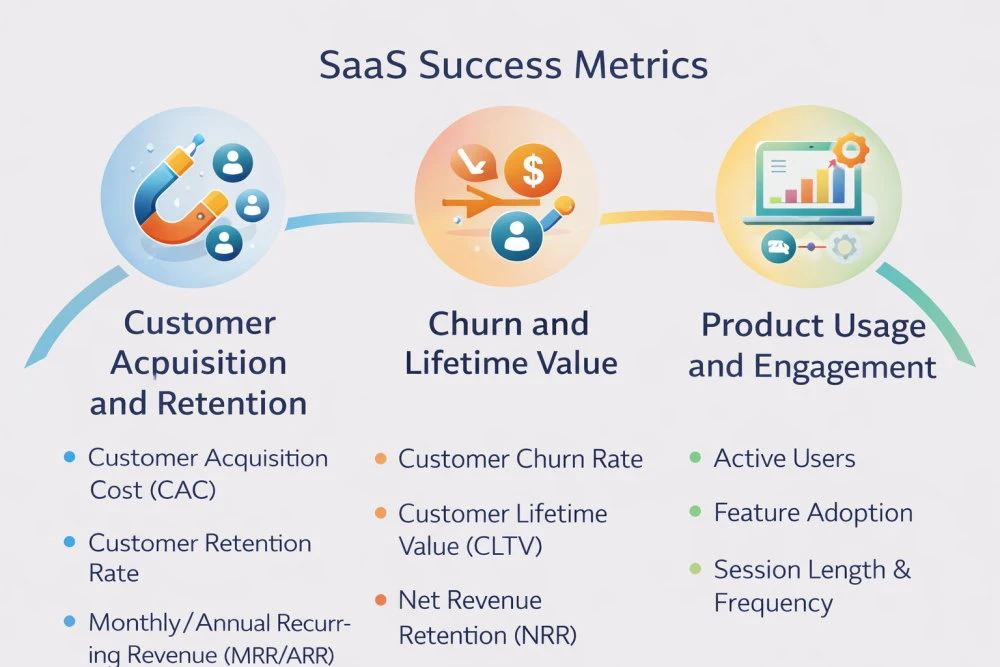
Leadership teams require a clear, disciplined view of performance signals that link customer behavior, revenue durability, and platform reliability. In case the coherence is missing, decision-making drifts into a reactive mode, brought in by short-term symptoms, and gradually loses connection to actual product performance.
Customer Acquisition and Retention
Customer acquisition metrics reveal how efficiently the business converts market demand into paying users. Cost of acquisition, onboarding completion rates, and time-to-value help leaders evaluate whether growth is sustainable. Retention metrics are equally vital to track, as recurring revenue depends on customers continuing to extract value over time. A SaaS product that acquires users quickly but fails to retain them signals misalignment between positioning, product capabilities, and customer expectations.
Churn and Lifetime Value
Churn serves as a direct indicator of product-market fit and operational quality. An upward trend in churn typically reflects usability friction, performance degradation, or unmet customer expectations, rather than short-term competitive pressure alone. Lifetime value provides context by measuring the total revenue a customer generates over their relationship with the platform. Leaders should evaluate churn and lifetime value together to determine if growth efforts are compounding value or simply replacing lost customers at increasing cost.
Product Usage and Engagement
Usage and engagement metrics show if customers are integrating the product into their daily workflows. Active usage frequency, feature adoption patterns, and depth of engagement provide early signals of retention risk or expansion opportunities. From a leadership perspective, such metrics guide prioritization decisions by highlighting which capabilities deliver measurable value and which create friction or go unused.
Technical Metrics Executives Should Still Monitor
While executives do not manage systems directly, certain technical metrics have strategic implications. Uptime, response times, incident frequency, and deployment stability influence customer trust and support costs. Infrastructure spend relative to revenue impacts margins and scalability. It’s essential to monitor these indicators at a high level and ensure that operational health supports future elaboration objectives.
Common SaaS Development Mistakes Decision-Makers Make
Many SaaS products fail for a common reason: early leadership decisions that set the wrong constraints long before engineering issues appear. These mistakes are caused by early optimism, launch pressure, or flawed assumptions about how SaaS businesses operate in practice. Early recognition of the following patterns helps leaders make more responsible strategic choices that help avoid rework and maintain structural integrity as the platform grows.
Overbuilding Before Validation
One of the most widely made mistakes is investing heavily in features before validating real customer demand. Extensive roadmaps and complex functionality may, in fact, appear to reduce market risk, but they often delay learning and inflate costs. Without real usage data, teams build based on assumptions rather than evidence. Such approaches commonly lead to bloated architectures that are costly to operate and slow to adapt when expectations prove inaccurate.
Ignoring Scalability Early
Scalability is frequently treated as a future problem, addressed only after traction appears. While premature optimization is risky, ignoring scalability entirely creates hidden technical debt. Core decisions around data models, tenant isolation, and deployment processes are difficult to reverse later. When growth arrives, systems built without scalability in mind tend to fail under load, forcing disruptive and expensive architectural modifications.
Underestimating Operational Complexity
Running SaaS-based products as reliable services requires sustained operational effort that many organizations underestimate early on. Consequently, monitoring, incident response, security patching, customer support, and compliance activities require continuous, structured attention. When these responsibilities lack proper planning or resourcing, engineering teams have to shift into reactive mode, and product velocity degrades under mounting operational load.
Treating SaaS as a One-Time Project
Perhaps the most damaging misconception is viewing SaaS application development as a project with a defined end date. In reality, launch marks the beginning of the most resource-intensive phase. Successful SaaS companies plan for well-structured, regular improvement, enhancing infrastructure, and long-term maintenance. Therefore, considering SaaS as a one-time build leads to underinvestment after launch and undermines both customer trust and long-term growth.
What Happens After Launch
Launch is a turning point in the SaaS software development lifecycle, after which customer adoption intensifies technical, operational, and business demands. The post-deployment phase determines whether a product stabilizes and scales efficiently or accumulates compounding friction that hinders growth.
Continuous Development Model
After launch, development redirects from feature delivery to continuous improvement. Customer feedback, usage data, and operational signals drive prioritization. Teams must balance new functionality with refinements to usability, performance, and reliability. SaaS updates are deployed frequently and impact all active users, requiring disciplined release processes, testing, and rollback strategies. Continuous development sustains innovation and preserves market relevance as competition intensifies.
Infrastructure Scaling Decisions
Rising adoption requires infrastructure to scale capacity without compromising performance or driving disproportionate cost growth. Effective scaling requires optimizing data access paths, improving caching efficiency, and adopting more resilient deployment practices. Poorly planned scaling leads to disproportionate infrastructure spend or fragile systems. SaaS operationally mature engineers should track capacity, performance boundaries, and cost efficiency to ensure technical changes facilitate expansion reliably and smoothly.
Balancing Speed, Stability, and Cost
Post-launch outcomes of SaaS software development are also impacted by how well trade-offs are managed. Rapid iteration accelerates learning and feature adoption, but excessive speed can compromise stability. Excessive reliability engineering can slow delivery velocity and drive disproportionate infrastructure and operational costs. Leadership must define clear priorities and acceptable risk thresholds, guiding teams to optimize for sustainable progress across delivery speed, system stability, and cost efficiency. SaaS growth emerges when these dimensions are balanced through informed execution decisions and consistent operational discipline.
Conclusion
SaaS application development should be considered an ongoing business strategy with ongoing operational and financial implications. Time-to-market remains one of the highest priorities, yet decisions made too quickly often lock in structural constraints that only surface as the product scales. Architecture, security, pricing, and operational design are tightly coupled to commercial outcomes, and pulling them apart compromises both scalability and long-term sustainability.
Successful SaaS companies prioritize in-depth alignment between the business model, technical foundations, and customer expectations, enabling products to progress without expensive modifications. Leaders who invest in durable systems, realistic operating models, and the right execution partners secure flexibility that endures through scale.
Managing SaaS product development as a continuously running business strengthens competitive positioning. Reliable scaling, customer retention, and long-term growth come from disciplined strategic execution. If you are planning or scaling a SaaS product, talk to PLANEKS representatives to review your architecture, cost model, and scalability risks before they turn into expensive constraints.