
API (Application Programming Interface) data integration is a business capability that materially impacts efficiency, scalability, and competitive positioning. In a nutshell, API data integration is a structured approach that enables software systems to exchange data in real-time, allowing applications, platforms, and services to function as a cohesive operational ecosystem.
The growth of API implementation is quite measurable. A recent global survey by McKinsey & Company found that 88% of respondents believe APIs have become more important over the past two years, while 81% now consider APIs a priority for both business and IT functions. Large organizations are backing this priority with investment, allocating an average of 14% of their total IT budgets to API programs.
For stakeholders and entrepreneurs, the value of API data integration helps remove friction from business processes that were never designed to scale. Manual transfers, CSV exports, duplicated entries across systems, and delayed reporting introduce hidden operational costs that compound as transaction volumes grow. APIs enhance fragile workflows by introducing automated, continuously running data flows that operate reliably without human intervention.
In this article, we focus on API data integration from a practical business perspective, explaining not only how it technically works but also why it is extremely valuable commercially. Our objective lies in helping business owners, tech leaders, and executives comprehend where APIs deliver real operational value, how they support automation and scalability, and what trade-offs should be considered before investing in integration projects.
In digital environments, API data integration enables businesses to synchronize customer data between CRM and marketing platforms, connect payment systems with accounting tools, pull real-time inventory levels into sales channels, or consolidate analytics across multiple data sources. In these terms, integrations cut operational overhead, improve data accuracy, and create a centralized source of truth that leadership can rely on for their performance. Instead of reacting to outdated reports, teams gain access to current, decision-grade data that represents what is actually happening in the business.
Just as importantly, APIs are a prerequisite for scalability. Companies adopt new tools, enter new markets, or expand digital services, requiring the ability to integrate systems quickly. Here, well-designed interconnections can adapt faster, automate more aggressively, and establish new revenue models without constantly rebuilding internal processes. In this sense, API data integration is an investment in operational resilience, long-term growth, and decision-making grounded in reliable data.
Table of Contents:
What Does API Data Integration Mean?
API data integration is often described in overly technical language, which obscures its real purpose for business leaders. When it comes to practical terms, it describes how information flows between systems across the organization and how consistently that data is shared and used.
What an API Is in Business Terms
From a business perspective, an API is a standardized model for one system to request specific data or trigger an action in another system, automatically and on demand. It serves as a formal agreement that defines what information can be shared, under what conditions, and in what format. For instance, a sales platform can request up-to-date pricing from a billing system, or a reporting tool can retrieve real-time performance metrics from multiple applications. The key point is that these interactions happen system-to-system, without manual steps, and are designed to be reliable, repeatable, and secure.
How API Data Integration Differs From Manual Data Handling
Manual data handling relies on exports, spreadsheets, scheduled uploads, or human input to move information between tools. Such processes are inherently slow and error-prone, and they create data delays that undermine decision-making. API data integration replaces batch-based processes with cohesive, API-based data exchange. Systems stay coordinated as events occur, reducing reconciliation work and ensuring that teams operate on current, consistent data.
Common Misconceptions About APIs
A frequent misconception is that APIs are only relevant for large enterprises or highly technical products. However, in reality, most cutting-edge, leading business platforms already expose APIs as a standard feature. Another misunderstanding is that API integration always requires building complex custom software. In fact, effective integration is about connecting existing systems in a structured, maintainable way to support automation, scalability, and long-term operational efficiency.
When API Data Integration Makes Sense for Small and Growing Businesses
API data integration is most effective when it handles concrete operational setbacks or streamlines particular flows rather than being introduced as a forward-looking technical upgrade. For small and growing businesses, the critical question is not whether APIs are useful in theory, but whether current processes are creating friction that limits growth, visibility, or reliability.
Business Processes That Benefit Most From API Integration
Processes that engage frequent data exchange across systems are the strongest candidates for API integration. This typically comprises sales operations that depend on accurate customer and order data, finance workflows that require consistent synchronization between payments and accounting, and marketing activities that rely on real-time performance and attribution data. When transaction volume increases, these areas may be difficult to manage manually, making automated data flows essential to maintain accuracy and speed.
Early Signs That Manual Workflows Are Holding Growth Back
Manual workflows often fail gradually, which makes their impact easy to underestimate. Common warning signs you may catch include teams spending excessive time reconciling reports, conflicting numbers appearing in different systems, delays between customer actions and internal updates, and growing dependence on spreadsheets to bridge system gaps. In case the operational decisions process outdated or incomplete data, the business starts reacting instead of executing proactively.
When Integration Is Premature or Unnecessary
Not every business needs API integration immediately. If operations are simple, data volumes are low, and systems rarely need to share information, manual workflows may still be sufficient. Integration also becomes premature when processes themselves are unstable or poorly defined. In such cases, automating inefficiency only amplifies existing problems. API data integration delivers the most value once workflows are precise, repeatable, and ready to scale.
Common Use Cases of API Data Integration in Small Businesses
API data integration becomes tangible when viewed through specific operational scenarios. For small businesses, the most impactful integrations are typically those that reduce manual coordination between core systems and provide more in-depth visibility into day-to-day performance. The use cases share a crucial goal: ensuring that data flows reliably between tools that were never designed to operate separately.
CRM and Sales Tools
Sales teams rely on accurate, current customer data to prioritize leads and close deals efficiently. Therefore, API data integration allows CRM systems to automatically receive updates from websites, product platforms, or customer support tools, ensuring that sales pipelines reflect real customer activity. This way, teams can eliminate delays caused by manual data entry and minimize the possibility of pursuing outdated or incomplete opportunities.
Accounting and Payment Systems
Financial accuracy depends on consistent synchronization between payment processors, invoicing tools, and accounting software. Through API data integration, transactions can be recorded automatically as they occur, reducing reconciliation effort and improving financial visibility. Business owners can obtain near-live cash flow insight without relying on end-of-month adjustments.
Marketing Platforms and Analytics
Marketing effectiveness heavily depends on timely, consolidated data from multiple channels. API data integration extracts performance metrics from advertising platforms, email tools, and web analytics to be pulled into a unified reporting layer. Campaign performance becomes highly transparent, giving stakeholders the context they need to act on current results and adjust strategy in real time.
Inventory, Logistics, and Order Management
For businesses that manage physical goods, inventory accuracy directly impacts prosperity. API data integration ensures that orders, stock levels, and shipment statuses stay aligned across sales channels, warehouses, and logistics providers across the supply chain. Overselling, fulfillment delays, and manual coordination are reduced when order volumes grow.
Internal Reporting and Dashboards
The reliability of internal dashboards depends entirely on data quality. APIs enable automated details retrieval from multiple systems into centralized reporting tools, providing leadership with consistent, decision-ready insights. It enables consistent planning decisions by removing manual report preparation from the workflow.
Key Business Benefits of API Data Integration
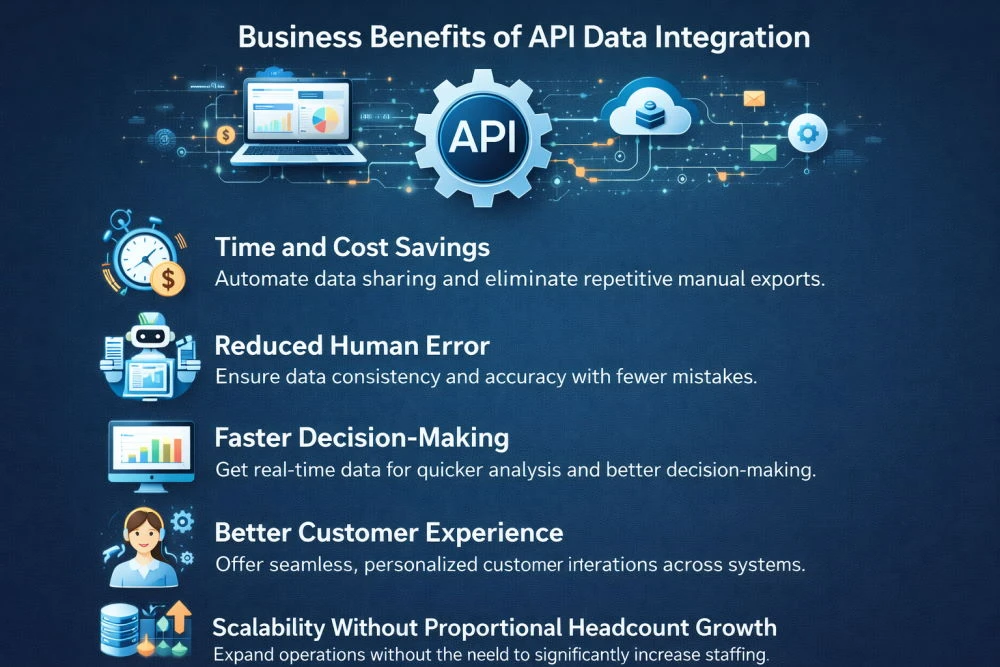
API data integration delivers value not through technical sophistication, but within measurable business outcomes. When systems exchange data automatically and consistently, organizations reduce operational friction and gain the structural capacity to grow without constant process redesign. For small and mid-sized businesses, such benefits bring a positive impact on profitability, resilience, and customer satisfaction.
Time and Cost Savings
Automated data exchange eliminates repetitive manual tasks such as exporting files, reconciling records, and re-entering information across systems. Over time, these efficiencies deliver lower operational costs and a more productive use of internal resources. Monoscope data shows that API-driven automation can reduce operational costs by up to 15%, while businesses that actively use APIs are 24% more likely to be profitable than those that don’t. The practical effect is apparent: teams spend less time maintaining data consistency and manual workflows, and more time focused on revenue-generating and strategic initiatives that directly support growth and employee productivity.
Reduced Human Error
Manual data handling introduces errors through duplication, omissions, and inconsistent formatting. API integrations enforce standardized structures and automated validation, significantly reducing the likelihood of discrepancies. In fact, studies show that automated data entry systems can be up to 100 × more accurate than manual processes, where humans make roughly 100-400 errors per 10,000 entries compared with just 1-4 errors for automation at the same scale. This leads to cleaner datasets, more reliable reports, and less time spent correcting mistakes. As a result, systems remain aligned, reports become more reliable, and operational risk is reduced across critical business functions.
Faster Decision-Making
Up-to-date or near-real-time data access enables leaders to make decisions based on current conditions, supported by validated data flows and a consistent system state. API-based integrations ensure that performance metrics, financial indicators, and operational data are continuously updated, allowing businesses to respond faster to market changes and internal performance signals. Organizations that leverage real-time data analytics can improve decision-making speed by up to 30% compared with slower, traditional reporting cycles, enabling faster reactions to leading-edge trends and challenges.
Better Customer Experience
When systems are synchronized, customer-facing processes become more responsive and consistent. Orders are processed accurately, account information stays up to date, and support teams have immediate access to relevant data. This reduces friction in customer interactions and builds trust through reliability. Research from Forbes shows that companies that lead in customer experience outperform laggards by nearly 80%, meaning that consistent, data-driven interactions directly ensure stronger commercial performance.
Scalability Without Proportional Headcount Growth
As transaction volumes increase, manual workflows scale poorly. API data integration allows businesses to handle higher demand without adding equivalent staff, supporting sustainable growth while keeping operational complexity under control. As per SSRN, APIs and data networks can increase operational efficiency by around 12% while also streamlining costs, meaning your business can do more with the same resources.
API Integration Options
API data integration can be implemented through different approaches, each offering a distinct balance between speed, flexibility, and long-term control. Choosing the right option depends on business complexity, data sensitivity, and how critical the integration is to core operations.
No-Code Tools
No-code integration tools are designed to connect popular platforms with minimal setup and no programming effort. They offer a straightforward answer to how to integrate company data into CRM using API, covering common, event-driven workflows such as syncing leads from a website into a platform or pushing payment confirmations into an accounting tool. However, no-code tools become limiting when integrations require complex logic, custom data transformations, or strict performance guarantees. They also introduce dependency on third-party platforms, which can constrain scalability and reduce control over data handling as systems and volumes grow.
Low-Code Platforms
Low-code platforms offer a middle ground, enabling custom logic while accelerating development. They are suitable for businesses that need more flexibility than no-code tools can offer but do not require fully bespoke architectures. Low-code solutions support conditional workflows, moderate data processing, and integration across a wider range of systems, though they still impose structural limits that may surface as the business scales.
Custom API Integrations
Custom API data integration is a purpose-built solution designed around specific business workflows and data models. They offer full control over performance, security, and scalability in cloud environments, making them suitable for mission-critical processes. The trade-off is higher upfront investment and longer implementation timelines, offset by greater long-term adaptability.
Balancing Speed, Flexibility, and Control
Every integration approach involves trade-offs. Faster, templated solutions accelerate time-to-deployment but limit customization, while fully custom integrations require more planning and investment but provide durable, scalable infrastructure. The right choice aligns integration depth with operational risk, data complexity, and a long-term growth strategy, not short-term convenience.
API Data Integration Process
Successful API data integration is less about individual technical steps and more about following a disciplined, outcome-powered process. A structured and established workflow helps set realistic expectations around timelines, costs, and organizational involvement, while reducing the risk of integrations that fail to deliver business value.
Defining Business Requirements
Every effective data integration using API starts with a comprehensive view of the business problem it is meant to handle. For instance, this may be identifying which processes need automation, what data must be exchanged, how frequently updates are required, and which teams rely on the outcome. In case profound requirements are missing, integrations often optimize technical details while lacking operational priorities.
Evaluating APIs and Data Sources
Once requirements are defined, relevant APIs and data sources must be assessed for reliability, documentation quality, data completeness, and security controls. Not all APIs are equally mature, and drawbacks such as rate limits, data freshness, or missing endpoints can directly affect feasibility and long-term maintainability.
Designing Data Flows
At this stage, teams define how data moves between systems, including transformations, validation rules, and error handling. Well-designed data flows ensure consistency across platforms and prevent downstream issues caused by mismatched formats or incomplete records.
Implementation and Testing
Implementation implies building the integration logic and validating it under real-world conditions. Testing focuses not only on correctness, but also on performance, edge cases, and failure scenarios to ensure the integration behaves predictably as workloads grow.
Monitoring and Maintenance
After deployment, integrations require ongoing monitoring to detect failures, API changes, or performance degradation. Regular maintenance and a disciplined API management ensure data reliability over time and protect business operations from silent integration breakdowns.
Cost, Timeline, and Complexity: What to Expect
API data integration projects frequently fail during planning as a result of underestimated costs, effort, and long-term ownership requirements. For decision-makers, the focus should be on understanding the factors that drive complexity and how integration investments change over time. Meticulously designed upfront expectations are the guaranteed means to avoid budget overruns and post-launch operational disruption.
Factors That Influence Integration Cost
The cost of data integration using API is shaped primarily by data complexity, the number of systems involved, and the quality of the solution being integrated. Well-documented, stable APIs with clear data models reduce development effort, while fragmented systems, inconsistent schemas, or restrictive rate limits increase implementation time. Security requirements, compliance constraints, and the need for custom transformations also materially affect cost.
One-Time vs Ongoing Expenses
It’s essential to note that the initial implementation is only part of the total investment. One-time costs typically include design, implementation, and testing, while ongoing expenses cover monitoring, API usage fees, maintenance, and updates driven by external API changes. Decision-makers should plan for continuous ownership and avoid treating integration as a one-off project.
Typical Timelines for Small Business Integrations
For small businesses, simple integrations using existing platforms can be delivered in weeks, while more customized or multi-system integrations may take several months. Timelines depend less on company size and more on clarity of requirements, data readiness, and the maturity of external APIs.
Hidden Costs Decision-Makers Overlook
Commonly unobvious, hidden outgoings include internal coordination time, data cleanup before integration, and the effort required to handle edge cases and failures. Additional costs often arise from building and maintaining retry logic, monitoring, and alerting to ensure integrations behave predictably under load and during partial outages. Besides, changes to external APIs, including version deprecations and schema updates, also require continuous engineering effort.
We’ve prepared some rough figures that are indicative and vary based on data volume, API maturity, security requirements, compliance constraints, and long-term ownership expectations.
| Integration scope | Typical timeline | One-time cost range | Ongoing monthly cost | Complexity level |
| Simple point-to-point integration (2 systems, standard APIs) | 2-4 weeks | $3,000 – $8,000 | $200 – $600 | Low |
| Multi-system integration (3–5 systems, moderate logic) | 1-3 months | $10,000 – $25,000 | $600 – $1,500 | Medium |
| Custom integration with transformations & validations | 2-4 months | $25,000 – $50,000 | $1,500 – $3,000 | Medium–high |
| Mission-critical integration (high volume, strict reliability & security) | 3-6+ months | $50,000+ | $3,000+ | High |
To obtain in-depth cost, timeline, and complexity estimates tailored to your systems, you can speak directly with PLANEKS integration specialists. Our team estimates your specific business context and system constraints, providing accurate projections grounded in real production experience.
Security, Reliability, and Data Privacy Considerations
API data integration directly affects how sensitive business information is accessed, transmitted, and stored. For executives, security and reliability are not technical details but risk management concerns with legal, financial, and reputational implications. Handling the following considerations early is necessary to ensure integrations operate reliably when scale increases.
Data Access and Permissions
APIs operate on controlled access models that define exactly what data can be read or modified. Proper integration design enforces the principle of least privilege, ensuring systems and services have access only to the data they require. Limiting access reduces exposure in the event of compromised credentials and strengthens internal governance over sensitive information.
API Reliability and Uptime Risks
An integration’s operational reliability is governed by the behavior and availability of the APIs it relies on. External API outages, rate limiting, or unexpected behavior can disrupt downstream operations if not handled correctly. Resilient integrations include retry mechanisms, graceful degradation, and alerting to prevent silent failures from impacting critical business processes.
Compliance and Regulatory Requirements
For businesses operating in regulated environments, API integrations must align with data protection and security frameworks such as the General Data Protection Regulation (GDPR), which governs the processing and storage of personal data in the EU; the California Consumer Privacy Act (CCPA) and California Privacy Rights Act (CPRA), which define consumer data rights in the United States; Health Insurance Portability and Accountability Act (HIPAA) requirements for protected health information; and Payment Card Industry Data Security Standard (PCI DSS) controls for handling cardholder data. Depending on the industry, integrations may also need to comply with ISO/IEC 27001 (ISO 27001) for information security management and Service Organization Control 2 (SOC 2) standards for system security, availability, and confidentiality.
These compliance requirements mandate responsible data handling, support for access and deletion requests, strict access controls, and assurance that third-party vendors meet defined security standards. Integration architecture plays a direct role in enabling or constraining an organization’s ability to meet these obligations consistently.
Vendor Dependency and Lock-In Risks
Relying heavily on third-party platforms introduces long-term dependency risks. Proprietary tools or tightly coupled integrations can limit future flexibility and increase switching costs. Careful evaluation of portability, exit strategies, and API maturity helps mitigate vendor lock-in without disrupting operations.
Choosing the Right API Integration Approach or Partner
Selecting how API data integration will be delivered is a vital aspect that affects not only implementation quality but also long-term operational stability, helping businesses choose the best approach for their needs. During the decision process, emphasis should be placed on aligning technical execution with business objectives to ensure engineering work delivers operational efficiency, financial accuracy, and scalable system behavior rather than standalone technical achievements.
In-House vs Outsourced Integration
In-house integration can be effective when internal teams have strong API and data integration experience, as well as sufficient capacity to own both implementation and ongoing maintenance. Nonetheless, this approach often competes with product development priorities. Outsourced integration provides access to specialized expertise and proven delivery processes, minimizing risk for complex or business-critical integrations, provided knowledge transfer and long-term ownership are clearly defined.
Questions to Ask Vendors or Developers
Decision-makers should examine how the proposed solution integrates with existing workflows, supports anticipated growth, and sustains operational resilience over time. Well-defined practices around error handling, monitoring, security controls, and post-launch ownership provide a more reliable signal of solution quality than implementation speed or technology selection.
Red Flags in Proposals or Timelines
Overly optimistic timelines, vague scope definitions, or a lack of discussion around maintenance and failure scenarios signal potential delivery risk. Proposals that concentrate solely on implementation, without adequate consideration for long-term reliability and data governance, should raise concerns about underestimating real-world complexity.
Aligning Technical Solutions With Business Goals
The most effective API integrations are designed around measurable business outcomes. Technical architecture, tooling, and delivery models should be designed around efficiency, scalability, and decision-making needs, ensuring integration investments remain in sync with operational aims as systems and data volumes grow.
Measuring Success: How to Know Your API Integration Is Working
API data integration should be evaluated by the business outcomes it enables. Prevalently, success is defined by measurable improvements in efficiency, reliability, and customer impact. Establishing clear evaluation criteria ensures integrations continue to justify their investment as time passes.
Time Saved and Process Efficiency
One of the most immediate indicators of success is the reduction in manual effort across teams. When API integration and data processing work as intended, routine tasks such as data reconciliation, reporting, and system updates require significantly less human involvement. The reclaimed time can be redirected toward higher-value activities, improving operational efficiency.
Data Accuracy and Availability
Effective API data integration ensures that data is consistent and accessible across systems when it is needed. Fewer discrepancies between platforms, faster access to current information, and reduced reliance on manual validation all signal that integrations are delivering reliable, decision-ready data.
Impact on Customer Experience
Improvements in customer experience often reflect integration success indirectly. Thus, faster order processing, more accurate account information, and quicker support resolution indicate that internal systems are coherent and responsive. Such improvements make customer interactions pleasant, straightforward, and enhance perceived reliability.
ROI Indicators for Small Businesses
Return on investment within API and data integration can be assessed through reduced operational costs, faster decision cycles, and the ability to scale without proportional increases in headcount. Integration delivers measurable business value when it supports growth without increasing operational and architectural complexity.
A great example of tangible integration ROI comes from Spontivly, a US-based data analytics platform built to consolidate insights from fragmented community and marketing tools. The platform integrates with 120+ external systems, including Slack, Zoom, LinkedIn, Discord, Eventbrite, and Telegram, bringing thousands of data points into customizable dashboards updated instantly.
Following implementation, Spontivly customers achieved 50% faster automation workflows, reduced manual data management, and gained access to 1,000+ structured data points across teams without increasing operational headcount. The system now supports 70+ growing organizations, enabling scalable reporting, faster decision cycles, and consistent data visibility across departments.
Common API Integration Mistakes Decision-Makers Make
API data integration initiatives tend to fail not because of technical shortcomings but because of strategic missteps at the decision-making level. As a business owner, you should be acquainted with these common mistakes to avoid investments that increase complexity without delivering meaningful business value.
Automating Broken Processes
One of the most frequent errors is integrating systems before underlying processes are clearly defined or optimized. Automating inefficient workflows only accelerates existing problems, making them harder to diagnose and correct later. Integration should elevate well-structured operations, but not compensate for unclear ownership or inconsistent processes.
Overengineering Simple Needs
Another common bottleneck is selecting overly complex solutions for relatively straightforward requirements. Custom architectures, excessive tooling, or unnecessary data processing layers do nothing more than increase costs and the maintenance burden without providing a proportional benefit. In some cases, concise integration approaches often deliver faster value when requirements are limited and stable.
Ignoring Long-Term Maintenance
Many integration projects are scoped as one-time efforts, with insufficient attention paid to ongoing ownership. APIs progress, data models change, and business requirements shift over time. Consequently, failing to plan for monitoring, further updates, and support leads to brittle integrations that degrade silently.
Choosing Tools Based on Trends, Not Fit
Technology trends and popular platforms often influence integration decisions more than actual business needs. When tools are selected without careful consideration of architectural fit and operational constraints, friction with existing systems is almost inevitable. Sustainable integration strategies avoid novelty-driven choices and instead prioritize system compatibility, reliability, and long-term operational value.
Conclusion
API data integration is most effective when treated as a strategic opportunity with defined business goals and long-term impact. That perspective matters most as APIs move from peripheral infrastructure to central elements of application and data architecture. The global API market has already surpassed $269 billion by 2025 and is projected to exceed $420 billion by the early 2030s, as per Cognitive Market Research.
When coordinated with well-described business objectives, API integration and data processing reduce operational friction, strengthen data reliability across systems, and enable faster, more confident decision-making. For growing businesses, APIs form the foundation for automation and scalability without proportional increases in complexity or headcount. Approached deliberately, API and data integration provide a solid, adaptable growth layer when volumes, integrations, and business requirements continue to grow.
Looking to extract real business value from your API integrations?
Reach out to PLANEKS for expert consultation and high-quality API integration services delivered by engineers with deep experience in building reliable, scalable data ecosystems. We focus on aligning integrations with practical business objectives and use cases, making sure every API delivers maximum value to your operations as your systems and data volumes grow.