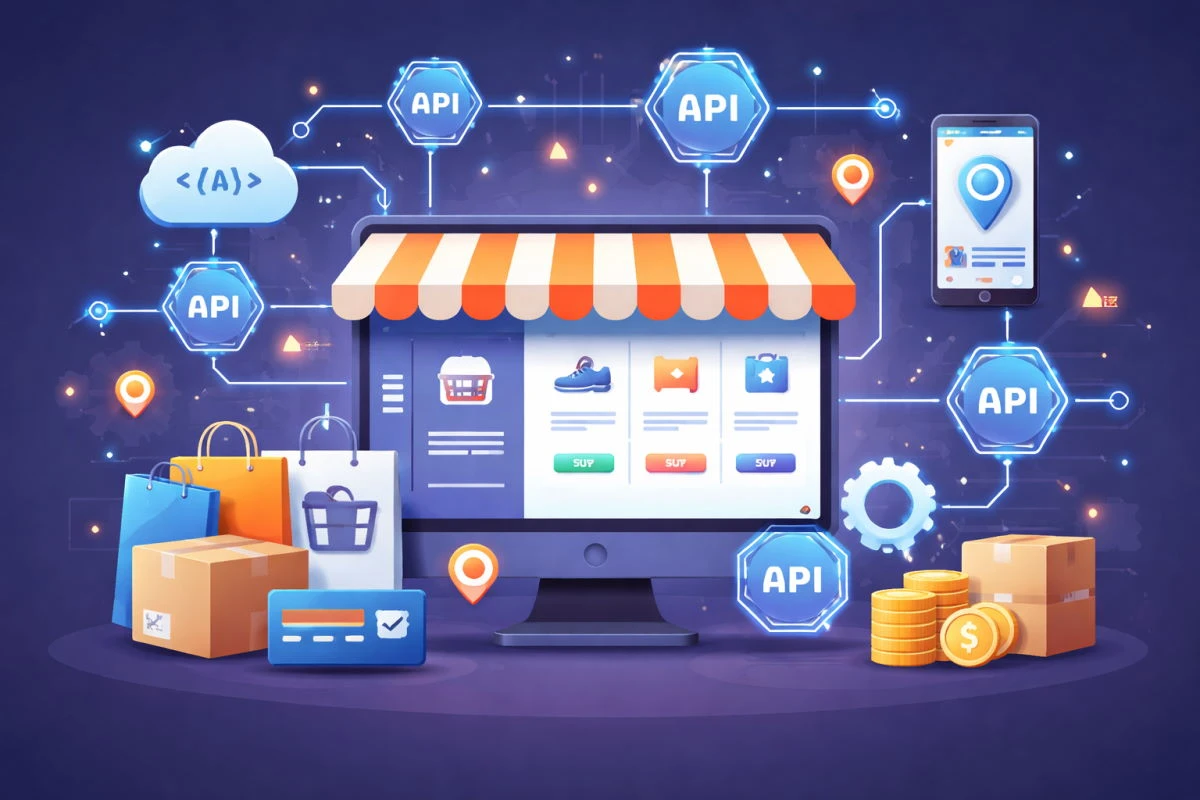
Modern eCommerce in 2026 runs on a distributed stack of specialized services. In these terms, Application Programming Interfaces (APIs) serve as the integration layer that connects the storefront with payment gateways, logistics and fulfillment providers, inventory systems, and analytics tools. Each component can grow standalone, while the overall system continues to operate as a single, reliable commerce workflow, even when the services come from different vendors. In practice, according to The State of Headless, 73% of businesses now operate on a headless (API-driven) commerce architecture, meaning that modular, API-centric eCommerce isn’t niche anymore but is approaching mainstream adoption.
Online stores expand across markets, sales channels, and customer touchpoints, and large all-in-one platforms start to slow things down. Changes take longer, integrations get messy, and technical debt builds up fast. Here, APIs can significantly ease that pressure by allowing teams to adjust, replace, or scale individual parts of the system without affecting the rest. As a result, most high-performing eCommerce teams now run on a set of focused APIs rather than relying on a single, “oversized” platform. This guide explains the essential eCommerce APIs every modern store depends on.
Table of Contents:
What Are eCommerce APIs?
eCommerce API integration is a structured interface that allows online stores to exchange data and trigger actions across systems in a predictable, secure way. It interconnects core commerce platforms with external services such as payments, shipping, tax calculation, inventory management, and customer data tools, without hardwiring each flow into a single application. Instead of forcing all functionality into one platform, APIs let each system do its job efficiently and stay loosely coupled. This approach has made API-first, composable commerce the default for modern eCommerce teams, supporting faster changes, cleaner integrations, and long-term scalability without constant replatforming or fragile custom code.
If you are interested in a deeper breakdown of the budget required for your specific case, feel free to use the API cost calculator. This tool enables you to estimate development and integration costs based on your specific technical requirements and architecture choices. You can receive a detailed estimate by email or book a free consultation to discuss cost optimization strategies before committing to implementation.
Product & Catalog Management APIs
Product and catalog management APIs are responsible for handling products, variants, attributes, pricing logic, and inventory data in a centralized and structured way.
They enable eCommerce systems to expose catalog data programmatically, ensuring that storefronts, marketplaces, search services, and internal tools all access the same source of truth. Implementing such APIs reduces duplication, minimizes inconsistencies, and enables growing catalog structures without tightly coupling business logic to the front end.
In practice, these APIs are employed to synchronize product data across multiple sales channels, support regional assortments and pricing strategies, and manage large catalogs with thousands or even millions of SKUs. As a result, frequent updates such as stock changes, price adjustments, and attribute enrichment can be handled without introducing latency or operational overhead.
API examples
The Shopify Storefront API is often used in headless setups to expose product data to custom frontends while Shopify remains the system of record on the backend. When it comes to stores with large or complex catalogs, the BigCommerce Catalog API provides stronger control over product relationships, variants, and bulk updates, which makes it well-suited for multi-channel operations. Built for fully composable commerce, the commercetools Product API goes a step further, offering flexible data models that support advanced pricing logic, localized catalogs, and deep integration with external systems.
Order Management APIs
When it comes to order management APIs, they coordinate the creation, updating, fulfillment, and resolution of orders after checkout. They sit between the storefront, payment systems, warehouses, and customer support tools, ensuring that order data remains accurate as it moves through its lifecycle. In distributed eCommerce environments, these APIs are critical for keeping fulfillment workflows reliable and auditable.
The primary purpose of order management APIs is to handle order creation, status changes, fulfillment events, and post-purchase operations such as returns and refunds. They provide a consistent interface for tracking order state across systems without manual reconciliation.
API examples
The Shopify Order API provides real-time order updates and makes it easier to connect with fulfillment partners as orders move through the system. For WordPress-based stores, the WooCommerce REST API offers a flexible way to manage orders while staying close to the site’s existing architecture. Magento Order Management APIs are another option built to support complex fulfillment scenarios, comprising multi-warehouse operations and distributed inventory workflows.
Payment Processing APIs
Payment processing is the most sensitive part of the eCommerce flow, so these types of APIs are tasked with securely authorizing, capturing, and settling transactions. They connect storefronts with banks, card networks, and alternative payment providers while enforcing security, compliance, and fraud controls. Within modern architectures, they operate as isolated, well-audited services, not embedded checkout logic.
As their name suggests, payment APIs are accountable for processing purchases with high safety and resilience, supporting card transactions, digital wallets, and recurring billing models without exposing sensitive data to the application layer.
To select and integrate the right payment gateway without introducing operational or security risks, it’s best to consult with API developers for hire who have hands-on experience designing and implementing production-grade payment integrations.
API examples
The Stripe Payments API is commonly used to build flexible payment flows and subscription models. For stores that rely on wallet-based transactions and have broad international coverage, the PayPal REST API provides a familiar, trusted option. At the enterprise end of the spectrum, the Adyen Checkout API supports large-scale payment processing across multiple regions, currencies, and payment methods within a single integration.
For EuropaFoodXB, our PLANEKS team has successfully integrated Opayo as the payment layer for their UK eCommerce store build, so checkout could support modern wallet payments like Google Pay and “saved cards” for returning customers. In practice, that means a shopper can securely save a card on their first purchase (as a token, not raw card data). On the next order, they simply pick the saved card from their account and pay without re-entering details, which speeds up repeat purchases and makes the entire procedure even more handy.
Shipping & Fulfillment APIs
Shipping and fulfillment eCommerce API connects platforms with carriers, warehouses, and last-mile delivery services. This type enables stores to dynamically calculate shipping options, automate fulfillment tasks, and keep customers informed regarding each step of the delivery process. In multi-region or high-volume operations, these APIs reduce manual handling and help standardize logistics workflows across partners.
The main purpose of shipping API integration is to calculate rates, manage deliveries, and coordinate fulfillment events programmatically. Therefore, delivery logic remains accurate even as carrier rules, pricing, and service levels change.
API examples
The Shippo API simplifies shipping by giving stores access to multiple carriers through a single integration, covering rate calculation, label generation, and tracking. In case your teams need stable shipment workflows and accurate address validation, the EasyPost API offers a dependable alternative. When direct carrier integration is required, the FedEx Web Services API allows enterprises to connect straight to FedEx for shipping operations and end-to-end tracking.
A more operationally focused instance worth attention is the Veeqo Shipments API, which we’ve integrated for our eCommerce clients to streamline order creation and fulfillment across multiple couriers. There’s no need to manually create shipments or manage separate carrier integrations. Orders placed on the website are automatically pushed to the relevant courier through a single API flow. Therefore, hands-on work is removed, consequently minimizing the risk of fulfillment errors when order volume grows.
Mentioning user benefits, such an integration introduces higher transparency and control levels. Each order is tied to a shipment status that reflects its real position in the delivery lifecycle: created, dispatched, in transit, or delivered. Customers can easily check the stage of their order, while internal teams get a consistent, comprehensive view of shipments across carriers such as Royal Mail, UPS, DHL, FedEx, DPD, and others. When a specific carrier isn’t supported, the API still allows fallback handling via a generic “Other” carrier, so the workflow remains uninterrupted.
Technically, the Shipments API aims to provide the orchestration layer between the store and multiple courier services. It centralizes shipment creation, carrier assignment, and status updates into one predictable interface. As an outcome, businesses can experience a more accurate fulfillment pipeline, faster order processing, and a shipping system that scales without extending operational complexity for either the company or its customers.
Inventory & Stock Management APIs
Real-time visibility into product availability across warehouses, physical stores, and fulfillment partners is critical for accurate inventory and stock management, which is made possible through dedicated inventory and stock management APIs. They introduce an optimized coordination layer between sales channels and physical stock, preventing overselling and enabling accurate fulfillment decisions. Businesses operating across online and offline channels adopt these APIs as an essential tool to maintain consistency at scale.
The primary purpose of the inventory eCommerce API is to track stock levels across locations and synchronize availability data wherever products are sold. Inventory updates caused by sales, returns, or restocking are propagated across all connected systems in near real time.
API examples
TradeGecko, now part of QuickBooks Commerce, provides APIs for centralized inventory control and multi-channel synchronization. Designed for vast, complex setups, the NetSuite Inventory API supports enterprise-grade stock management across multiple warehouses. On the omnichannel side, the Square Inventory API extracts and assembles in-store and online stock data together, keeping inventory levels consistent across physical and digital sales channels.
Customer & Identity Management APIs
Customer and identity management APIs define how users are identified, authenticated, and understood across an eCommerce ecosystem. Their aim is to power login flows, account management, and personalization logic, keeping customer data consistent, secure, and accessible across storefronts, mobile apps, support tools, and marketing platforms.
These essential eCommerce APIs handle customer profiles and authentication workflows with a focus on structure, security, and consistency. They centralize identity data, support login and access control, and enable segmentation based on behavior, purchase history, or account attributes without fragmenting customer records across systems.
API examples
The Auth0 API is commonly used to implement secure authentication, single sign-on, and scalable identity management across digital products. If organizations demand stricter security and compliance requirements, the Okta Customer Identity API provides enterprise-grade controls for consumer-facing applications. Within Shopify-based commerce stacks, the Shopify Customer API offers direct access to customer records, supporting account management, segmentation, and personalization use cases.
Pricing, Tax & Compliance APIs
Pricing, tax, and compliance APIs handle the rules that determine how much customers are charged and how transactions align with regional regulations. As eCommerce expands across borders, these rules become too complex to manage manually or hardcode into applications. Dedicated APIs isolate this logic and keep it up to date as laws and pricing models change.
The core responsibility of these APIs is to support dynamic pricing and accurate tax calculation based on location, product type, and transaction context. They ensure compliance with VAT, sales tax, and other regulatory requirements without adding operational risk.
Aside from tax and compliance, our team has also integrated competitor price tracking APIs to support dynamic pricing decisions. Tools like Prisync, Price2Spy, and SerpAPI enable businesses to monitor competitors’ prices in near real time, track market movements, and automatically adjust pricing strategies. From an entrepreneur’s perspective, this means achieving accurate tax calculations, regulatory compliance, and market-aware pricing, without requiring teams to manually track alterations across regions and competitors.
API examples
The Avalara AvaTax API is often used to automate tax calculation and compliance across multiple jurisdictions, especially in complex regulatory environments. For online sellers looking for a simpler setup, the TaxJar API streamlines sales tax calculation and reporting. When tax logic needs to sit directly inside the checkout and billing flow, the Stripe Tax API integrates tax calculation into payment workflows for international transactions.
Search & Recommendation APIs
Search and recommendation APIs for eCommerce directly influence how easily customers find products and how effectively stores guide them toward relevant choices. In large or fast-growing catalogs, basic database queries are no longer sufficient. Dedicated search services optimize discovery, relevance, and personalization in real time, which has a measurable impact on conversion rates and average order value.
The main goal is to support fast, accurate site search and deliver personalized product recommendations based on user behavior, context, and inventory signals. Such APIs decouple discovery logic from the core platform, allowing teams to improve relevance without reworking backend systems.
API examples
Fast, low-latency product discovery is a key reason teams choose the Algolia Search API, especially when relevance tuning directly affects conversion. For more advanced use cases, the Elasticsearch API offers deep customization for search behavior and analytics across large or complex catalogs. Taking discovery a step further, the Bloomreach Discovery API seamlessly merges search with AI-driven recommendations that adapt to individual shopper behavior.
Marketing, Analytics & CRM APIs
Marketing, analytics, and CRM APIs provide the visibility needed to understand how customers interact with an online store and how those interactions translate into revenue. They connect behavioral data, campaign activity, and customer records into systems that support measurement, attribution, and long-term relationship management rather than isolated metrics.
This type’s APIs for eCommerce track performance and customer behavior across channels, enabling data-driven marketing, lifecycle management, and reporting. They allow teams to automate data flows between commerce platforms, marketing tools, and internal dashboards without manual exports.
API examples
Accessing performance data at scale is handled through the Google Analytics Data API, which allows teams to analyze traffic and conversion metrics programmatically. Customer lifecycle insights and sales alignment come from the HubSpot CRM API, connecting marketing and revenue data in one system. Retention workflows are driven by the Klaviyo API, which reacts to real-time commerce events to power targeted email and lifecycle campaigns.
Headless Commerce & Frontend APIs
Headless commerce and frontend APIs reflect a broader shift toward decoupled architectures, where the user experience evolves independently from backend commerce logic. Instead of binding presentation and business rules together, these APIs allow teams to build faster, more flexible customer interfaces while keeping core commerce services stable and reusable.
Headless commerce APIs are intended to separate frontend experiences from backend systems. Their aim is to expose commerce and content capabilities through APIs, enabling custom web, mobile, and in-store experiences without duplicating business logic or data models.
Why headless commerce APIs are growing in 2026
As part of the latest API trends and tendencies, headless adoption continues to progress since it enhances rapid iteration, multi-channel delivery, and performance optimization without requiring replatforming core systems. This approach can become highly beneficial for brands operating across regions, devices, and touchpoints.
API examples
A fully composable commerce backend is what the commercetools API is built around, exposing core commerce logic entirely through APIs. Shopify Hydrogen APIs take a frontend-first approach, enabling custom storefronts while Shopify continues to manage commerce operations behind the scenes. Content delivery is handled separately through the Contentful Content API, which distributes structured content to any frontend without tying it to a specific commerce platform.
AI & Automation APIs for eCommerce
AI and automation APIs for eCommerce are increasingly used to move operations beyond rule-based logic and manual optimization. They enable systems to learn from data, adapt in real time, and scale decision-making across customer experience, merchandising, and operations without adding headcount or complexity.
AI and automation APIs heavily support personalization and operational automation at scale. Their use cases span conversational support, intelligent product recommendations, and predictive demand planning, allowing eCommerce teams to react to customer behavior and market signals more accurately.
API examples
Chatbots, search enrichment, and content automation are common applications of the OpenAI API within modern eCommerce stacks. When machine learning needs to be applied directly to structured commerce data, the Google Vertex AI API provides tools for training and deploying models at scale. If planning and forecasting are essential, the Amazon Forecast API emphasizes demand prediction and inventory optimization using historical data combined with external factors.
How to Choose the Right eCommerce APIs
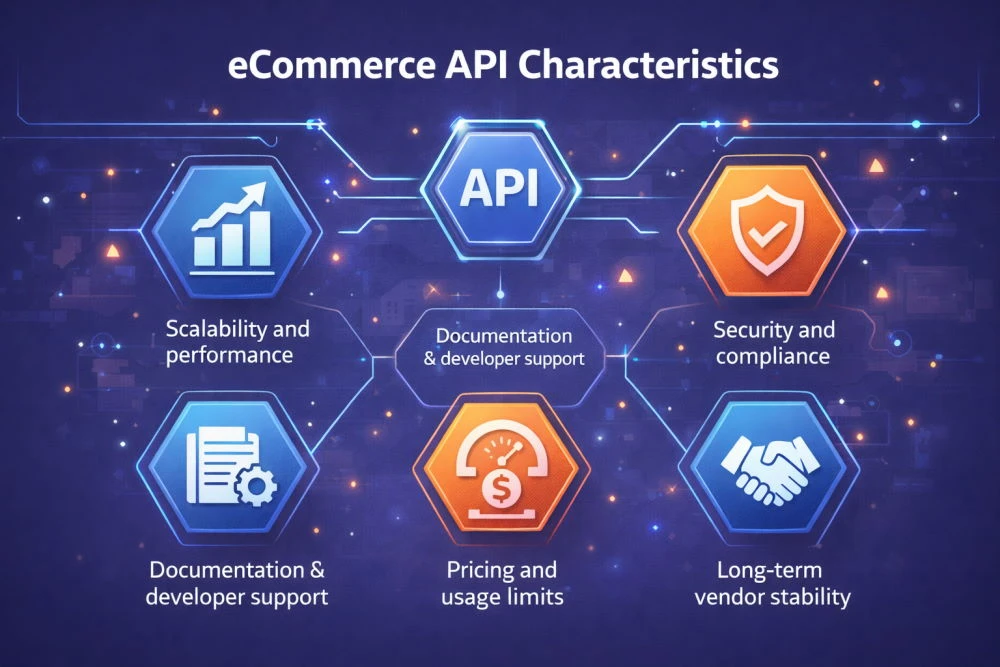
eCommerce APIs become long-term dependencies that straightforwardly impact system flexibility, operational cost, and the speed at which a business can adapt. Each criterion should be evaluated in the context of your specific business traffic, real data volumes, and long-term ownership.
Scalability and performance
To integrate an API successfully, each option must scale predictably as order volume, catalog size, and traffic increase. This implies stable latency under load, sensible rate limits, and proven behavior during peak events such as promotions or seasonal spikes. Strong test performance means little if an API breaks down under real-world concurrency.
Security and compliance
Security should be an inalienable part of the API design from the outset. That means using modern authentication, isolating data correctly, and accounting for compliance requirements like PCI DSS, GDPR, and local tax regulations early on. Weak security models introduce systemic risk that compounds over time.
Documentation and developer support
Clear documentation for developers, consistent schemas, and transparent versioning policies directly affect delivery speed and maintenance effort. Besides, strong developer support reduces integration friction and lowers the cost of operating the API in production environments.
Pricing and usage limits
A healthy API pricing model grows alongside the business and coordinates with your concept. Usage-based models should be evaluated against projected traffic, data volume, and automation scenarios to eliminate unexpected API integration cost escalation when systems scale.
Long-term vendor stability
An API for eCommerce website is a long-term infrastructure solution for your organization. As a result, selecting vendors with a well-defined product roadmap, strong financial footing, and ongoing platform investment helps minimize the risk of disruptive migrations and architectural rewrites over time.
Common eCommerce API Integration Challenges
Most API integration challenges pass the initial implementation and surface later, under real traffic and operational pressure, when multiple systems interact continuously. The bottlenecks we’ve described are the ones that most often damage stability, performance, and long-term maintainability.
API rate limits
Rate limits constrain how data can be exchanged at scale. High-frequency updates such as inventory syncs or order polling can quickly exceed allowed thresholds, leading to throttling or delayed updates. Effective integrations are established on batching, event-driven updates, caching, and controlled retry logic to stay within limits without disrupting core flows.
Data synchronization issues
Synchronization problems often occur when multiple systems update the same data without clear ownership. This results in inconsistent inventory, incorrect pricing, or outdated order states. Here, stable integrations define a single source of truth, use idempotent operations, and include reconciliation mechanisms to detect and correct mismatches.
Versioning and backward compatibility
APIs for eCommerce change over time, meaning that unmanaged updates can easily introduce hidden risk. Thus, deprecations or schema changes can break assumptions even if calls continue to succeed. Mitigating this requires monitoring API versions, isolating external contracts, and planning updates before forced migrations occur.
Security and authentication concerns
Many production incidents of eCommerce store APIs can be traced back to authentication failures. Expired tokens, misconfigured scopes, or poor secret handling can interrupt critical workflows. In contrast, solid integrations depend on proper access control, safe credential storage, and predictable key rotation practices, successfully protecting your business from API security challenges.
Build a Scalable API-First eCommerce Stack
Building a scalable eCommerce stack starts with identifying the API capabilities the business actually requires before committing to specific vendors. Therefore, you achieve high architecture flexibility and reduce long-term lock-in.
An API-first approach makes it easier to adapt over time, letting teams update or replace individual components when markets, channels, and customer expectations change, without destabilizing the entire system. In most cases, third-party APIs are the most relevant choice for standardized domains such as payments, tax, or shipping. Custom APIs become justified when the logic is core to differentiation or tightly coupled to internal operations.
If you’re planning an API-first eCommerce architecture and want to obtain maximum benefits for your business, PLANEKS is here to help. We assist teams in defining the right API boundaries, choosing between third-party and custom integrations, and designing stacks that scale without locking the business into fragile strategies. Start with a short conversation with our experienced consultants to build an eCommerce architecture that supports new markets, channels, and features without expensive rebuilds.
FAQ
Let’s delve into a quick overview of the most common questions businesses ask when considering an API for eCommerce website and the right integration strategy.
What are eCommerce APIs?
eCommerce APIs are interfaces that allow online stores to connect with payment gateways, shipping providers, inventory systems, analytics tools, and other third-party services in a structured and secure way. They handle the way systems exchange data and coordinate core commerce operations across the stack.
Why are APIs essential for eCommerce in 2026?
In 2026, APIs directly impact the scalability and adaptability of commerce systems. They enable automation, support omnichannel experiences, and make headless architectures practical, allowing businesses to expand individual components without rebuilding the entire platform.
What types of APIs does an eCommerce website need?
The prevalent part of modern eCommerce websites depends on a combination of product, order, payment, shipping, inventory, customer, marketing, and analytics APIs. In conjunction, these APIs cohesively support day-to-day operations while enabling growth across channels and regions.
Are eCommerce APIs platform-specific?
Some APIs are tightly coupled to specific platforms, such as Shopify or Magento, while others are platform-agnostic and designed to work across different commerce stacks. The right mix depends on how much flexibility and portability a specific business necessitates.
What is the difference between headless commerce APIs and traditional eCommerce APIs?
Headless commerce APIs separate the frontend from the backend, giving teams more control over user experience, performance, and multi-channel delivery. Traditional APIs often assume a fixed storefront, which can limit customization and scalability.
How do businesses choose the right eCommerce APIs?
The suitable API selection usually comes down to scalability, security standards, documentation quality, pricing models, and vendor reliability. It’s critical to note that here, long-term considerations, such as versioning strategy and ecosystem maturity, are just as vital as short-term feature sets.
Are free eCommerce APIs good enough for growing stores?
Free eCommerce store APIs can be sufficient at early stages, but growing stores often outgrow them quickly. Paid APIs typically offer higher rate limits, better reliability, stronger support, and features required for more sophisticated workflows and higher traffic.
What are the common challenges with eCommerce API integrations?
Most widely faced challenges cover rate limits, data synchronization issues, breaking modifications between API versions, security concerns, and the ongoing effort required to maintain multiple integrations through the system’s further growth.