The difference between Go and Python is that Go is compiled and often faster and simpler to deploy, while Python is more flexible and productive for rapid development and has a larger ecosystem for data and AI.
Backend development plays a critical role in determining a product’s performance, reliability, and long-term scalability, making the choice of programming language a strategic decision rather than a purely technical one. Among today’s most widely adopted backend technologies, a comparison of Golang vs Python lies in efficiency, modern design, and the ability to support high-growth digital platforms. Although both languages are used across cloud services, APIs, microservices, and distributed systems, they follow fundamentally different philosophies that shape how teams build and scale software.
Python prioritizes development speed, readability, and a vibrant ecosystem, enabling teams to deliver complex functionality rapidly and iterate with minimal friction. Go emphasizes simplicity and raw performance, offering a lightweight concurrency model optimized for low-latency workloads.
This article compares Python vs Go across essential criteria, including performance, scalability, developer experience, ecosystem maturity, and use-case suitability, to help technical leaders choose the language that best aligns with their product requirements and long-term architectural goals.
Table of Contents:
Overview of Go and Python
Go and Python are both widely adopted in modern backend development, yet they approach software design from fundamentally different angles. Understanding their core philosophies and technical foundations helps teams evaluate how each language aligns with their product goals, engineering processes, and future scalability needs.
What Is Go (Golang)?
Go, developed by Google, is a statically typed, compiled language engineered for simplicity, speed, and efficient concurrency. Its creators designed it to address challenges found in large-scale, networked systems, particularly the need for predictable performance and clean, maintainable code in distributed environments. Go’s lightweight syntax eliminates unnecessary complexity, while features like goroutines and channels enable highly efficient parallel execution without the overhead of traditional threading models.
These characteristics make Go especially strong for cloud-native applications, containerized services, DevOps tooling, and microservices architectures where throughput, stability, and low memory consumption are crucial. The language’s built-in tooling for testing, formatting, and dependency management also supports consistent engineering workflows across large teams. While Go offers strong performance and operational simplicity, its minimalist standard library and intentionally limited abstraction layers can require more manual implementation for advanced functionalities, particularly in areas such as data science, machine learning, or complex business logic orchestration.
What Is Python?
Python is a high-level, general-purpose programming language built around readability, expressive syntax, and rapid development. Its design minimizes boilerplate and allows developers to focus on solving problems rather than managing low-level implementation details. This accelerates prototyping, reduces maintenance overhead, and enables teams to deliver features at a pace that is difficult to match with more rigid, performance-focused languages.
Python’s true strength lies in its unparalleled ecosystem. With extensive libraries and frameworks covering web development (Django, FastAPI), AI and machine learning (TensorFlow, PyTorch), data processing (Pandas, NumPy), automation, scripting, and cloud integrations, Python provides a comprehensive foundation for building both simple applications and highly sophisticated platforms. This breadth makes Python exceptionally versatile, allowing teams to scale products, explore new features, or integrate advanced capabilities without switching languages or rewriting core components. Given this depth, many organizations choose to hire dedicated Python developers when building complex, data-intensive, or AI-powered solutions that must evolve quickly over time.
While Go excels in narrow, high-performance operational environments, Python offers a far more adaptable, innovation-ready ecosystem suited to businesses that require fast iteration, complex functionality, and long-term flexibility.
Go vs Python: Key Comparison Factors
Go and Python both excel in backend development, yet they solve problems in fundamentally different ways. Evaluating their differences and strengths across performance, scalability, and ecosystem depth helps teams determine which language aligns with their product goals, engineering culture, and long-term architectural strategy.
Speed and Performance
When exploring Python vs Go speed, the latter delivers faster execution due to its compiled nature, static typing, and highly optimized runtime. Programs are translated directly into machine code, enabling predictable performance with minimal overhead – a critical advantage for systems that process large volumes of requests or require low-latency responses. Go’s concurrency model amplifies this efficiency, allowing thousands of concurrent operations through lightweight goroutines that consume only a few kilobytes of memory each.
Python, being an interpreted language, executes more slowly in raw computational terms. However, this trade-off enables exceptional development speed and flexibility, making Python ideal for rapid prototyping, experimentation, and building complex logic without excessive verbosity. While Python cannot match Go’s low-level performance, its productivity advantages often lead to shorter delivery cycles and faster iteration on data-heavy or feature-rich applications.
Scalability and Concurrency
Go was engineered with scalability in mind, particularly for distributed and cloud-native systems. Goroutines allow developers to spawn massive numbers of concurrent tasks with near-zero overhead, making Go exceptionally well-suited for microservices, API gateways, streaming platforms, and high-throughput backend systems. Its concurrency primitives (channels, select statements, and lightweight scheduling) provide deterministic performance even under heavy load.
Python supports concurrency through asynchronous frameworks like FastAPI, asyncio, and Celery, enabling robust parallel task execution. However, due to the Global Interpreter Lock (GIL) and its interpreted architecture, Python is inherently less efficient for CPU-bound concurrent workloads. It scales well through multiprocessing, distributed task queues, and cloud-native designs, but achieving Go-level concurrency typically requires more architectural planning.
Ease of Development
Python is renowned for its concise, expressive syntax that minimizes boilerplate and allows developers to move from concept to implementation quickly. Its readability accelerates onboarding, encourages clean coding practices, and reduces development time for teams building complex business logic or evolving feature sets. This simplicity is especially valuable in fast-paced product environments and data-oriented projects. For organizations that want to move quickly without sacrificing code quality, partnering with a Python software development company can further streamline implementation and ensure best practices across complex codebases.
Go demands more explicit code due to its strict typing, limited abstraction layers, and preference for clarity over syntactic shortcuts. While this can result in longer initial development time, it also reduces runtime errors, improves predictability, and creates highly maintainable codebases. For teams prioritizing operational stability and strict coding standards, Go’s structural discipline can be an asset.
Ecosystem and Libraries
Python offers one of the most extensive ecosystems in the software industry. Its mature frameworks (Django, Flask, FastAPI) support everything from rapid MVP creation to large-scale enterprise applications. Beyond web development, Python dominates AI, machine learning, automation, data engineering, and scientific computing, giving teams access to advanced capabilities without reinventing foundational components. Many Python development companies capitalize on this ecosystem to deliver robust, scalable solutions across a wide range of technical and business domains.
Go’s ecosystem is modern and growing quickly, especially within the cloud-native space. Frameworks like Gin, Fiber, and Echo provide efficient foundations for high-performance web services, and Go’s built-in tooling simplifies dependency management and deployment. However, the overall breadth of Go’s ecosystem remains smaller than Python’s, particularly in specialized domains such as AI, ML, data processing, and scientific analytics.
Community and Support
Python has a massive, globally established community with decades of accumulated knowledge, learning resources, best practices, and open-source contributions. Whether debugging an issue, exploring architectural patterns, or integrating a niche library, Python’s support ecosystem ensures solutions are readily available.
Go’s community is smaller but rapidly expanding, driven by strong adoption in DevOps, SRE, cloud engineering, and distributed systems. Backed by Google and embraced by the Kubernetes and cloud-native ecosystem, Go’s community offers high-quality resources, although it lacks the depth and variety that Python provides across broader disciplines.
Use Cases
When it comes to the use cases of Go programming vs Python, the first option excels in environments demanding stability, throughput, and efficient concurrency. It is ideal for cloud services, container orchestration tools, networking applications, real-time processing systems, and highly scalable backend APIs. Its predictability under load makes it a natural fit for infrastructure components and microservices that must run continuously with minimal overhead.
Python use cases cover a wider range of domains thanks to its flexibility and extensive libraries. It is the dominant choice for AI/ML, data analytics, automation scripts, and scientific computing. Python also powers countless web applications, backend services, and rapid MVPs, making it invaluable for startups and enterprises that prioritize fast delivery, iterative development, and advanced data capabilities. These strengths explain why it is so prevalent across many industries that use Python, from fintech and healthcare to logistics, cybersecurity, and research-driven organizations.
When to Choose Go
Go is most suitable for teams that require a language optimized for speed, concurrency, and operational simplicity. Its design focuses on predictability and performance, making it highly effective for infrastructure-heavy systems and backend architectures where low latency and efficient parallelism are critical. While Python excels in versatility and rapid development, Go stands out when the engineering challenge revolves around handling massive throughput with minimal overhead.
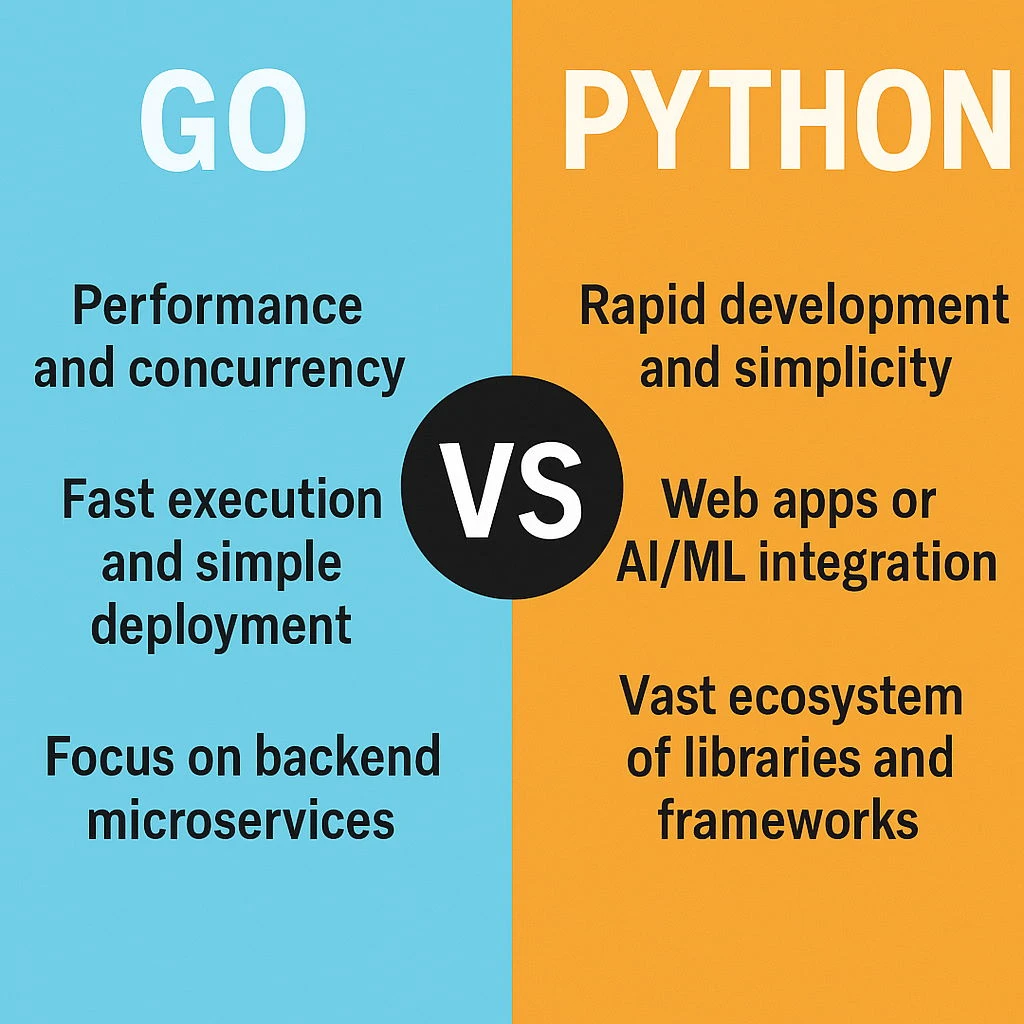
You need high performance and concurrency
Go was built to power large-scale, distributed applications where thousands of tasks must run in parallel without sacrificing responsiveness. Its goroutine-based concurrency model provides extremely lightweight parallel execution, allowing the runtime to schedule millions of concurrent operations efficiently. This makes Go particularly strong for real-time systems, event-driven platforms, message brokers, and network-intensive services where performance bottlenecks can quickly degrade user experience. By eliminating the complexity of traditional threading, Go enables teams to write highly concurrent code with clarity and stability.
You want fast execution and simple deployment with compiled binaries
Because Go is a compiled language, it produces self-contained binaries that run with predictable speed and minimal startup latency. These binaries eliminate external dependencies, simplify CI/CD pipelines, and make deployment straightforward across diverse environments. This operational simplicity is especially valuable for DevOps teams managing containerized applications, edge computing systems, or services that must run reliably with limited resources. The combination of compilation speed, runtime performance, and small memory footprint makes Go an appealing choice for performance-critical workloads.
Your project focuses on scalability and backend microservices
When comparing Go vs Python for backend, the first one aligns naturally with architectures composed of modular, independently scalable services. Its built-in networking capabilities, efficient memory usage, and strong concurrency primitives make it ideal for API gateways, microservices clusters, load balancers, and distributed processing pipelines. In large-scale ecosystems where services must handle unpredictable spikes in traffic, Go’s deterministic performance helps maintain system resilience and operational consistency. Although Python offers more flexibility and broader ecosystems, Go’s engineered simplicity gives it an edge in infrastructure-centric projects that depend on strict performance guarantees and horizontal scalability.
When to Choose Python
In terms of the difference between Go vs Python performance, the second option is the stronger choice when development speed, adaptability, and ecosystem breadth drive more value than raw execution performance. Its expressive syntax, extensive libraries, and thriving community make it an exceptionally productive environment for building modern digital products. While Go excels in infrastructure-heavy, performance-critical systems, Python offers unmatched flexibility and faster innovation cycles – a decisive advantage for teams building feature-rich platforms, data-driven applications, or rapidly evolving services.
You prioritize rapid development and simplicity
Python’s clean, readable syntax dramatically accelerates development, enabling engineers to move from concept to implementation with minimal friction. This simplicity reduces cognitive load, shortens onboarding time, and allows teams to iterate quickly without being weighed down by verbose boilerplate or tightly constrained language structures. For organizations operating in competitive markets, this development velocity translates into faster releases, more experimentation, and the ability to refine features based on real user feedback. Python’s ease of use also supports smaller teams that need to deliver sophisticated functionality without the overhead of complex infrastructure code.
You’re building web apps, prototypes, or integrating AI/ML
Python is the dominant language for AI, machine learning, data analytics, and scientific computing, supported by industry-leading libraries such as TensorFlow, PyTorch, Pandas, and NumPy. This ecosystem empowers teams to develop anything from predictive models to fully operational MLOps pipelines without switching technology stacks. In web development, frameworks like Django, FastAPI, and Flask make it easy to build everything from MVPs to large-scale backend systems with clean architectural patterns, built-in security, and high extensibility. Whether validating a product idea, developing a data-heavy platform, or integrating advanced AI capabilities, Python provides the tooling and abstraction layers needed to move quickly and scale efficiently.
You need access to a vast ecosystem of libraries and frameworks
Python’s ecosystem is one of the most comprehensive in modern software development, covering virtually every domain: web applications, data engineering, automation, DevOps scripting, cloud integrations, API development, testing, scientific research, and beyond. This breadth dramatically reduces development effort by allowing teams to rely on proven, well-maintained libraries rather than building foundational components from scratch. The result is a language that supports rapid iteration while maintaining production-grade reliability. For companies focused on innovation, complex functionality, or cross-disciplinary solutions, Python’s ecosystem provides a level of versatility that Go cannot currently match, making it a more strategic long-term choice for many backend and product development initiatives.
Go vs Python: Comparison Table
A direct side-by-side comparison helps clarify how Go and Python differ in their core characteristics and operational strengths. While Go focuses on execution speed, concurrency, and simplicity at scale, Python delivers exceptional versatility, rapid development, and broad ecosystem support. The table below provides a concise overview of the most important distinctions to guide strategic technical decision-making.
| Feature | Go (Golang) | Python |
| Type | Compiled, statically typed | Interpreted, dynamically typed |
| Speed | Very fast due to machine-level compilation | Slower, optimized for fast development and iteration |
| Concurrency | Built-in concurrency via goroutines and channels | Concurrency through async frameworks and multiprocessing |
| Ease of use | Moderate learning curve with explicit structure | Very beginner-friendly and highly readable |
| Libraries | Growing ecosystem focused on cloud and infrastructure | Extensive ecosystem across AI, ML, web, automation, data science |
| Best For | Cloud services, microservices, DevOps tools, real-time systems | Scalable backend systems, high-load web apps, AI/ML, data-driven platforms, rapid prototypes |
Final Verdict
Choosing between Go and Python depends on aligning each language’s strengths with your project’s priorities. Both are powerful in their respective domains, yet they approach software development from different angles, making it essential to match the language to your performance needs, development speed requirements, and long-term architectural strategy.
Go for performance-oriented, scalable backend systems
Go stands out when raw execution speed, efficient concurrency, and operational predictability are critical. Its compiled binaries, strict typing, and lightweight goroutines make it exceptionally strong for high-throughput backend services, cloud-native microservices, infrastructure tooling, and real-time networked applications. In environments where latency, resilience, and parallel task execution define success, Go offers a clean, streamlined model that minimizes overhead and maximizes scalability.
Python for rapid development, flexibility, and innovation
Python excels in scenarios where development speed, readability, and ecosystem breadth provide more strategic value than low-level performance. Its expressive syntax, extensive standard library, and unmatched support for AI, machine learning, automation, and data analytics enable teams to build sophisticated functionality rapidly. Python’s flexibility makes it ideal for fast-evolving products, data-intensive systems, and projects where experimentation, iteration, and cross-domain capabilities drive competitive advantage.
The best choice depends on project type, team expertise, and future scalability
There is no universally “better” language – only the language that aligns with your engineering goals. Teams focused on infrastructure performance and large-scale distributed systems may benefit more from Go’s speed and concurrency model, while teams building data-driven platforms, AI-powered features, or rapidly evolving applications will gain more from Python’s rich tooling and accelerated development workflow. By evaluating your technical requirements, team strengths, and long-term roadmap, you can select the language that offers the most strategic value for your specific project.
FAQ: Go vs Python for Backend Development
Choosing the right backend technology between Go language vs Python often raises practical questions, especially when comparing two technologies as widely adopted as Go and Python. Each option brings distinct strengths, design philosophies, and ecosystem advantages, making them suitable for different types of projects and engineering teams. The following FAQ addresses the most common questions developers and decision-makers ask when evaluating Go and Python for backend development, providing clear, detailed insights to help guide informed technology choices.
Go faster than Python for backend development?
Yes. Go is considerably faster due to its compiled nature, static typing, and optimized runtime. Go translates code directly into machine instructions, resulting in low-latency execution and predictable performance even under heavy load. Its goroutine-based concurrency model allows millions of lightweight tasks to run simultaneously, making Go highly efficient for real-time systems, streaming platforms, and distributed backend services.
Python, while slower in raw execution speed, often compensates with rapid development, rich libraries, and efficient scaling strategies at the architectural level, but it cannot match Go’s pure runtime performance.
Which is easier to learn: Go or Python?
Python is generally easier for beginners thanks to its clean, intuitive syntax and extensive learning resources. Its focus on readability enables new developers to grasp programming fundamentals without being overwhelmed by low-level details or verbose constructs. Python’s large community also provides abundant tutorials, documentation, and examples, accelerating the learning curve.
Go is simpler than many statically typed languages but still requires developers to understand concepts such as strict typing, explicit interfaces, and manual error handling, which can present additional challenges for novices.
Is Go better than Python for backend development?
Not entirely. Go excels in backend environments that require maximum performance, effortless concurrency, and extremely efficient resource usage. For systems that process high volumes of simultaneous requests, Go is often the optimal choice.
However, Python offers far greater flexibility, a broader ecosystem, and significantly faster development cycles. Its mature frameworks, extensive libraries, and dominance in AI, automation, and data processing make it a more versatile option. The “better” language depends on context: Go for infrastructure-heavy performance; Python for complex features, rapid iteration, and cross-domain capabilities.
Which is better for web development: Go or Python?
Python is generally better for scalable web development due to its mature frameworks such as Django, Flask, and FastAPI. These frameworks provide robust tooling for database management, caching, authentication, background tasks, API design, and cloud integrations, allowing teams to deliver production-ready systems quickly.
Go offers impressive speed and can deliver high-performance APIs, but it lacks the deep ecosystem and built-in abstractions that Python provides. For complex, growing web applications with evolving requirements, Python’s flexibility and proven scalability make it the more efficient and strategic choice.
Is Go similar to Python?
When being stuck in front of the question of what to go for, Python or Go, it’s worth mentioning that they both share a philosophy of simplicity and efficiency, but they differ significantly in design goals and use-case focus. Python is more versatile, offering rich support for web development, automation, data engineering, scientific computing, and machine learning. It enables rapid development with minimal boilerplate and provides an ecosystem unmatched in breadth.
Go, by contrast, prioritizes speed, concurrency, and operational predictability, making it ideal for infrastructure, microservices, and high-throughput systems. While both are approachable languages, Python remains the more adaptable and broadly applicable choice for most backend and cross-functional projects.