The difference between Python and Java is that Python fits better with startups and scalable solutions that require rapid development, while Java is typically faster at runtime and common for large enterprise systems and strongly typed codebases.
Python and Java remain two of the most influential programming languages in modern software development, powering everything from high-traffic web applications to advanced data platforms and enterprise-grade systems. Both ecosystems have matured over decades, supported by strong communities, extensive libraries, and proven production use across industries. Yet despite serving many overlapping domains – web development, backend engineering, automation, data science, machine learning, and enterprise workflows – the two languages differ significantly in their performance models, development velocity, syntax complexity, and architectural philosophy.
Understanding these distinctions is essential for teams assessing Python vs Java for backend development, optimizing engineering productivity, or planning long-term product scalability. This comparison examines both programming languages across core dimensions, including speed, performance, concurrency, ecosystem capabilities, learning curve, and business fit. The goal is to help technical leaders and decision-makers determine which language offers the most strategic value for their project requirements, operational constraints, and long-term growth plans.
Table of Contents:
Overview of Python and Java
Both Python and Java have become foundational technologies in modern software engineering, each offering distinct strengths that shape how teams build, scale, and maintain applications.
What Is Python?
Python is a high-level, interpreted programming language designed to reduce cognitive overhead through simple, expressive, and highly readable syntax. Its philosophy emphasizes developer productivity, enabling the delivery of complex features with fewer lines of code and shorter development cycles. Despite its simplicity, Python is mighty for building scalable backend systems, asynchronous microservices, and data-intensive pipelines. Frameworks such as Django, FastAPI, and Flask enable rapid development of high-load web applications, making Python extremely competitive in Java vs Python for web development discussions. Besides, native support for multiprocessing and distributed task queues helps services scale horizontally.
Thanks to this strong technical foundation, many companies choose to hire dedicated Python developers when building complex, data-centric platforms. The language’s flexibility also makes it ideal for automation, DevOps tooling, web scraping, testing, and API integrations. As a result, Python has become a strategic choice for both startups and enterprises seeking fast iteration, strong ecosystem support, and long-term maintainability.
What Is Java?
Java is an object-oriented, compiled language that runs on the Java Virtual Machine (JVM), enabling predictable performance and seamless portability across platforms. Its static typing, mature tooling, and extensive enterprise frameworks make it a staple in large-scale, mission-critical systems that require reliability and strict architectural discipline. Technologies such as Spring, Hibernate, and the broader JVM ecosystem support complex backend applications, transactional systems, and multilayered enterprise workflows.
Java’s stability and optimized runtime model position it as a strong foundation for applications requiring consistent throughput and long-term operational resilience. It also plays a central role in Android development, embedded systems, and corporate IT infrastructures. While Java tends to require more boilerplate and longer development cycles than Python, its structured nature appeals to organizations prioritizing formal engineering processes, type safety, and highly predictable runtime behavior.
Python vs Java: Key Comparison Factors
When considering the difference between Python and Java, both languages serve similar engineering domains; the philosophies lead to meaningful differences in performance, development experience, and architectural suitability.
Speed and Performance
Java typically achieves higher execution speeds because its code is compiled into bytecode and executed on the JVM, which applies just-in-time optimizations to enhance throughput. Python, in contrast, processes instructions at runtime through interpretation, creating additional overhead that slows execution during compute-heavy operations. This difference reflects a fundamental trade-off between runtime efficiency and development flexibility: Java prioritizes performance predictability, while Python emphasizes rapid iteration and expressive development. Python remains an excellent option for data-driven workloads, automation, and complex logic, yet extremely high-load systems often demand optimized extensions or compiled modules to reach Java’s performance envelope.
Syntax and Ease of Learning
Python’s syntax is intentionally clean, structured, and highly expressive, enabling teams to produce maintainable and professional-grade code with significantly less boilerplate. This readability accelerates onboarding and simplifies long-term maintenance, particularly in fast-moving environments. Java, on the other hand, adopts a more verbose syntax that enforces strict structure and explicit declarations. Although this increases code volume, it introduces a level of discipline that benefits large, multi-team projects where architectural consistency, predictability, and formalized design patterns are essential for long-term stability.
Memory Management
Both languages rely on automatic garbage collection, but their approaches differ in flexibility and efficiency. Java provides substantial control over memory allocation and garbage collection behavior, allowing engineering teams to tune heap size, pause times, and execution characteristics for demanding enterprise environments. Python uses reference counting combined with a cyclic garbage collector, offering simplicity at the cost of occasional inefficiencies during memory-intensive operations. While adequate for most use cases, Python’s model can require additional optimization when handling large datasets or long-lived object graphs.
Scalability
Java’s architecture and JVM-based execution make it a longstanding choice for highly scalable enterprise and cloud systems, supporting distributed services, microservice ecosystems, and mission-critical transactional workloads. Python can scale effectively as well, but high-throughput environments often require architectural patterns that leverage asynchronous execution, event-driven frameworks, or distributed task queues such as FastAPI, asyncio, or Celery. With proper design, Python delivers excellent scalability, though it may demand more deliberate optimization compared to Java’s built-in performance characteristics.
Ecosystem and Libraries
Python offers a broad and rapidly evolving ecosystem centered on artificial intelligence, machine learning, scientific computing, automation, and modern backend development. Frameworks like Django, FastAPI, and Flask accelerate API and application delivery, while libraries such as NumPy, Pandas, TensorFlow, and PyTorch support advanced computational workloads. This ecosystem is also why many organizations rely on a Python software development company when building complex digital products. Java’s ecosystem is equally comprehensive but more focused on enterprise engineering, with mature frameworks such as Spring, Hibernate, and Jakarta EE delivering the foundation for robust, large-scale systems. Both ecosystems are well-established, yet their priorities differ according to typical use cases and architectural demands.
Community and Support
Both languages benefit from extensive, active global communities and long histories of industry adoption. Python’s community drives innovation in open-source libraries, data science tooling, and AI research, contributing to its rapid growth in emerging technical fields. Many leading Python development companies contribute heavily to open-source frameworks and scientific tools. Java’s community remains deeply rooted in enterprise development, platform standardization, and Android tooling, offering strong support for organizations managing complex legacy systems or large-scale corporate infrastructures. Each community provides abundant documentation, learning resources, and continuous improvements aligned with its respective strengths.
When to Choose Python
Python is the strongest fit in scenarios where development speed, clarity, and adaptability deliver greater strategic value than raw execution performance. Its design philosophy prioritizes streamlined syntax and rapid iteration, enabling teams to move from concept to deployment significantly faster than with more rigid, verbose languages. This makes Python exceptionally effective in environments where innovation cycles are short, and the ability to experiment quickly drives competitive advantage.
You’re a beginner or learning programming fundamentals
Python offers a uniquely accessible starting point for new developers thanks to its clean, intuitive syntax. By eliminating unnecessary boilerplate, it allows learners to focus on mastering universal programming concepts, algorithms, data structures, object-oriented design, modularity, and problem-solving patterns, without being overwhelmed by implementation details. For organizations, this clarity reduces onboarding time, improves code readability across teams, and helps junior engineers contribute meaningfully to production systems sooner. As a result, Python becomes not only an educational tool but a strategic asset for talent development and long-term team scalability.
You’re building prototypes, web apps, or data science projects
The most common Python use cases are where teams need to validate ideas quickly or manage highly dynamic workloads. For web development, frameworks like Django and FastAPI provide robust foundations for scalable backend systems, offering built-in security features, ORM layers, asynchronous capabilities, and extensive ecosystem support. In data-driven domains, Python stands at the center of modern analytics and AI thanks to libraries such as Pandas, NumPy, TensorFlow, and PyTorch. These tools demonstrate Python benefits over Java, indispensable for prototyping research models, operationalizing machine learning pipelines, or powering data-intensive applications. Its flexibility ensures that prototypes can evolve smoothly into production-ready solutions without rewriting entire codebases.
You need rapid development and flexible syntax
Python’s expressive syntax allows complex logic to be implemented cleanly and concisely, reducing development time and minimizing maintenance overhead. This flexibility is especially valuable in fast-changing environments where product requirements shift frequently, or experimentation guides decision-making. Engineers can automate workflows, integrate third-party APIs, build internal services, or develop full-scale applications with minimal friction. Because the language supports multiple paradigms – procedural, object-oriented, and functional – teams can choose the approach that best matches their architecture and long-term goals. Python’s adaptability ensures that development velocity stays high even as systems grow more complex, enabling organizations to innovate faster while maintaining a stable, scalable foundation.
When to Choose Java
Java is a strong choice when stability, strict structure, and predictable performance are essential for long-term, large-scale software systems. Its combination of static typing, JVM optimizations, and mature frameworks makes it a dependable foundation for organizations that prioritize reliability, architectural consistency, and structured development processes. In environments where software must operate flawlessly for years, integrate with legacy systems, and scale across global infrastructures, Java’s disciplined design and operational predictability deliver significant strategic value.
You’re building large-scale enterprise or Android applications
Java continues to be a cornerstone of enterprise engineering due to its strong runtime performance, robust memory management, and strict type system. These characteristics make it highly effective for systems that process large volumes of transactions, handle sensitive data, or orchestrate complex business logic across distributed architectures. Enterprise frameworks like Spring, Spring Boot, and Jakarta EE provide deep tooling for dependency injection, microservices orchestration, cloud deployment, and modular design, allowing teams to build resilient, production-grade systems with clearly defined patterns. Java’s relevance is equally strong in mobile development. Its foundational role in the Android ecosystem, combined with long-standing backwards compatibility guarantees, ensures that mobile engineering teams can build applications that remain stable and maintainable across many OS versions and device configurations.
You value speed, structure, and long-term maintainability
Java’s compiled nature and the optimizations of the JVM (such as JIT compilation and advanced garbage collection strategies) enable consistent runtime performance that benefits compute-heavy or latency-sensitive workloads. The language’s verbosity, while often contrasted with Python’s expressiveness, serves a clear purpose: it enforces explicit design choices, enhances code predictability, and reduces ambiguity.
For large organizations operating multi-team development environments, this structure becomes a critical advantage. Static typing improves error detection early in the development lifecycle, while clear architectural patterns enable seamless collaboration, systematic reviews, and long-term maintainability. Systems written in Java frequently operate reliably for decades, evolving through modular updates rather than full rewrites.
You want to work in corporate or enterprise environments
Java remains deeply integrated into the technology stacks of major corporations, financial institutions, telecom providers, and government agencies. These sectors require stringent security, compliance readiness, and operational continuity – areas where Java’s maturity, documentation depth, and predictable versioning model outperform many alternatives.
For developers pursuing careers in enterprise environments, Java offers stable, long-term demand and exposure to large-scale engineering practices. Its ecosystem provides sophisticated tools for monitoring, performance tuning, testing, and deployment, making it a natural fit for organizations that rely on repeatable processes and structured engineering methodologies. As a result, Java continues to be a primary choice for organizations needing dependable, highly maintainable systems with long operational lifespans.
Python vs Java: Comparison Table
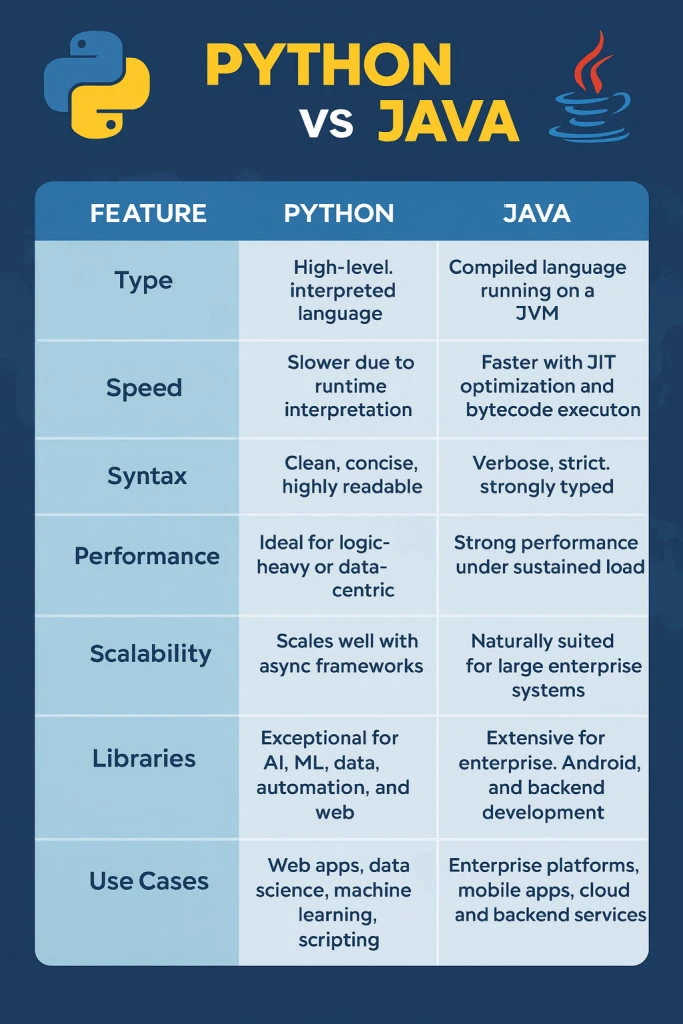
Let’s consider a comparison table that highlights the fundamental distinctions between Java and Python to help teams quickly assess which language better aligns with their technical goals.
| Feature | Python | Java |
| Type | High-level, interpreted language | Compiled language running on the JVM |
| Speed | Slower due to runtime interpretation | Faster with JIT optimization and bytecode execution |
| Syntax | Clean, concise, highly readable | Verbose, strict, strongly typed |
| Learning curve | Very beginner-friendly | Moderate, more structure to learn |
| Performance | Ideal for logic-heavy or data-centric tasks | Strong performance under sustained load |
| Scalability | Scales well with async frameworks | Naturally suited for large enterprise systems |
| Libraries | Exceptional for AI, ML, data, automation, and web | Extensive for enterprise, Android, and backend development |
| Use Cases | Web apps, data science, machine learning, scripting | Enterprise platforms, mobile apps, cloud and backend services |
Real-World Use Cases
Both languages power major global platforms, each excelling in different operational domains while frequently working together within modern distributed architectures. Their coexistence reflects a broader industry trend: organizations optimize their technology stacks not by choosing a single language, but by strategically aligning each language with the tasks it performs best. This balance allows companies to accelerate development, maintain operational stability, and support long-term product evolution without compromising performance or flexibility.
Python in Real-World Systems
Python has become a core technology for companies prioritizing rapid development, data processing, and AI-driven capabilities. Google extensively uses Python for machine learning research, internal tooling, and automation workflows, relying on its ability to support high-velocity experimentation across large engineering teams. Instagram’s backend, built largely on Python and Django, enables the platform to handle massive global traffic while maintaining short deployment cycles, giving teams the agility to roll out new features continuously.
Netflix integrates Python across its data analytics, recommendation engines, and automation pipelines, leveraging the language’s scientific ecosystem to evaluate user behavior, optimize streaming quality, and orchestrate critical infrastructure processes. The most competitive industries that use Python are finance, healthcare, and logistics, which similarly depend on this programming language for predictive modeling, data engineering, and real-time analytics, demonstrating its versatility across both consumer and enterprise domains.
Java in High-Load Enterprise and Mobile Platforms
Java remains a cornerstone for organizations requiring predictable performance, strict reliability, and long-term maintainability. LinkedIn relies on Java to power backend systems responsible for millions of real-time interactions, ensuring consistency and uptime under sustained global load. Uber incorporates Java into mission-critical components of its dispatching, routing, and pricing infrastructure, where deterministic behavior and JVM optimizations are essential.
Amazon employs Java across numerous backend and service-layer components, using its type safety, performance characteristics, and structured patterns to support systems that must run continuously and securely at an immense scale. Beyond backend engineering, Java underpins the Android operating system and powers a vast majority of native Android applications, making it central to mobile development worldwide. These examples highlight Java’s unmatched stability in environments where system longevity and compliance-driven engineering are paramount.
How Python and Java Coexist
In practice, many companies combine both languages to leverage their complementary strengths within unified, distributed architectures. Python often drives data science, machine learning, rapid prototyping, and user-facing features that evolve quickly, providing the agility needed to validate concepts and implement refinements at high speed. Java, conversely, anchors high-performance microservices, enterprise workflows, and mission-critical backend components where consistency, type safety, and long-term maintainability are non-negotiable.
This hybrid approach blends Python’s adaptability with Java’s structural rigor, enabling teams to scale efficiently while optimizing the strengths of each language. As a result, modern engineering ecosystems frequently use Python and Java side by side, creating systems that are both innovative and resilient – a combination essential for today’s high-growth software products.
Final Verdict
Choosing between Python and Java ultimately depends on the nature of your goals, the demands of your project, and the environment in which your software will operate. Both languages are powerful, mature, and widely adopted, yet they support fundamentally different development philosophies that influence how teams build, scale, and maintain applications.
Python: Simplicity, Speed of Development, and Flexibility
Python excels when rapid iteration, readability, and adaptability are top priorities. Its concise syntax and rich ecosystem enable teams to prototype quickly, deliver features faster, and explore data-driven or AI-powered capabilities with minimal overhead. This makes Python ideal for startups, innovation-focused teams, automation workflows, and analytics-driven products where development velocity directly impacts business outcomes.
Java: Stability, Scalability, and High Performance
Java is the stronger choice for systems requiring long-term reliability, strict structure, and predictable performance under load. Its JVM foundation, strong typing, and mature enterprise frameworks support large, distributed architectures designed to operate at scale for many years. Organizations building financial systems, enterprise platforms, or complex backend infrastructures often rely on Java for its consistency and operational durability.
Choosing the Right Path
In practice, the best option depends on what you value most: Python for fast innovation, experimentation, and data-intensive work; Java for large-scale reliability, structural discipline, and high-performance environments.
FAQ: Python vs Java
This section addresses the most common questions developers, product teams, and decision-makers ask when comparing Python and Java, offering clear guidance on performance, usability, and practical applications.
Q1. Which is faster: Python or Java?
Java is faster because it compiles code into optimized bytecode and executes it on the JVM, which enhances performance through just-in-time compilation. Python interprets code at runtime, making it inherently slower but more flexible for rapid development and dynamic use cases.
Q2. Is Python easier than Java?
Yes. Python’s clean, minimal syntax makes it significantly more approachable for beginners and faster to write for experienced developers. Java’s stricter, more verbose structure requires more upfront learning but improves consistency in large systems.
Q3. Which language is better for web development?
When considering Java or Python for web development, it’s worth noting that the latter is more robust, with frameworks such as Django, Flask, and FastAPI that enable fast delivery and clean architecture. Java, particularly with Spring Boot, is preferred for large enterprise platforms where reliability, structure, and long-term maintainability are essential.
Q4. Which is better for machine learning: Python or Java?
Python is the clear leader in AI and machine learning because of its robust scientific ecosystem, including TensorFlow, PyTorch, NumPy, and Scikit-learn. Java can support ML, but lacks the breadth and maturity of Python’s toolset.
Q5. Which is better for backend development?
Both languages are strong choices. Python offers speed of development and flexibility, making it ideal for evolving or data-driven systems. Java delivers high performance and stability, excelling in large-scale, mission-critical backend architectures.
Q6. Is Python similar to Java?
Python and Java share object-oriented foundations, but Python is far more expressive and efficient for modern development. Its concise syntax, extensive libraries, and rapid prototyping capabilities make it ideal for web apps, automation, and AI, whereas Java’s strict structure and verbosity favor long-term enterprise systems requiring precise control and predictable performance.