Hiring qualified tech talent has turned into a struggle for businesses of all scales since the global skills gap widens, recruitment cycles stretch over months, and local markets fail to deliver engineers with the proficiency levels modern software initiatives require. According to IDC, the IT skills shortage is projected to impact nine out of ten organizations by 2026, resulting in an estimated $5.5 trillion in delays, quality issues, and revenue loss. In turn, this scarcity of expertise often disrupts delivery schedules and restricts sustainable innovation.
In today’s technology landscape, IT staff augmentation has evolved from a short-term staffing workaround into a strategic resourcing model that enables organizations to scale engineering capacity with precision while maintaining full control over quality and delivery. Instead of replacing internal teams, it strengthens them by adding specialized external expertise that can be expanded or reduced as business needs change. With this level of flexibility, companies accelerate feature delivery, minimize the cost and time associated with permanent hiring, and stay competitive in environments where innovation speed is as critical as execution excellence.
In this article, we’ll walk you through an IT staff augmentation guide, disclosing why this hiring model has become inalienable for tech-based businesses, how it is being adopted in practice, and how to implement it as a scalable, measurable component of your engineering strategy.
Table of Contents:
Definition and Core Concept
Staff augmentation definition implies a strategic resourcing model that enables companies to supplement their internal engineering teams with external, highly skilled IT professionals for a defined period or on an ongoing, as-needed basis. In these terms, businesses no longer have to rely solely on lengthy recruitment cycles to build a full in-house team; organizations can rapidly extend their capabilities with comprehensively vetted developers, Quality Assurance (QA) specialists, DevOps specialists, UI/UX designers, data engineers, cloud architects, or other, more narrow, niche experts. Such professionals join the company’s existing workflows, contribute to active initiatives, and operate as a direct extension of the internal team, while remaining employed by the augmentation provider.
How Staff Augmentation Differs From Traditional Outsourcing
The core principle and value behind IT staff augmentation services is flexibility without sacrificing control. In contrast to traditional outsourcing, where a vendor independently manages a product or subsystem, augmented engineers perform inside your environment, adopt your engineering practices, and follow your internal development cadence. Your managers define daily tasks, priorities, and performance expectations.
The model preserves transparency, maintains alignment with internal quality standards, and ensures full ownership of architectural decisions. For companies with established engineering cultures, it’s a perfect approach to retain the cohesion and accountability – the benefits of staff augmentation that cannot be reached with other hiring approaches.
Why It’s Not the Same as Hiring Independent Contractors
Staff augmentation also differs significantly from hiring contractors. Independent contractors generally operate without the institutional support, structured processes, or technical oversight that reputable augmentation providers deliver. When it comes to augmentation, the partner manages sourcing, technical screening, HR operations, retention, and continuous upskilling, ensuring the engineers you onboard are stable, well-supported, and aligned with your project needs. Such activities minimize risks related to turnover, skill mismatches, or inconsistent performance, which are commonly associated with ad hoc contracting.
The Strategic Value Behind the Model
At its foundation, staff augmentation addresses the practical flows of modern software development, where the technology environment progresses very fast, project scopes often alter frequently, and teams must scale expertise within days rather than months. By integrating external professionals seamlessly into internal teams, organizations gain access to global talent without assuming long-term hiring commitments.
The borderless hiring opportunities mean faster delivery, precise coverage of skill gaps, and the agility needed to remain competitive in fast-moving digital landscapes. Considering all, staff augmentation is not a temporary fix but a deliberate strategy for tech leaders who require both adaptability and control in their engineering operations.
Why Companies Choose Staff Augmentation
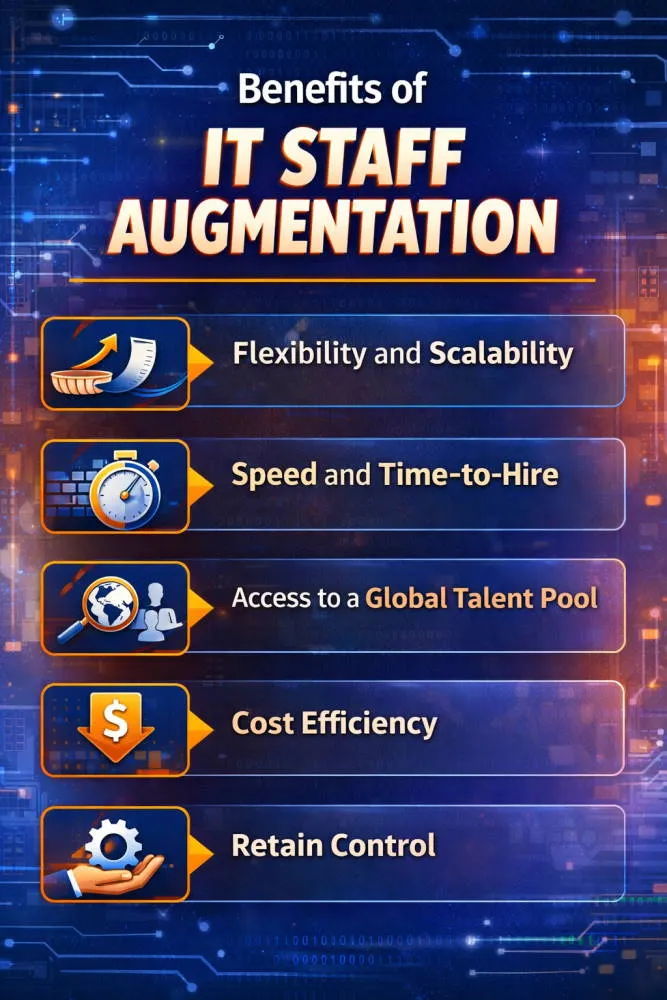
The core benefits of staff augmentation imply that it successfully merges the responsiveness and adaptability of external support with the cohesion of an internal team. Companies choose this approach because it strengthens project delivery, reduces hiring friction, and provides scalable access to global expertise, without forfeiting oversight or compromising technical consistency.
Flexibility and Scalability
In software-driven organizations, teams often encounter sudden shifts in scope, emerging technical challenges, or workload fluctuations that make rigid hiring models impractical. Staff augmentation offers the ability to scale teams with precision, increasing or decreasing engineering capacity exactly when needed without long-term commitments.
The operational elasticity is even more valuable for companies navigating unpredictable development roadmaps, seasonal demands, or multi-phase product cycles. Instead of restructuring teams or overextending internal resources, leaders can adapt their engineering force dynamically and maintain consistent delivery velocity.
Speed and Time-to-Hire Advantages
Traditional hiring introduces unavoidable delays: sourcing candidates, screening, conducting multiple interview rounds, negotiating offers, and running onboarding processes. For many companies, such cycles extend for weeks or even months, creating bottlenecks that slow product development and introduce opportunity costs.
Staff augmentation addresses this challenge by providing access to professionals who have been evaluated in advance and can join ongoing initiatives with minimal ramp-up time. Thus, businesses can preserve project forward movement and allow organizations to respond to technical requirements immediately rather than waiting for internal hires to materialize. The outcome is a more resilient delivery pipeline where time-sensitive work is not hindered by recruitment constraints.
Access to a Global and Broader Talent Pool
As specialized skill sets become increasingly scarce in local markets, staff augmentation widens the available talent landscape. Companies are no longer limited to regional availability or constrained by competitive hiring environments. Instead, they obtain access to global engineering expertise across multiple domains, from Python development and DevOps automation to cloud architecture, cybersecurity, AI engineering, and data-intensive system design.
This model is particularly valuable when projects require niche competencies that may be difficult or impossible to source locally. By leveraging a broader geographic pool, organizations secure highly qualified professionals whose experience directly matches the complexity of the technological challenges at hand.
Cost Efficiency and Lower Overhead
Building a full-time team requires significant financial and administrative commitment: salaries, benefits, equipment, onboarding, training, and long-term retention costs. Staff augmentation reduces this burden by allowing organizations to pay strictly for the expertise they need for the exact duration required. Because augmented professionals remain employees of the provider, companies avoid additional overhead while still integrating the specialists into their development workflow. This makes the model economically attractive for both short-term intensive sprints and long-term engagements where predictable budgeting and operational efficiency are essential.
Retain Control and Full Integration Compared to Outsourcing
While outsourcing transfers ownership of tasks or entire product components to an external vendor, staff augmentation preserves internal control over engineering execution. Augmented professionals work within your infrastructure, follow your processes, and report to your managers, ensuring alignment with the company’s development standards and long-term architectural vision.
This model enhances collaboration and maintains strong communication channels, enabling teams to share context, domain knowledge, and technical expectations without the disconnects that often occur in traditional outsourcing. Because these engineers operate as a seamless extension of the existing team, they contribute to code quality, culture, and strategic objectives with the same accountability as full-time employees.
When Staff Augmentation Is the Right Fit
In a nutshell, staff augmentation introduces maximum benefit in cases that prioritize agility, speed, and targeted expertise. Nonetheless, projects that rely heavily on domain immersion, constant on-site interaction, or highly sensitive operational processes may require alternative resourcing strategies to achieve optimal outcomes.
Specialized expertise
Staff augmentation is most effective when an organization needs specialized expertise that its in-house team cannot provide within the required timeframe. This often occurs during the launch of new features, system migrations, architecture redesigns, or short-term projects that demand niche competencies such as cloud engineering, AI development, security hardening, or performance optimization. In each example, hiring full-time specialists is unnecessary or impractical, yet the project still requires a high level of technical precision.
Variability of Project Scopes
It is also well-suited for environments where project scopes or workloads tend to fluctuate. Product roadmaps may evolve rapidly, introducing new priorities that the internal team is not immediately equipped to handle. Augmented talent from IT outstaffing services allows companies to respond to these changes without overburdening existing teams or delaying delivery. Consequently, leaders can maintain predictable velocity even when technical requirements expand unexpectedly.
Timing is a crucial component of the decision, especially for teams operating under aggressive roadmaps. When deadlines tighten, schedules are aggressive, and delivery is critical, staff augmentation enables companies to bring in experienced specialists who adapt quickly to existing processes. This allows high-priority initiatives to continue advancing instead of being delayed by lengthy recruitment procedures.
Control
And finally, staff augmentation brings particular value to companies that want to preserve strategic control over their engineering efforts. Whereas outsourcing transfers direction and quality oversight to a partner, augmentation keeps these responsibilities in-house while still providing the elasticity to expand or contract talent based on shifting priorities. For companies intentionally growing their core team, augmentation becomes a practical connection that keeps development moving as internal hiring progresses at a sustainable, well-paced rhythm.
When Staff Augmentation Is Less Ideal
Although the staff augmentation meaning suggests broad flexibility, the model is far from a one-size-fits-all solution and must be applied thoughtfully.
Specific knowledge
There are specific projects that necessitate in-depth, long-term domain knowledge that external specialists cannot acquire quickly enough to deliver meaningful value. Systems that require extensive institutional context, highly specific business logic, or close engagement with end-users may be better suited to dedicated internal teams.
Strict availability
The model may be limited in contexts that depend on on-premises presence or uninterrupted availability with 24/7 coverage. Augmented talent can often match a client’s working schedule, but projects engaging mission-critical operations or regulated facilities with strict access protocols may not fully benefit from this setup.
Team friction
Another consideration to keep in mind is the possibility of team friction. Introducing external specialists, particularly for short-term needs, can create uncertainty among existing employees regarding ownership, responsibilities, and long-term role stability. Unless leaders communicate proactively and establish clear expectations, morale issues may emerge and disrupt your project’s productivity.
Comparison of hiring models
Selecting the appropriate hiring model comes down to how much control you need, the degree of integration required between external talent and your engineering workflow, and whether your priority is adaptability or long-term stability. The table below outlines how staff augmentation, direct hiring, and outsourcing differ across the critical evaluation areas that guide decisions for CTOs, product leaders, and engineering managers.
| Hiring model | Staff augmentation | Direct hiring (Full-time employees) | Outsourcing/managed services |
| Project control | Full control over tasks, priorities, performance, and engineering decisions. You manage augmented engineers directly. | Full, ongoing control with strong internal ownership of product development and long-term architecture. | Minimal control. Vendor manages the project, team, and delivery workflow, taking responsibility for outcomes. |
| Integration with the internal team | High integration. External specialists work inside your environment, follow your processes, use your tools, and collaborate as part of your team. | Deep integration. Permanent team members contribute to culture, institutional knowledge, and sustained product evolution. | Low integration. External team operates independently with their own processes, tools, and communication structure. |
| Cost structure | Flexible pay-as-you-go model (hourly or monthly). No long-term employee liabilities, benefits, or administrative overhead. | Fixed long-term commitment: salary, benefits, overhead, onboarding, training, retention, and compliance. | Project-based, milestone-based, or fixed retainer. Can be higher, but includes managed delivery and administrative costs. |
| Best use cases | Filling specialized skill gaps, accelerating delivery during peak demand, supporting variable workloads, strengthening teams without increasing headcount, and enabling budget-efficient scaling for short- or mid-term needs. | Core roles requiring long-term continuity, domain expertise, on-site presence, leadership positions, or roles central to ongoing product strategy and organizational growth. | Complete end-to-end delivery handled externally, non-core activities, maintenance work, well-defined scopes, or initiatives where internal involvement should remain minimal. |
A practical evaluation method, consistent with leading staff augmentation tutorial frameworks, is to start by determining whether your priority is integrating external specialists into your internal workflow or delegating delivery to an external provider. Equally worth attention is your position on flexibility versus long-term investment. Staff augmentation offers rapid scalability, direct hiring secures long-term capability, and outsourcing provides structured execution with limited control.
Used in conjunction with the right contexts, these models create a comprehensive talent strategy that supports both rapid scaling and sustained product development. Each approach should be synchronized with the specific needs of your roadmap to help you maintain momentum, achieve the highest engineering quality, and adapt to changing priorities without harming long-term team stability.
How to Implement IT Staff Augmentation
Implementing staff augmentation successfully demands a structured, disciplined approach that ensures synchronization with your engineering goals, seamless integration with internal workflows, and tangible business outcomes. A clear roadmap helps organizations avoid miscommunication, mismatched expectations, and inefficiencies that often arise when external talent is introduced without proper planning. The following steps outline a practical, repeatable framework for integrating augmented engineers into high-performing software teams.
Audit Your Team and Clearly Define Needs
The first stage is a comprehensive assessment of your current capabilities compared to the upcoming project requirements. The analysis should unfold precise skill gaps, whether you need a senior backend developer, a cloud architect, a QA automation engineer, or a specialist in data-intensive systems. Vague descriptions such as “we need more developers” lead to poor matches and onboarding delays. Instead, determine the exact experience level, tech stack proficiency, domain background, and expected engagement duration needed for the project. Clarity in your requirements ensures you source talent that perfectly coordinates with both the complexity of the work and the operational tempo the project demands.
Choose an Engagement Model and Location Strategy
After defining the needs, determine the most suitable engagement structure. Onshore, nearshore, and offshore models each present distinct advantages and trade-offs. In short, onshore specialists typically offer stronger cultural alignment and real-time collaboration, but at higher rates. Nearshore solutions balance cost efficiency with overlapping time zones and similar working cultures. Offshore teams provide the best value-for-money rate but require disciplined communication practices, well-established documentation, and clear expectations around availability. As was mentioned before, selecting the right model straightforwardly depends on your operational priorities, budget constraints, and the level of interaction required with your core team.
Select the Right Partner or Talent Platform
If you engage external vendors or talent-as-a-service providers, careful due diligence is vital. Review client testimonials, assess the depth and quality of the talent pool, and evaluate legal and compliance readiness, particularly regarding data protection, IP ownership, and NDA enforcement. Favor partners who offer transparent pricing, detailed engineer profiles, verifiable technical vetting, and structured onboarding processes. Here, a trustworthy tech partner reduces recruitment overhead, bolsters risk management, and guarantees access to certified, pre-qualified engineers who join your environment seamlessly and keep delivery on track.
Develop an Onboarding and Integration Plan
Streamlined onboarding is integral for reducing ramp-up time and ensuring engineers contribute productively as early as possible. Ensure new team members receive access to code repositories, communication channels, documentation, and project management systems from day one. Establish clear objectives, defined roles, and measurable key performance indicators (KPIs) for their first week, month, and project milestones.
Cultural integration matters as much as technical readiness; include augmented staff in regular standups, sprint planning, and retrospectives. Pairing each external specialist with an internal member accelerates knowledge transfer and supports faster adoption of your team’s culture and working style.
Address Legal, Compliance, and Governance Requirements
Given that augmented specialists often handle sensitive information and contribute to proprietary products, legal clarity is a non-negotiable aspect. Contracts should explicitly define intellectual property ownership, confidentiality obligations, data security standards, and regulatory compliance requirements. Internally, establish governance mechanisms such as code review guidelines, access control policies, and communication protocols to ensure consistent quality and accountability. Robust governance is a go-to strategy that prevents misalignment and ensures the integrity of your engineering workflows remains intact.
Measure Success and ROI Through Relevant KPIs
To determine whether staff augmentation delivers expected value, track key performance indicators throughout the engagement. Time to productivity reveals how quickly the specialist becomes an effective contributor. Project milestone velocity shows whether deliverables accelerate and deadlines become more reliable. Cost efficiency can be assessed by comparing the total cost of augmentation against full-time hiring, including salaries, benefits, and operational overhead.
Quality indicators, such as defect rates, rework frequency, review turnaround time, and adherence to engineering standards, ensure that speed does not compromise technical excellence. Finally, keep a pulse on internal team satisfaction to gauge cultural fit and long-term viability, especially when augmentation transforms into a long-term approach.
Common Challenges & Risks
Staff augmentation provides undoubted value, such as flexibility and access to specialized talent; at the same time, it can also bring in operational and organizational challenges that can undermine its effectiveness if not handled during the early stages. Tech entrepreneurs need to explore the pros and cons of software development outstaffing before adopting this model to design better onboarding processes, maintain team cohesion, and protect long-term engineering integrity. Let’s define the primary considerations, highlight the most common bottlenecks and their potential impact on productivity, culture, and governance.
Onboarding Overhead and Ramp-Up Time
Even highly qualified external professionals require time to understand your product, domain, internal architecture, and development practices. Without structured onboarding and accessible documentation, augmented staff may take longer than expected to contribute meaningful work. This delay can reduce the short-term benefits of rapid hiring unless teams deliberately plan for knowledge transfer and early context-building.
Team Dynamics and Morale Challenges
Bringing temporary specialists into an established team can create friction, especially if internal employees feel threatened, undervalued, or uncertain about their future role. These concerns can manifest as reduced collaboration, reluctance to share knowledge, or an “us vs. them” dynamic. Maintaining transparency, defining responsibilities clearly, and reinforcing internal career development paths help mitigate these issues.
Dependency on External Talent
Relying heavily on augmented staff may limit the development of internal capabilities, especially if external specialists consistently handle the most complex tasks. Over time, this can weaken the organization’s technical autonomy and make future projects overly dependent on outsourced expertise. Balancing external contributions with internal skill-building is essential for sustainable growth.
Quality and Consistency Risks
If external engineers are not thoroughly screened or effectively guided, organizations may encounter misalignment in coding standards, architectural direction, communication expectations, and quality benchmarks. Such discrepancies and gaps can accumulate, increasing technical debt and slowing product delivery. Clear governance structures, shared engineering guidelines, and disciplined review processes help maintain coherence and consistency across internal and augmented teams.
Legal, Compliance, and IP Considerations
International hiring brings heightened exposure to risks involving IP ownership, confidentiality, data protection, and adherence to regulatory standards. In the absence of well-defined contracts and secure delivery processes, companies may face significant legal and security liabilities. Comprehensive agreements, controlled access protocols, and strict compliance alignment are the basic time-tested practices to safeguard both the organization and its product.
Best Practices & Tips for Maximizing Value
To generate real value, companies must approach the model with clear intent, well-established processes, and continuous evaluation, following the structured steps outlined in any comprehensive staff augmentation tutorial. The objective is not merely to fill temporary skill gaps but to expand delivery capacity, uphold engineering quality, and strengthen long-term team performance. When implemented deliberately, staff augmentation can grow into a smooth extension of your internal workforce instead of being a disconnected third-party resource.
Start With a Skills Audit and Gap Analysis
Implementing staff augmentation effectively begins with a precise understanding of what your team is missing. Conduct a structured audit of current competencies, map them against upcoming project requirements, and identify concrete gaps in experience level, domain expertise, and technical stack. This eliminates ambiguity and ensures you source specialists whose capabilities directly align with the work ahead, reducing ramp-up time and improving engineering outcomes from day one.
Use a Hybrid Engagement Model
A balanced approach that combines a core in-house team with augmented specialists enables both stability and agility. Your full-time engineers maintain institutional knowledge, architecture ownership, and long-term product direction, while augmented staff cover peaks in workload or bring narrowly focused expertise for time-sensitive initiatives. This hybrid model preserves core competencies while allowing teams to scale capacity without overextending internal resources.
Treat Augmented Staff as True Team Members
The value of augmentation increases exponentially when external contributors are fully integrated into the team’s culture, communication routines, and decision-making processes. Include them in daily standups, sprint ceremonies, design discussions, retrospectives, and documentation workflows. This creates a unified engineering environment where knowledge flows freely, expectations are clear, and collaboration feels seamless rather than transactional.
Use Structured Onboarding and Knowledge Transfer
Smooth integration depends on clear onboarding processes that define responsibilities, provide documentation, grant timely access to tools, and offer guidance on engineering standards. Assigning a “buddy” accelerates knowledge transfer and ensures augmented engineers understand both technical expectations and team norms. Well-designed onboarding significantly reduces the time required for external specialists to reach full productivity.
Start With Short-to-Mid-Term Engagements
Initial contracts should provide flexibility, allowing teams to evaluate performance, communication style, and cultural fit before extending the engagement. This approach reduces risk and supports a sustainable scaling strategy, ensuring you retain only those specialists who strengthen your engineering organization.
Track KPIs and Continuously Iterate
Measure the effectiveness of augmentation using explicit KPIs such as productivity, delivery velocity, defect rates, cost efficiency, and milestone reliability. Regularly review these metrics to refine your engagement model, adjust team composition, or revise expectations. Iteration ensures the augmented structure remains aligned with shifting business and technical objectives.
Safeguard Compliance, IP, and Data Security
Because augmented staff often work remotely and across jurisdictions, robust legal and security frameworks are essential. Use clear contracts, Non-Disclosure Agreements (NDAs), and well-defined governance processes that outline IP ownership, access rights, confidentiality obligations, and data protection controls. Contracts set the legal foundation for collaboration, NDAs prevent the unauthorized sharing of sensitive information, and governance processes ensure consistent and compliant execution. Applied in conjunction, these measures maintain trust, safeguard critical assets, and preserve long-term operational integrity.
Use Cases
Many organizations turn to staff augmentation when internal capacity is stretched, priorities evolve rapidly, or niche expertise is required temporarily. The model provides a solid approach to accelerate delivery while maintaining ownership of culture, governance, and technical quality. To decide whether augmentation is the right move for your specific case, leaders must first examine the practical situations where it creates measurable strategic value.
Startups and Fast-Growing Companies Moving at High Speed
Startups and fast-growing companies typically work against ambitious deadlines, whether they’re launching an MVP, expanding their product, or adapting quickly to user behaviour. Slack, Stripe, and Revolut are solid market players that have historically relied on external engineers and augmented teams during periods of rapid growth to accelerate feature delivery and infrastructure scaling. Their internal teams alone could not always absorb the pace of experimentation without risking burnout or quality. Staff augmentation enables startups to onboard experienced engineers immediately, maintain momentum, and support fast iteration, without committing to long-term hires before the business model fully stabilises.
Companies Building Niche or Highly Specialized Projects
Technical initiatives like cloud migrations, Artificial Intelligence (AI) and Machine Learning (ML) deployments, cybersecurity programs, or large-scale data platforms often require expertise that internal teams lack. Enterprises such as Netflix (cloud and data engineering), Airbnb (ML and data infrastructure), and Capital One (cloud security and compliance) have all leveraged external specialists to support complex transformations. Hiring such expertise permanently is often inefficient for short-term or highly focused initiatives. Staff augmentation allows organizations to bring in proven specialists with targeted skills, execute high-impact projects, and protect the focus of their core engineering teams.
Businesses with Variable or Seasonal Workloads
Organizations experiencing fluctuating demand, like Amazon during peak shopping seasons, Shopify during large merchant events, or logistics platforms like UPS and FedEx during holiday cycles, require engineering capacity that scales up and down efficiently. IT staff augmentation provides this elasticity without long-term payroll commitments. Teams can expand during high-pressure development phases, then contract once workloads normalize, preserving operational efficiency while keeping costs predictable.
Companies That Want Control Without Full Outsourcing
Many organizations aim to preserve their engineering culture, code ownership, and internal governance while still requiring short-term reinforcement to meet aggressive deadlines or manage workload spikes. Companies such as Spotify, Atlassian, and GitHub have leveraged staff augmentation models to scale delivery capacity without compromising established engineering standards or decision-making structures. In these scenarios, external specialists integrate directly into existing teams, workflows, and toolchains, operating under the same practices as internal engineers. This allows leadership to retain full control over technical quality, delivery priorities, and architectural decisions. In practice, staff augmentation delivers the best of both worlds: increased execution capacity without sacrificing ownership, accountability, or long-term technical integrity.
IT staff augmentation has matured into far more than a temporary solution for short-term talent shortages. It is currently a robust mechanism that enables companies to scale engineering capacity with precision, maintain full control over product quality, and access specialized skills on demand. When applied thoughtfully, with clear requirements, strong onboarding, and consistent management, it becomes a powerful driver of speed, efficiency, and innovation. Yet, like any operational strategy, its success depends on comprehensive planning, disciplined integration, and ongoing evaluation. Organizations should assess their current challenges, compare augmentation with direct hiring and outsourcing, and determine whether this flexible model matches their long-term technology and growth objectives.
Looking for clarity on staff augmentation? Contact PLANEKS for a consultation. With extensive experience integrating engineers into demanding product ecosystems, we can evaluate your needs and recommend the optimal approach based on real-world delivery outcomes.