A programming language behind a backend has a direct impact on how an app scales, how fast a team moves, and how manageable maintenance becomes two years down the road. If you’re considering PHP vs Python for web applications, both are well-established, solid options, but your decision has more long-term consequences within the software lifecycle.
Both languages effectively support millions of websites, but their concepts are very different. While PHP was responsible for the early web and it was a default answer for almost any server-side project for a long time, Python development has grown significantly over recent years. Today, it’s a technology most companies and projects want to work with. According to Itransition, Python now has around 18.2 million users, compared to PHP’s 9.8 million.
This guide provides a deep comparison of Python vs PHP for web development, covering the indicators such as performance, frameworks, scalability, the ecosystem, and practical use cases, so you can start your web development project with the most relevant solution stack.
Table of Contents:
PHP vs Python: Core Language Philosophy
PHP’s main objective is to put dynamic content on web pages. Python, on the contrary, started as a general-purpose technology and has come in handy for web development later.
PHP compounds server-side logic directly with HTML, provides intuitiveness from the outset, but can make a growing codebase more complicated to maintain. Here, Python has a cleaner separation, meaning developers work with structured, readable code almost by default.
Both Python vs PHP for web development are dynamically typed, meaning variable types are determined at runtime. PHP has provided gradual typing over recent versions, while Python ensures optional type hints. In practice, developers working with Python tend to catch bugs earlier and move through refactoring significantly easier.
Web Development Ecosystem Overview
PHP has a comprehensive framework ecosystem that mainly addresses content delivery. Laravel is the most popular choice for full-featured web applications, Symfony supports many enterprise-level projects, and CodeIgniter effectively holds its ground for lightweight builds. PHP frameworks are relevant for CMS-heavy projects and content-driven websites. Based on PHP, WordPress claims to run on over 40% of the web.
Python’s framework lineup has a different focus. At PLANEKS, we work with its entire web development ecosystem, depending on what your project actually requires. Django, ensuring a full-stack solution with built-in admin, authentication, and ORM, is our default for product-heavy implementations, platforms with complex data models, user management, and long-term maintainability requirements. Flask stays intentionally minimal and flexible, ensuring in-depth control over structure. When the project is based on a high-performance API layer, FastAPI is the optimal choice, especially where auto-generated documentation optimizes time.
A solid example of Python exosystem efficiency is our work with a Canadian insurtech company. Here, we used both Django and FastAPI to build Robot Factory, which is a web platform that lets insurance brokerages create and manage automation bots. Setting up a single robot through the platform saves brokerages between 90 and 120 hours per month, with certain workflows accelerating by 90%.
Therefore, the direction of Python vs PHP for web development is impacted by the ecosystem and the invention goals. PHP tooling aims to handle page rendering and content management, while Python’s ecosystem is focused on building applications, services, and data-connected platforms, catering to the requirements of modern web development.
Architecture and Application Design
A page-based model of PHP works as follows: a request comes in, the server processes it, and a page goes out. The pattern supports most of the early web and still works well for content-based sites where a CMS handles the heavy lifting. WordPress is the primary example, performing smoothly within that architecture.
Modern web apps, though, have some differences, like separate frontends, mobile clients, third-party integrations, and microservices. To this end, the backend needs to serve many different consumers at once, and not only generate pages for a browser.
Django REST Framework, FastAPI, and similar tools fit this model extremely well. The backend exposes clean endpoints, the frontend consumes them, and each part of the system can grow in separation. Our specialists reach for this architecture by default – most of the startups and product teams we work with seek exactly high flexibility from the outset.
Service-oriented design also considerably streamlines testing, scaling, and onboarding. When each part of the system has a clear responsibility, the codebase is easier to understand, debug, and extend.
Performance and Scalability
Raw speed comparisons between PHP vs Python for web development can be misleading. Every time a user makes a request, PHP starts fresh, does its job, and closes out with no state carried over between requests. For content sites serving lots of pages, that model scales well with standard web servers.
Python isn’t slower in any way that may impact real-world applications. Where it is efficient is in I/O-heavy workloads and async tasks, like processing queues, handling concurrent API calls, or running background jobs. For such cases, FastAPI and async Django keep response times low without requiring significant infrastructure overhead.
Scaling looks different, too: PHP scales horizontally in a straightforward way, while Python applications rely on async workers, task queues like Celery, and service separation to handle load. There are more moving parts upfront, but much more control over the system.
The honest answer: for a blog or marketing site, the performance difference can barely be registered. When it comes to a platform with real application logic, Python’s architecture performs much better under pressure.
Development Speed and Productivity
PHP gets you moving faster on concise websites and CRUD-heavy apps. But when the application grows in complexity, the initial speed advantage tends to be lost. Messy legacy patterns accumulate, and eventually, the codebase becomes slow and costly to work with.
When comparing Python vs PHP for web development, the first technology keeps the codebase readable even throughout scaling. This has a cost-saving benefit attached to it: new developers onboard faster, code reviews are more productive, and technical debt builds up more slowly.
An excellent example of Python staying highly efficient under growing complexity from one of our cooperations: we implemented a data analytics platform using Python. The platform needed 120+ integrations – Slack, Zoom, LinkedIn, Discord, Eventbrite, and many more – as well as 10+ chart types, drag-and-drop dashboard customization, AI-assisted theme generation, and workspace-level permissions. With Python’s structure, we made that complexity manageable – and Spontivly now helps over 70 companies run 50% faster automation workflows with 1,000+ available data points.
Modern Web Apps: Why Python Has an Advantage
When talking about modern web applications, Python’s architecture coordinates well with how products are implemented and scaled.
API-First by Default
Modern web apps often serve web clients, internal tooling, partner systems, and third-party integrations simultaneously. Python frameworks, especially FastAPI and Django REST Framework, cater to this need very well. Defining, versioning, and documenting APIs doesn’t feel like extra work, being a natural part of the workflow.
Microservices and Service Layers
Python fits cleanly into service-oriented architectures: each service can be scoped, deployed, and scaled independently – which matters a lot when products outgrow their initial scope.
Async and Real-Time Capabilities
With native async support and tools like Celery and Django Channels, Python handles real-time features and background processing without requiring you to reconsider your entire architecture.
Frontend Integration
From our experience, Python backends integrate cleanly with React, Vue, and other modern frontend frameworks. The separation is well-defined: the backend exposes structured endpoints, the frontend consumes them, and each layer can be developed, tested, and deployed standalone.
SaaS Alignment
Most SaaS products need multi-tenancy, role-based access, scalable data layers, and clean APIs from early on. In case these are relevant to your product, Python’s ecosystem meets these requirements well.
Data-Driven and AI-Powered Web Applications
Python is one of the best technologies for the data science and machine learning sectors, mainly because its ecosystem introduces many in-demand frameworks: libraries like TensorFlow, PyTorch, scikit-learn, Pandas, and NumPy are all Python-native. If your web app needs to process large datasets, run predictions, generate recommendations, or plug into an AI model, Python can help connect to all of that seamlessly.
PHP can consume APIs that expose ML functionality, but designing anything data-intensive natively runs counter to the language’s strengths. The tooling isn’t at the same level, and the community around data science in PHP isn’t as well-established as Python’s.
More web platforms now require intelligent pre-configured features, such as anomaly detection, personalization, automated reporting, and natural language interfaces. At PLANEKS, more clients are asking for such functionality from the start. With Python as the backend, they are already part of the same stack no need to add a separate system just to support them.
CMS and Content Websites: Where PHP Still Leads
Not every project needs Python. For content-focused websites, PHP is a tried-and-true, more practical technology to go for.
WordPress and Market Share
WordPress powers a considerable part of the entire web, representing an enormous ecosystem of themes, plugins, developers, and hosting infrastructure created on PHP. For content-driven sites, it is the most time-tested and widely supported option available.
Drupal and Joomla
Both platforms offer solid functionalities for structured content, multilingual sites, and complex publishing workflows. Teams that have worked with these platforms for many years rarely have a good reason to adopt another technology.
Content Publishing Workflows
PHP-based CMS platforms handle editorial workflows, media management, and content scheduling extremely well. They were designed for exactly such activities from the start.
Template-Driven Sites
If content publishing is the core requirement of your project, a PHP template setup is sufficient to handle it seamlessly without over-engineering.
When PHP Makes Sense
PHP is a perfectly reasonable choice if you’re aiming to create a marketing site, a blog, a news platform, or any other product with a high focus on content management. Adopting Python for such goals here would be absolutely meaningless.
Real-World Use Cases: Python Web Applications
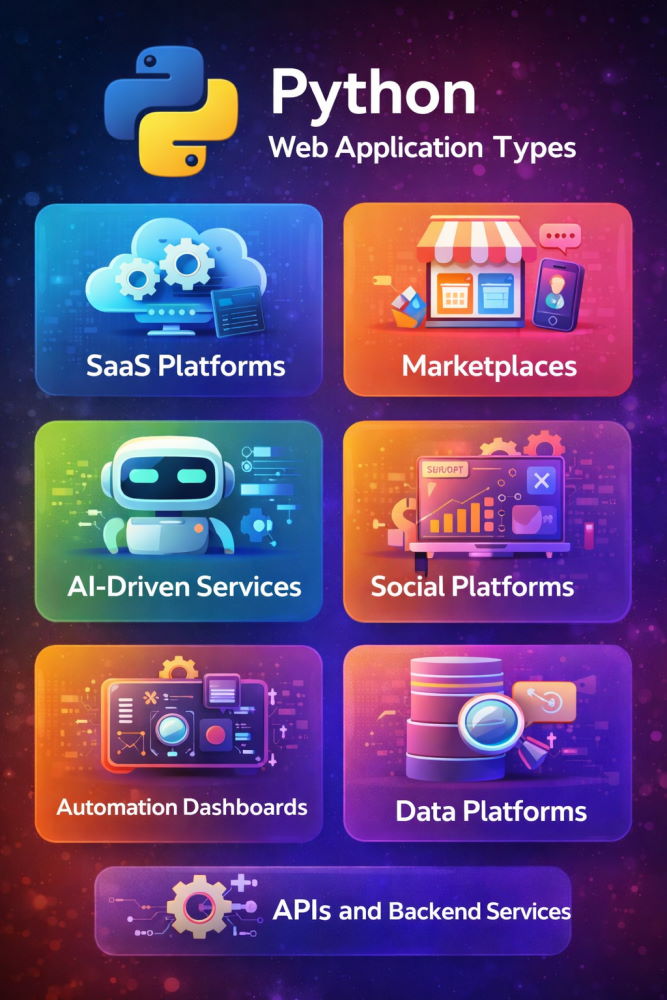
In our practice, Python is employed to build scalable, data-based web applications, ensuring high product quality. It is flexible enough to support a broad range of project types, such as SaaS platforms, marketplaces, and APIs, while facilitating seamless future growth and integrations.
SaaS Platforms
Multi-tenant architecture, subscription logic, role-based access, and clean APIs are standard SaaS requirements, and Python handles each of them well. We’ve implemented several SaaS platforms for early-stage startups that needed a solid base to scale from, without overengineering the entire architecture.
Marketplaces
On marketplace and e-commerce projects across different verticals, Python can keep the backend clean and navigable when the product grows. A good illustration is EuropaFoodXB, the UK’s leading European food supermarket – a platform that needed a custom CRM, flexible delivery management across multiple regions and courier services, automated order reporting, and abandoned cart recovery, all working together reliably. Built on Python, Django, and Celery, the outcome was a platform serving over 7,000 products to thousands of customers, including well-known companies and brands from around the world.
Social Platforms
Backend architecture for social platforms faces significant pressure: feed algorithms, notifications, user connections, and content moderation all run concurrently. Python’s native async support and service-oriented structure help maintain heavy workloads in a well-balanced, efficient manner.
AI-Driven Services
More products now need AI features baked in from the outset, including recommendation engines, automated tagging, and intelligent search. Such capabilities can be smoothly implemented into the backend with Python, as they are already part of the same ecosystem.
Automation Dashboards
We’ve also delivered internal tooling and automation dashboards for operations teams – platforms that connect to multiple data sources, run scheduled jobs, and surface actionable metrics. Celery, Django, and PostgreSQL are our core stack for such projects.
Data Platforms
PLANEKS has successfully designed a customized application for energy efficiency in the fleet management industry. Vessels generate enormous amounts of operational data every second, and the goal was to make that data actually usable. We created Spark using Python, Django, and Celery on Azure, equipping fleet operators and captains with a live view of fuel consumption, efficiency benchmarks, and vessel rankings across the entire fleet. Each vessel now shows a 5-10% daily fuel-savings potential, delivering 1,000-4,000 tons of fuel oil per ship per year.
APIs and Backend Services
A huge part of our work covers building backend services that power third-party integrations and client-facing platforms. In these cases, the “web app” is a well-structured API. FastAPI is the crucial tool for these projects.
Real-World Use Cases: PHP Web Applications
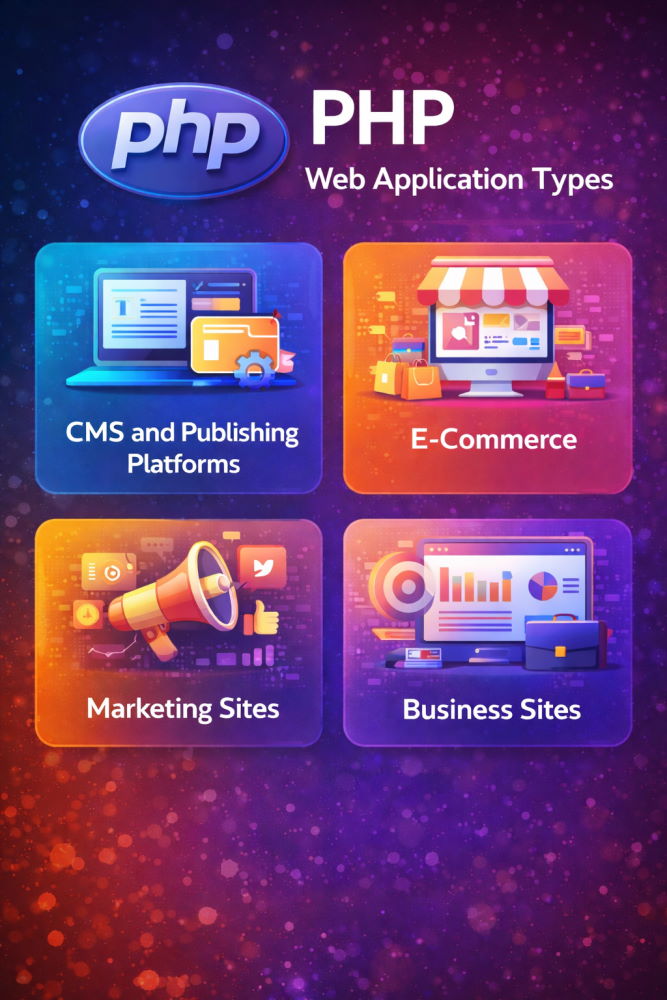
PHP covers fewer use cases than Python, because it suits a narrow set of requirements, addressing a specific range of problems.
CMS and Publishing Platforms
News sites, editorial platforms, and content-heavy properties based on WordPress or Drupal benefit from mature plugin ecosystems, well-documented extension APIs, and a large global developer pool with a deep background in these stacks.
E-Commerce
WooCommerce and Magento have made PHP the standard for a vast share of the e-commerce market. Both platforms offer extensive out-of-the-box functionality, like product management, payment gateway integrations, and inventory handling. Thus, PHP is a reasonable solution for small and mid-sized stores that don’t require custom backend logic or a purpose-built architecture.
Marketing and Business Sites
Agencies building marketing sites for small businesses use PHP for several good reasons: deployment is straightforward, shared hosting is widely available and inexpensive, and WordPress’s admin interface gives non-technical clients full control over content updates without requiring developer involvement. For these projects, the tooling is mature, and the day-to-day operational demands are minimal.
Security Considerations
Django delivers a solid set of pre-built protections: CSRF protection, SQL injection prevention, clickjacking defense, and secure password hashing are all enabled by default, without any additional configuration. This is highly relevant for platforms handling sensitive user data or business-critical logic.
In PHP, older codebases, especially WordPress plugins and custom PHP applications from the early 2000s, were very prone to vulnerabilities. WordPress alone has documented a long history of issues spanning SQL injection, XSS, CSRF attacks, and arbitrary code execution across almost every major version release. The language has elevated significantly, and modern PHP with a well-maintained framework is more secure. Yet, in case there’s legacy code left, it carries certain risks.
Secure coding practices matter in both ecosystems, regardless of language. Input validation, proper authentication flows, and dependency auditing – none of these is automatic anywhere.
When considering PHP vs Python for web development, security also depends on the domain. A marketing site has a very different threat surface than a SaaS platform handling payment data or personal records. For enterprise and application-level security requirements, Python’s defaults give a stronger and more resilient base.
Community, Libraries, and Tooling
PHP’s impact on the web is vast: according to W3Techs, 72% of all websites use PHP for server-side functionality. It sits at 7th place among the most popular languages, with 3.72% of tutorial searches per Itransition, and around 3.7% of GitHub projects use PHP, placing it 9th overall. Its hosting support is universal, and the CMS plugin ecosystem is also very rich. The developer pool for traditional web projects is large enough that hiring won’t become a challenge.
Python’s ecosystem has some considerable differences. According to the PYPL PopularitY of Programming Language, Python holds the top spot with a 29.97% popularity share. The Stack Overflow Developer Survey found 57.9% of respondents used Python over the past year – the highest of any language. The community is very strong in backend development, data engineering, and automation, which address the needs of modern web development.
Hosting, Deployment, and Infrastructure
PHP’s deployment roadmap is concise, requiring you to upload files to a shared host, configure Apache or Nginx, and then the application will be running. The LAMP stack has been the standard choice for a very long time, and virtually every hosting provider supports it out of the box.
Containerized deployments with Docker, orchestration with Kubernetes, and cloud-native infrastructure on AWS, GCP, or Azure are typical environments for running Python applications. WSGI servers like Gunicorn and ASGI servers like Uvicorn handle the application layer, sitting behind a reverse proxy. It requires more setup upfront, but ensures reproducibility, scalability, and smooth environment management in the long run.
Cost of Development and Maintenance
PHP can be cheaper to get started with – there’s a broad range of developers, hosting is cost-efficient, and simple sites can be deployed very fast. For a straightforward marketing site or content platform, that is a great choice. Python’s upfront cost is comparable for most application-level work, and the efficiency gains on complex projects tend to outweigh any initial difference over time.
A basic issue clients reach out to us with is an inherited PHP codebase that’s become expensive to touch with logic tangled across files, inconsistent patterns, and no clear architecture to build on. Python offers readability and structure that tend to age much better. Python developers coming onto an existing project can orient themselves faster, which keeps ongoing costs more predictable.
Hiring and Talent Availability
There’s no shortage of PHP developers, particularly for CMS work and traditional web maintenance. According to Itransition, open vacancies in the US alone stand at 14,000+ on DevJobsScanner, 4,000+ on Indeed, and 2,500+ on Glassdoor. CoderPad ranks PHP among the top 10 most-requested languages by companies. That said, the trend lines are pointing downward – GitHut shows +0.050% growth, while PYPL worldwide and US figures range between -0.8% and -0.7% respectively, with TIOBE showing a -0.41% decline.
The Python developer market is deep and growing as well, with strong representation across backend, data, and API-focused roles. According to Itransition, growth is up across every major index – GitHut (+0.13%), PYPL worldwide (+1.6%), PYPL US (+2.2%), and a notable +9.32% on TIOBE. CoderPad reports 42% of recruiters actively seek Python skills. RedMonk and Statista both place it among the top three languages globally. Most telling: Stack Overflow reports 66.4% of beginners choose Python as their first language, and it accounts for 29.9% of all tutorial searches per the PYPL Index.
To make your choice easier and sum up our Python vs PHP for web development comparison, we’ve prepared a comprehensive table covering the key criteria we’ve discussed.
| Criteria | Python | PHP |
|---|---|---|
| Primary use case | Web apps, APIs, data platforms, SaaS | Content sites, CMS, traditional web |
| Framework ecosystem | Django, Flask, FastAPI | Laravel, Symfony, CodeIgniter |
| Architecture | API-first, service-oriented | Page-based, request/response |
| Async support | Native async, Celery, Django Channels | Limited, improving in recent versions |
| AI/ML integration | Native, extensive library support | Limited, API consumption only |
| CMS support | Limited | WordPress, Drupal, Joomla |
| Security defaults | Strong out-of-the-box (Django) | Improved, but legacy risks remain |
| Deployment | Docker, Kubernetes, cloud-native | Shared hosting, LAMP stack |
| Learning curve | Moderate, clean syntax | Low for simple sites |
| Developer popularity | 18.2M users, growing across all indexes | 9.8M users, declining trend |
| Long-term maintainability | High – readable, structured code | Moderate – legacy patterns accumulate |
| Best for scalability | Strong – service separation, async workers | Basic – horizontal scaling |
| Hiring trend | Growing demand, 42% of recruiters seek Python skills | Stable pool, but declining interest |
| Cost for simple sites | Comparable | Slightly lower upfront |
| Cost for complex apps | Lower long-term due to maintainability | Higher – technical debt accumulates |
Can PHP and Python Be Used Together?
Short answer: yes, and it’s more common than you may think. Some teams run a PHP frontend – often an existing WordPress or Laravel setup – while Python handles specific backend services like data processing, ML inference, or automation. The two layers communicate through APIs, and neither needs to know much about the other’s internals.
The hybrid approach also makes migration more manageable. There’s no need to rewrite everything at once; teams can gradually translate functionality to Python services while keeping the existing PHP layer running. This minimizes the risk and lets you validate the new architecture prior to the full transition.
Future Trends: PHP vs Python in Web Development
Laravel continues to enhance PHP, and the ecosystem keeps improving. But PHP’s growth is incremental; it’s consolidating around the functions it already does efficiently, avoiding the new areas of web development.
Python’s elaboration is aimed at API-first development, AI-powered applications, and cloud-native architecture. Intelligent web features like recommendations, automation, and predictive logic are much easier to implement when your web layer and your ML are based on the same language.
In the future, both languages are guaranteed to remain relevant. However, when considering Python vs PHP for web development of new applications, Python has become the more common technology to adopt.
Decision Framework: How to Choose
The decision between PHP vs Python for web applications becomes more obvious once you comprehensively define the product you’re implementing, as well as its future growth directions.
Choose Python If…
You’re building a SaaS product, a data-driven platform, or anything that needs a clean API layer. If AI or ML features are part of your functionality, if the product is expected to scale, or if you’re thinking in terms of a long-term platform, Python can provide a resilient foundation.
Choose PHP If…
You need a content website, a WordPress-based setup, or a straightforward e-commerce business. It doesn’t restrict using Python for an online store. PHP, however, suits well for projects on a tighter budget and well-defined requirements that won’t change significantly. For these use cases, PHP is sufficient, and there’s no reason to seek more sophisticated technologies.
Conclusion
PHP is still relevant on the web and remains highly efficient in the right contexts. For content sites, CMS platforms, and traditional web platforms, it is a practical, well-established technology.
Cutting-edge web applications, such as SaaS products, data platforms, and API-driven services, as well as products expected to grow fast, are implemented using Python due to its resilience, wide framework choice, and scalability. The ecosystem, the talent pool, and the architecture patterns can support modern web products and support their innovation in the long run.
The best choice depends on the type of product you want to build, its level of complexity, and how much you expect it to grow. If you’re still weighing Python vs PHP for web development or want a second opinion on your tech stack, the PLANEKS team is happy to provide you with a personalized consultation. We work with startups and established product teams every day – reach out and let’s define the right fit for your project.
FAQ
Discover the questions we at PLANEKS regularly hear from teams working through the decision between PHP vs Python for web development.
Is Python better than PHP for web development?
For modern web applications, APIs, and scalable platforms – yes, Python tends to be the more relevant choice. When it comes to content sites and CMS-driven projects, PHP is inherently a reasonable option.
Should I migrate from PHP to Python?
It depends on where the pain is. If your PHP codebase is becoming expensive to maintain or your product needs capabilities that PHP can’t handle cleanly, migration is worth considering. It doesn’t have to happen all at once, either: a gradual, service-by-service roadmap works well in practice.
Is PHP still relevant in modern web development?
For certain use cases, absolutely. PHP’s relevance is connected with the CMS sector, with WordPress alone running over 40% of the web. Thus, for content sites and traditional web projects, it remains a solid and well-supported technology.
Can Python replace PHP for websites?
Technically, yes, but it’s not always the right strategy. Python caters to application-heavy projects. This means that replacing a well-functioning PHP content site with Python would add complexity without much benefit.
Which language is better for SaaS: PHP or Python?
Python is fairly comfortable for such projects. SaaS products typically require clean APIs, scalable architecture, and data or automation capabilities; in all these areas, Python’s ecosystem is substantially stronger.